Tree Rhododendron
Rhododendron arboreum
The Gardening Year
Best months in UK gardens · full planting calendar →
🖨 Printable care card (PDF)At a Glance
| Botanical name | Rhododendron arboreum |
|---|---|
| Common name(s) | Tree Rhododendron |
| Family | Ericaceae |
| Plant type | shrub (evergreen shrub or small tree) |
| Height × Spread | 12–20 m × 2.5–4 m |
| Position | Partial shade |
| Soil | moist but well-drained, leafy, humus-rich acid soil |
| Flowering | March–May |
| Toxicity | Harmful if eaten |
| Native range | Bhutan, China, India, Myanmar, Nepal, Sri Lanka, Pakistan, Thailand, Tibet |
Overview
Rhododendron arboreum, the tree rhododendron, is the largest and arguably the most spectacular species in a genus of more than a thousand. In the wild it forms a small evergreen tree across the Himalayas from northern Pakistan through Nepal, Bhutan and northern India to Yunnan in south-west China, with outlying populations in Sri Lanka, Myanmar and Thailand. It grows between roughly 600 m and 4,000 m elevation, occupying forest margins and open hillsides where the soil is acid and the air is moist.
For British gardeners it has particular interest. It is one of the parents, alongside R. ponticum, of many older hybrid rhododendrons, and it was the first rhododendron introduced to British cultivation from the East, arriving through Nepal in the early nineteenth century. The species is also culturally significant in its native range: it is the national flower of Nepal, where it is known as laliguras, and it is the state tree of Uttarakhand and Himachal Pradesh. The crimson-flowered form in particular is famous for producing burans honey from its nectar.
In UK gardens, R. arboreum is a large, slow-growing evergreen suited to mild, sheltered sites with acid soil. It is not a plant for cold inland gardens, but where conditions suit it, it is unrivalled for sheer presence in spring.
Appearance
In its native range, R. arboreum can reach 20 m tall, with a single trunk and a broad, rounded crown. In British cultivation it more usually makes a large shrub or small tree of 5–12 m, often with multiple stems from near the base. The bark is dark, fissured and slightly shredding with age, and mature specimens develop a distinctly woody character unusual among rhododendrons.
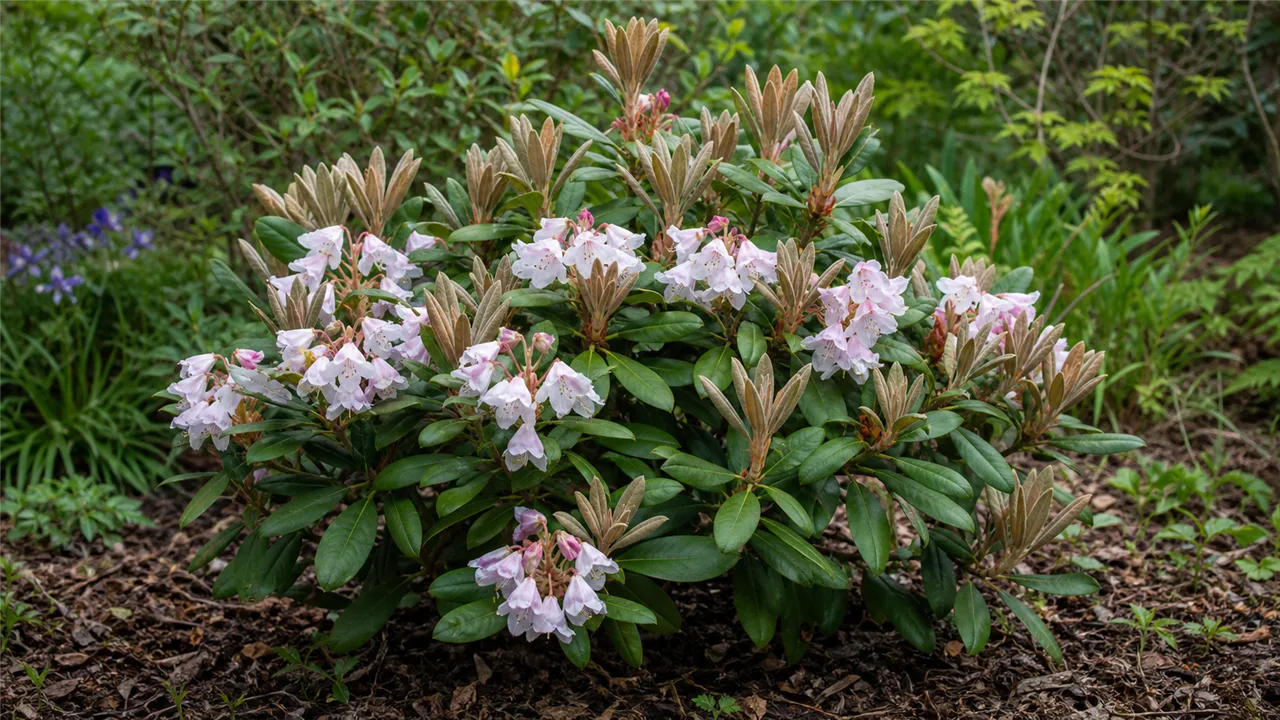
The leaves are evergreen, leathery and 7–20 cm long, broadly lanceolate to elliptic. The upper surface is dark green, glossy and hairless; the underside is paler and frequently carries a dense, rusty or silvery-brown felt (tomentum) that gives many forms a silvery sheen in the breeze. The leaf margins are entire, and the leaves are arranged in tight rosettes at the shoot tips.
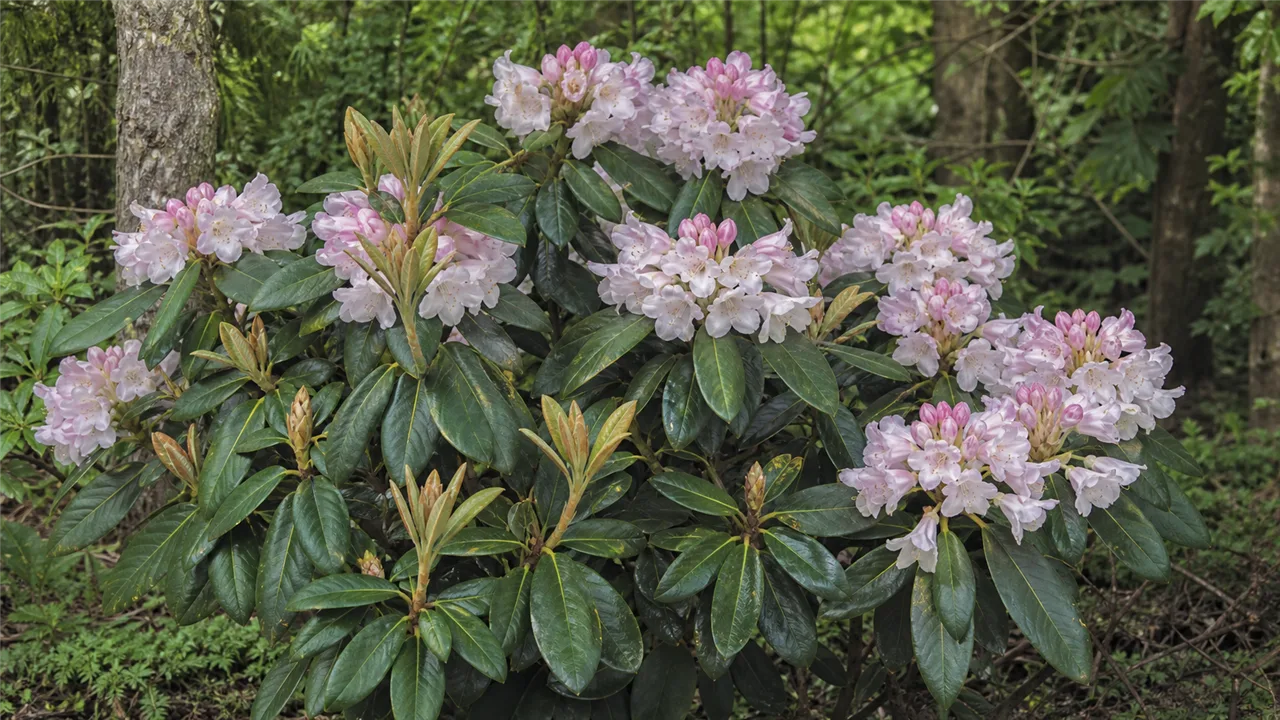
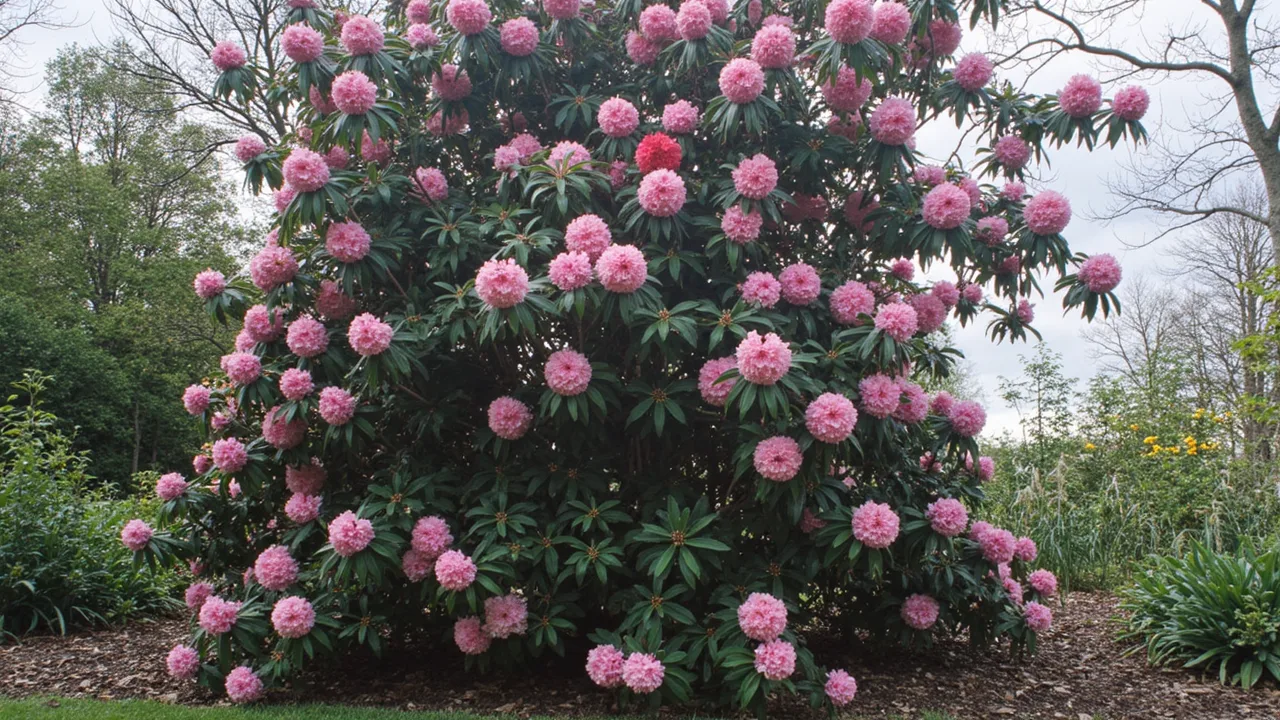
Flowering is the species' main event. Each truss carries 10–20 bell-shaped blooms, 3.5–5 cm long, with five broad lobes and ten stamens. Flower colour varies remarkably across the range: the Himalayan populations are predominantly deep crimson or scarlet; further south and east the species grades through pink and pale yellow to almost pure white. This natural variability is one of the species' distinguishing features and is the basis for the several subspecies recognised by botanists, including subsp. arboreum (crimson, central Himalayas), subsp. nilagiricum (pink to red, southern India), subsp. zeylanicum (Sri Lanka) and subsp. cinnamomeum (often with white or pale pink flowers and a cinnamon-coloured leaf underside).
The fruit is a dry, woody capsule, 1.5–2.5 cm long, which splits open in autumn to release large numbers of fine, winged seeds.
Growing Conditions
In the UK, R. arboreum succeeds only where several conditions are met simultaneously. It is classified by the Royal Horticultural Society as H4 — hardy to about –10 to –5 °C — which places it firmly in the "mild garden" category. It grows reliably in coastal Cornwall, Devon, west Wales, the western Scottish Highlands, parts of Northern Ireland and other frost-sheltered areas, but it will struggle in cold inland districts and across much of the Midlands and the North.
Soil must be acid, ideally in the pH 4.5–6.0 range, humus-rich and reliably moist but free-draining. The species will not tolerate chalk or limestone ground, and on alkaline sites the leaves quickly turn yellow through iron and manganese lock-out. Where the garden soil is unsuitable, container cultivation in ericaceous compost is a workable alternative, provided the container is large and watering is consistent.
Light is best described as dappled or partial. The large, leathery leaves scorch readily in strong midday sun, especially on dry or windy sites, but a position in deep shade produces sparse flowering. An understorey position among larger deciduous trees, or a north- or east-facing border, is ideal.
Shelter from wind is essential. R. arboreum has notably large leaves that tear easily, and its heavy flower trusses snap in exposed sites. A woodland edge, a walled garden or a position behind a hedge or building will all give better results than an open lawn.
Planting and Care
Planting is best done in autumn or early spring, when the soil is moist and warm enough for roots to re-establish before the next dry summer. Container-grown stock can be planted at other times, but watering must then be diligent through the first two growing seasons. The planting hole should be two to three times the width of the root ball but no deeper, and the backfill should be improved with leaf mould, well-rotted bark or a proprietary ericaceous compost. Mulch immediately with pine bark or similar acidic material, keeping it clear of the stem.
Watering needs to be consistent. The species is shallow-rooted and intolerant of drought, particularly in its first five years. Use collected rainwater in hard-water areas: rhododendrons are sensitive to calcium build-up, and tap water in much of the UK will gradually raise the soil pH around the root zone.
Feeding should be modest. A single application of a slow-release ericaceous fertiliser in spring is usually sufficient. High-phosphorus feeds are best avoided: in acid soils they can lock out iron and manganese and make chlorosis worse, not better.
Pruning is minimal. The species resents hard cutting and regrows slowly if cut back into old wood, so work with the plant's natural shape rather than against it. Remove dead, diseased or damaged wood immediately after flowering, and deadhead spent trusses carefully to encourage next year's bud set.
Propagation is possible by semi-ripe cuttings taken in late summer, by simple layering in spring, or from seed. Seed does not come true to cultivar colour, and germination is slow; cuttings give the most reliable results for a named form.
Seasonal care through the year centres on mulching in spring, deadheading in early summer, watering in any dry spell from June to September, and protecting young plants from prolonged hard frost in their first few winters.
Common Problems
Chlorosis — yellowing leaves with green veins — is the most frequently encountered problem and almost always points to alkaline soil or hard tap water rather than to disease. It can be corrected with chelated iron and by switching irrigation to rainwater.
Powdery mildew may coat leaves in late summer in still, humid conditions, particularly on sheltered wall-trained plants with poor airflow. Improving circulation around the plant is usually enough; fungicide is rarely needed.
Rhododendron petal blight (Ovulinia azaleae) turns flowers brown and slimy and produces white fungal spores; affected trusses should be removed and destroyed rather than composted. It has become more widespread in the UK in recent decades.
Leaf spot fungi cause scattered brown markings on foliage. Damage is usually cosmetic, but severe cases respond to a copper-based fungicide applied in spring.
Phytophthora root rot is the most serious threat. It causes sudden wilting and collapse, typically on poorly drained or waterlogged sites, and there is no effective cure. Prevention — by ensuring free drainage at planting and avoiding ground that lies wet in winter — is the only realistic control.
Aphids cluster on young shoots and flower buds in spring. They can be washed off, controlled with insecticidal soap, or left to natural predators. In exposed sites, wind scorch and wind-tearing of the large leaves are common; rabbits and deer will browse young growth and may need guarding against.
Popular Varieties
Rhododendron arboreum shows exceptional natural variation in flower colour, and several subspecies and long-established clone names are recognised. The following are the forms most commonly encountered in British cultivation and in the historical horticultural literature; named cultivars of this species are relatively few, and colour descriptions below are drawn from the wild populations from which the forms were originally selected.
- R. arboreum subsp. arboreum — the central Himalayan form with deep scarlet to crimson flowers and a silvery leaf underside; the type most often seen in UK gardens.
- R. arboreum subsp. cinnamomeum — a high-elevation form with white to pale pink flowers and a cinnamon-coloured felt beneath the leaves; hardier than the type and worth trying at the limits of the species' range.
- R. arboreum 'Album' — a white-flowered clone of long standing in British collections, occasionally offered by specialist nurseries.
- R. arboreum 'Roseum' — a pink-flowered clone with a somewhat paler leaf indumentum, also of nineteenth-century origin and present in several heritage collections.
- R. arboreum subsp. nilagiricum — the south Indian form, with pink to red flowers and a long flowering season in milder climates; less hardy in the UK and best suited to the mildest coastal gardens.
Beyond these, the species has been crossed repeatedly with R. ponticum and other hardy rhododendrons, producing many familiar large-flowered hybrid rhododendrons whose tree-like vigour and bright colours derive in part from R. arboreum. Where space permits a single specimen, however, the species itself remains the most striking choice for a sheltered British acid-soil garden.
IMAGE_SCENE: a mature Rhododendron arboreum in full spring bloom, dense trusses of deep crimson flowers against dark evergreen foliage, set in a sheltered British woodland garden with dappled May morning light.
Pests and Diseases
| Problem | Symptoms | Management |
|---|---|---|
| Powdery mildew | White powdery fungal growth appears on leaves, buds, petals, and shoots, potentially causing distortion. | Tolerate unless severe; improve air circulation and avoid overhead watering to reduce humidity. |
| Bud blast | Flower buds turn brown, shrivel, and fail to open due to fungal infection or environmental stress. | Remove and destroy infected buds promptly if practical; ensure good drainage and avoid late pruning. |
| Vine weevil | Notches appear on leaf margins, while larvae damage roots causing wilting and poor growth. | Apply biological nematodes to the soil in autumn or use physical barriers like sticky bands. |
| Rhododendron leafhopper | Leaves show silvery-white speckling and may curl or drop prematurely due to sap feeding. | Encourage natural predators like ladybirds; use insecticidal soap for severe infestations. |
| Pieris lacebug | Upper leaf surfaces become stippled with white spots, while black tar-like excrement appears underneath. | Prune out heavily infested shoots; apply horticultural oil or insecticide if populations are high. |
For step-by-step help, read Treating Powdery Mildew. Or browse the full plant problem solver to diagnose an issue by symptom.
Recommended Products
GardenWizz earns a commission from qualifying purchases made through affiliate links on this page (including links within the article) — as an Amazon Associate, and from Thompson & Morgan via the Awin network. This does not affect the price you pay. See our disclaimer for details.