Rhubarb
Rheum rhabarbarum
The Gardening Year
Best months in UK gardens · full planting calendar →
🖨 Printable care card (PDF)At a Glance
| Botanical name | Rheum rhabarbarum |
|---|---|
| Common name(s) | Rhubarb |
| Family | Polygonaceae |
| Plant type | perennial (Deciduous rhizomatous herbaceous perennial) |
| Height × Spread | 75 cm × 100 cm |
| Position | Full sun, Partial shade |
| Soil | Moist but well drained soil; fertile garden soil |
| Flowering | April–July |
| Toxicity | Harmful if eaten. Wear gloves and other protective equipment when handling |
| Native range | Southern Siberia to north and central China; southeastern Siberia (Daurian region), northern Mongolia, northern provinces of China (Hebei, Heilongjiang, Henan, Hubei, Jilin, Inner Mongolia, Shanxi, Shaanxi) |
Overview
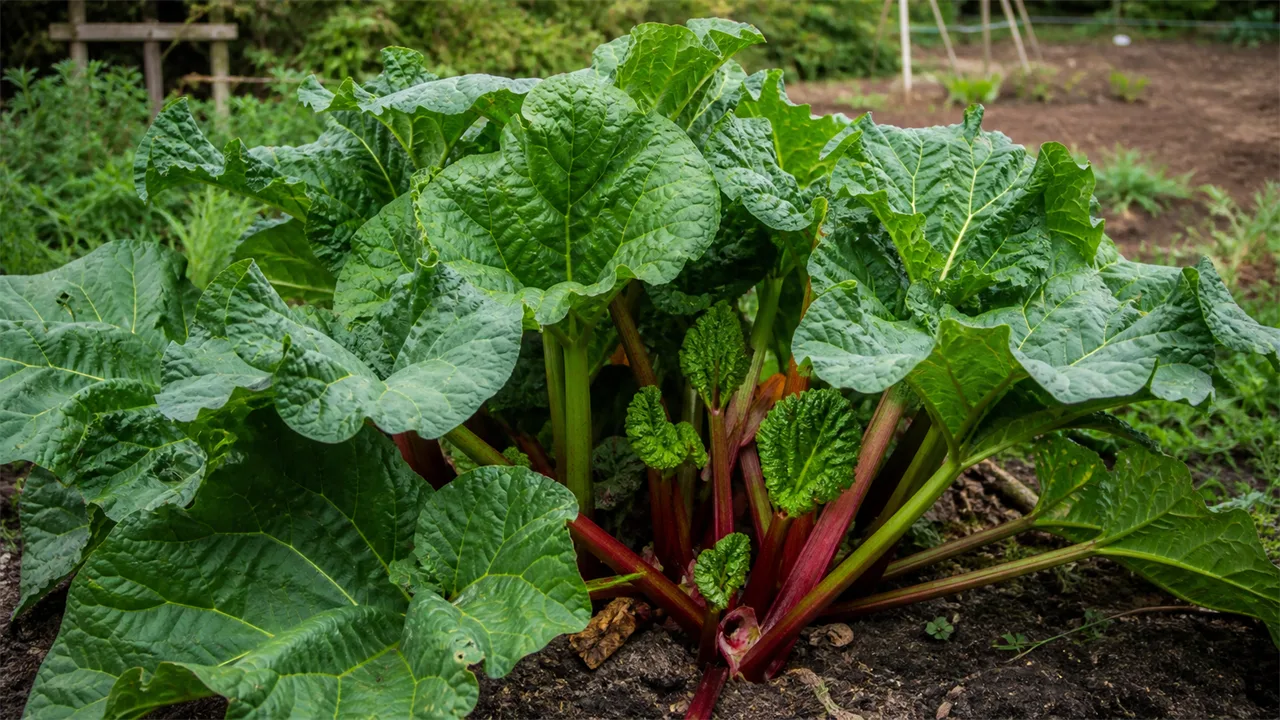
Rhubarb, Rheum rhabarbarum, is a hardy perennial grown across British gardens for its thick, tart leaf stalks — the only part eaten. The leaves themselves are toxic (high in oxalic acid) and must always be discarded; the stalks, forced or open-grown, are a quintessentially British spring ingredient, used in crumbles, jams, fools and cordials. Once planted, a single rhubarb crown will crop reliably for ten to fifteen years, and an established clump is one of the lowest-maintenance productive plants in the kitchen garden.
For UK growers, rhubarb's appeal is its earliness: it produces a useful harvest before almost any other fruit crop, from late February (forced) through to midsummer. The "rhubarb triangle" of West Yorkshire — Wakefield, Morley, Rothwell — grew rhubarb by candlelight in forcing sheds from the 19th century onwards, and the practice of forcing rhubarb in sheds and under pots remains a Yorkshire tradition. Mainland growers across England, Wales, Scotland and Northern Ireland can crop rhubarb outdoors with minimal fuss, given a sunny or lightly shaded site and a soil that does not waterlog in winter.
This guide covers the full UK growing cycle for rhubarb, from choosing and planting a crown through to harvest and storage, with regional timing for planting, forcing and main-crop windows across England, Wales, Scotland and Northern Ireland.
Sowing
Rhubarb is grown from crowns (dormant root divisions), not from seed in practice. Seed-raised plants are highly variable — they don't come true to type, take longer to reach cropping size, and usually produce thinner, greener stalks of inferior quality. Buy named-cultivar crowns from a reputable fruit nursery, either bare-root from autumn to early spring or as container-grown plants year-round.
When to plant. Bare-root rhubarb crowns are planted during the dormant season, from late October through to early March, when the ground is workable but not frozen or saturated. In mild southern England and the south-west, November to December planting gives the best root establishment before spring growth. In colder regions (the north, Scotland, exposed sites), delay planting until February or early March, when the worst of winter is past and the soil is starting to warm. Container-grown rhubarb can be planted at any time of year, but autumn and spring are still preferable because summer planting means heavy watering through dry spells.
Site and soil. Rhubarb wants a sunny or lightly shaded spot, with deep, fertile, free-draining soil — it will tolerate heavier clay better than most fruit crops provided the ground doesn't sit wet in winter. Before planting, dig in a generous barrow-load of well-rotted manure or garden compost per square metre, and remove perennial weeds (especially couch grass and bindweed, which are very hard to clear once a rhubarb clump is established). Rhubarb stays in the same spot for many years, so preparation matters.
Spacing and depth. Plant crowns 90 cm apart with 1.2 m between rows — rhubarb clumps are large at maturity, with leaves often reaching 60–90 cm across. Set the crown so the growing buds (the pinkish "knobs" at the top of the root) sit 2–3 cm below the soil surface. Planting too deep suppresses bud break; too shallow lets the crown dry out.
Planting windows by UK region.
- South-west England, south coast, London, East Anglia: November to early March, with November–December ideal.
- Midlands, south Wales, central southern England: late November to late February.
- Northern England, north Wales, Yorkshire, Lancashire: December to late February, avoiding the coldest spells.
- Scotland (lowland and central belt): late January to mid-March.
- Scotland (upland, north-east, Caithness): wait until February to early March; site selection becomes critical.
- Northern Ireland: December to mid-March.
Recommended cultivars for UK growers. `Timperley Early` is the earliest outdoor cultivar, cropping from March in mild areas — a good choice everywhere except the coldest spots. `Victoria` is a reliable mid-season maincrop with thick green-and-red stalks and good flavour, tolerant of a wide range of soils. `Stockbridge Arrow` produces slim, deeply red stalks and is widely grown by Yorkshire forcing sheds. For small gardens, `Glaskin's Perpetual` crops lightly in its first year (most rhubarb shouldn't be picked at all in year one) and is a sensible choice where space is limited.
Forcing. Established crowns (at least three years old) can be forced for an earlier, sweeter, paler harvest. From late December to January, cover a healthy crown with a traditional terracotta forcing pot, an upturned dustbin, or a deep bucket packed with straw or dry leaves around (not on top of) the buds. Exclude all light. Forced stalks are ready in about eight weeks, from late February into April. Forcing weakens the crown, so force each plant only every other year, and stop forcing altogether on crowns more than about ten years old.
Growing
Rhubarb is one of the easiest productive plants to maintain once established. The main jobs through the year are watering in dry spells, mulching annually, removing flower spikes, and dividing old clumps when they become crowded.
Watering. Newly planted crowns need regular watering through their first spring and summer — soak deeply once a week rather than little and often, to drive roots down. Established plants are remarkably drought-tolerant, but a dry spring reduces stalk yield and quality. If May is dry, give established clumps a thorough soak every ten days.
Feeding and mulching. Each winter or early spring, apply a 5–7 cm layer of well-rotted manure or garden compost as a mulch over the crown, taking care not to bury the growing buds. In March, a top-dressing of general-purpose organic fertiliser (or a handful of blood, fish and bone per plant) boosts early growth. Avoid high-nitrogen feeds in summer — they promote leafy growth at the expense of next year's crown reserves.
Weeding. Keep the area around each crown free of weeds, especially in the first two years. Once a clump is mature, the large leaves shade out most weed competition, but perennial weeds (dock, thistle, couch) should still be pulled out by hand rather than hoed, to avoid damaging the shallow crown.
Flower spikes. From late spring onwards, mature crowns sometimes send up a thick flower stalk. Cut this out at the base as soon as it appears — allowing a crown to flower reduces the stalk harvest and weakens the plant. Some cultivars (notably `Victoria`) flower more freely than others.
Dividing. Every five to seven years, when a clump's centre becomes woody and stalks get thinner, lift the dormant crown between November and February and split it into fist-sized pieces with a spade or sharp knife, each with at least one healthy bud. Replant the youngest, most vigorous pieces from the outside of the clump; discard the tired old centre. Dividing is also the easiest way to propagate named cultivars.
Pests and diseases. Rhubarb is largely trouble-free. Crown rot can occur on waterlogged soils — avoid this by improving drainage before planting. Aphids occasionally colonise flower stalks. Slugs may damage emerging stalks in wet springs but rarely affect the final harvest. There's no need to spray routinely.
Harvesting
Rhubarb's first harvest year depends on how the crown was started. Seed-raised plants should not be picked at all in their first year, and only lightly in their second. Crowns bought from a nursery should not be picked in their first season either — let the plant build reserves. From year three onwards, full harvesting can begin.
Outdoor harvest. Pick stalks by gripping them at the base and pulling gently outwards and downwards, twisting slightly — this removes the stalk cleanly from the crown without leaving a stub that can rot. Cut stalks with a knife if you prefer, slicing flush with the crown. Never take more than half the stalks at any one time, and always leave at least four strong stalks on the plant to rebuild the crown for next year.
Outdoor harvest windows by UK region.
- South-west England, south coast, London, East Anglia: April to late June.
- Midlands, south Wales, central southern England: late April to late June.
- Northern England, north Wales, Yorkshire, Lancashire: late April to mid-July.
- Scotland (lowland and central belt): May to mid-July.
- Scotland (upland, north-east, Caithness): late May to early July (shorter season).
- Northern Ireland: late April to early July.
Forced harvest. Forced stalks are pulled in late February to April, depending on when the crown was covered. Forced stalks are thinner, paler, sweeter and more tender than outdoor stalks; they're best eaten within a day or two of pulling.
Stopping. Stop harvesting outdoor rhubarb by the end of June (south) or mid-July (north). From midsummer onwards, the plant needs to rebuild its crown reserves for the following year — picking late in the season weakens the plant and reduces next year's crop. Allow the leaves to grow on unchecked from late summer; these large leaves photosynthesise and feed the crown through autumn.
Forcing rest. If you forced a crown in winter, do not harvest from it at all the following summer — give it a full season to recover.
Eating
Rhubarb is one of the most versatile British fruit substitutes: it's technically a vegetable, but it's used as a fruit in the kitchen. The flavour is sharply tart, so almost all recipes pair it with significant sugar, honey or another sweetener. The classic British use is rhubarb crumble, made with stewed stalks under a buttery oat or flour topping, but rhubarb's range is much wider than that.
Forced rhubarb is sweet enough to eat raw, in thin slices with a little sugar and cream, or macerated with sugar and orange zest. Outdoor rhubarb is tarter and almost always cooked — stewed with a little sugar and a strip of orange peel, it makes a traditional compôte to eat with custard, yoghurt, or rice pudding.
In the kitchen, rhubarb pairs naturally with ginger (a classic combination in crumbles, jams and chutneys), with vanilla, with orange and lemon zest, with cardamom, with elderflower (rhubarb and elderflower cordial is a May staple), and with strawberries — though strawberries don't crop until June, so in most of the UK rhubarb is past its main season before strawberries are ready. Forced rhubarb, however, can be paired with the very first forced strawberries under glass.
Classic British rhubarb dishes include rhubarb crumble, rhubarb and ginger jam, rhubarb fool (stewed rhubarb folded through sweetened whipped cream), rhubarb and custard tart, and rhubarb chutney to eat with cold meats and cheese. Less traditional but excellent: rhubarb gin (steep chopped rhubarb in sugar and gin for six to eight weeks), and rhubarb cordial for diluting with sparkling water.
Always discard the leaves — they contain high levels of oxalic acid and are not eaten, although they can be infused in water as a (controversial) natural insecticide for aphids on brassicas.
Storing
Fresh rhubarb stalks keep for up to two weeks in the fridge: trim the leaves, wrap the stalks in a damp tea towel or kitchen paper, and store in the vegetable drawer. For longer storage, rhubarb freezes well — cut into 2–3 cm pieces, open-freeze on a tray, then bag and return to the freezer. Frozen rhubarb cooks straight from frozen into crumbles and compôtes.
Rhubarb also bottles well in light sugar syrup, makes excellent jam and chutney (rhubarb and ginger is the classic), and can be stewed and frozen as a ready-made compôte. Forced rhubarb is so tender that it doesn't freeze as well as outdoor rhubarb — use it fresh or as cordial within a few days of pulling.
Pests and Diseases
| Problem | Symptoms | Management |
|---|---|---|
| Slugs and snails | Irregular holes chewed in young leaves and stems, often accompanied by silky trails. | Use beer traps, copper tape barriers, or apply iron phosphate-based slug pellets. |
| Crown rot | The central crown becomes soft, mushy, and discoloured, often leading to plant collapse. | Ensure soil is well-drained and avoid mulching directly over the crown to prevent waterlogging. |
| Aphids | Clusters of small green or black insects on new growth, causing leaf curling and sticky honeydew. | Squash by hand, blast off with a strong jet of water, or use insecticidal soap if infestations are severe. |
| Honey fungus | General decline, wilting leaves, and white fungal growth under the bark at the base of the crown. | Remove infected plants completely and avoid replanting rhubarb in that spot for several years. |
| Viral diseases | Mottled or yellowed leaves, stunted growth, and reduced vigour with no obvious external pests. | Remove and destroy infected plants immediately to prevent spread via tools or aphids. |
For step-by-step help, read Controlling Aphids Naturally and Dealing with Slugs and Snails. Or browse the full plant problem solver to diagnose an issue by symptom.
Rhubarb in our guides
Recommended Products
GardenWizz earns a commission from qualifying purchases made through affiliate links on this page (including links within the article) — as an Amazon Associate, and from Thompson & Morgan via the Awin network. This does not affect the price you pay. See our disclaimer for details.