Tarragon
Artemisia dracunculus · estragon · French tarragon · Russian tarragon
The Gardening Year
Best months in UK gardens · full planting calendar →
🖨 Printable care card (PDF)At a Glance
| Botanical name | Artemisia dracunculus |
|---|---|
| Common name(s) | tarragon, estragon, French tarragon, Russian tarragon |
| Family | Asteraceae |
| Plant type | perennial (Perennial herb. French tarragon seldom produces flowers or seeds and is propagated by root division; Russian tarragon can be grown from seed.) |
| Height × Spread | 120–150 cm × 30–50 cm |
| Position | Full sun |
| Soil | well-drained soil |
| Flowering | June |
| Toxicity | estragole (carcinogen and teratogen in mice) |
| Native range | widespread in the wild across much of Eurasia and North America |
Overview
Tarragon (Artemisia dracunculus) is a perennial herb in the family Asteraceae, grown in British gardens for its narrow, aromatic leaves and its distinctive anise-like flavour. Of the several forms in cultivation, French tarragon (Artemisia dracunculus var. sativa) is the one valued for cooking; the hardier Russian tarragon (A. dracunculus var. inodora) is easier to grow but is widely considered inferior in flavour. The quick-care table below summarises the essentials for UK growers; the rest of the article covers each point in detail.
Tarragon is a clump-forming perennial with narrow, lance-shaped leaves and small, drooping clusters of greenish-yellow flowers that are largely sterile in the French form. The genus Artemisia includes wormwood, mugwort and sweet Annie, and tarragon shares their typical habit of aromatic, finely divided or narrow foliage on upright stems. The culinary French clone, sold as "French tarragon" in British nurseries, sets no viable seed and is propagated only by division or cuttings, which is why plants are not normally raised from seed in the UK. The hardier Russian form grows true from seed and is widely sold in cheaper mixed herb collections, but its leaves lack the volatile oils that give the French clone its characteristic flavour. In the garden, tarragon is usually a culinary herb, but it also works well in a sunny border with other Mediterranean and silver-leaved plants, and the foliage remains usable for much of the year in mild districts.
Appearance
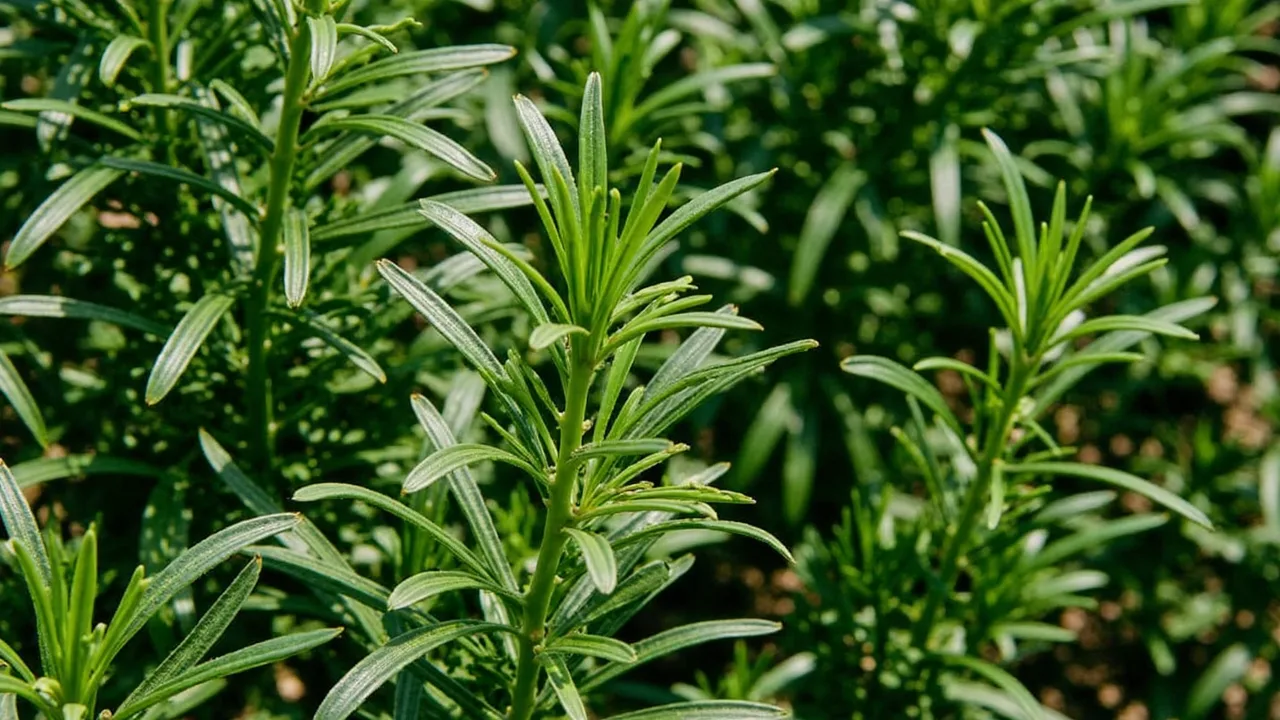
Artemisia dracunculus forms an upright to slightly spreading clump of slender, branched stems from a woody base. The leaves are narrow, lance-shaped, 2 to 8 cm long, smooth-edged, and soft grey-green. Crushed or bruised, they release a strong, sweet, anise-like scent that distinguishes the true French form from the milder-scented Russian clone. The stems are wiry, smooth, and often tinged red or purple at the nodes. In mid- to late summer the plant produces loose, drooping panicles of small, rounded, greenish-yellow flower heads at the shoot tips. The flowers are of little ornamental value and in the French clone are largely sterile. The overall habit is open and bushy in well-grown plants, becoming leggy and bare at the base on older specimens. In a mild British winter the foliage often persists, although the plant dies back to near ground level after sharp frosts and re-emerges from the crown in spring. Mature plants reach 60 to 90 cm tall, occasionally taller in rich soil, with a spread of 30 to 45 cm.
Growing Conditions
Tarragon needs the same general conditions as most Mediterranean herbs: a sunny, sheltered site and free-draining soil. It tolerates poor ground but resents winter wet, and the most common cause of loss in the UK is crown rot on heavy or waterlogged soil rather than cold itself. The Royal Horticultural Society rates Artemisia dracunculus as hardy across most of lowland Britain, with the French clone often listed in the H5 to H6 range; in practice the plant is more reliable in southern and central England than in cold northern or western districts, where it can struggle in damp winters. A south- or west-facing border at the foot of a warm wall, a raised bed, or a large container in a gritty loam-based compost suits it particularly well. Soil pH is not critical, but a near-neutral to slightly alkaline, low-fertility ground produces the most aromatic foliage; over-rich soil encourages soft, leafy growth with reduced flavour and increased winter losses. Full sun is essential: even light shade causes the plant to become leggy, and flowering (which is usually unwanted on a culinary plant) increases at the expense of leaf production. In the UK the plant is reliably hardy only in well-drained sites, and on heavy clay it is best grown in a pot or a raised bed where the crown can be kept drier through winter.
Planting and Care
Plant container-grown tarragon in spring after the worst frosts have passed, or in early autumn in mild districts. Space plants roughly 40 to 50 cm apart, setting the crown at, or just above, soil level. Water in well and keep the soil just moist until new growth is established; thereafter, additional watering is rarely needed except in prolonged summer drought. Tarragon is essentially a dry-garden plant and does not require routine irrigation once the root system is developed. Feeding should be light: a single application of a general-purpose fertiliser in spring, or a thin mulch of well-rotted compost, is sufficient, and overfeeding should be avoided as it produces soft, less aromatic growth. Pruning consists of two main tasks. Regular harvesting acts as a cut-and-come-again crop: pick young shoot tips through summer, fresh or dried, stopping about six weeks before the first expected frosts to allow the plant to harden off. A hard cut-back in late autumn, to within 10 to 15 cm of the crown, keeps the plant tidy and reduces dying foliage sitting over the crown through winter. In spring, remove any frost-damaged stems and thin out congested growth at the base. Propagation is by division in spring, splitting established clumps and replanting the more vigorous outer sections; this is the standard method for the French clone, which sets no viable seed. Semi-ripe cuttings of non-flowering shoots, taken in summer and rooted in a gritty compost under a cold frame, also root readily, and is the usual method for increasing stock of named forms. Russian tarragon is easily raised from seed sown under cover in spring, but the resulting plants are not a substitute for the French clone in the kitchen. Seasonal care in the UK follows a simple pattern: light spring tidy, summer harvesting, an autumn cut-back, and a top-dressing of coarse grit around the crown in winter to keep moisture away from the base. Plants in pots benefit from a cold frame or unheated greenhouse in winter, as their roots are vulnerable to freezing through the side of the pot.
Common Problems
Tarragon is generally a healthy plant in well-drained soil, but a small number of problems recur in UK gardens. The most serious is crown rot, caused by a combination of cold and wet conditions at the base of the plant, particularly on heavy or poorly drained ground; affected plants turn yellow, collapse, and fail to recover, and are best replaced after the ground has been improved. Rust (Puccinia species) can appear on the foliage in damp summers, producing small orange-brown pustules on the leaf undersides; prompt removal of affected growth, improved air circulation, and avoidance of overhead watering usually keep it in check, and badly affected plants should be cut back hard and allowed to regrow. Aphids occasionally colonise the soft shoot tips in late spring, but are easily washed off. Slugs and snails rarely trouble established plants, though they can damage young regrowth in early spring. Flowering is not in itself a problem, but the French clone rarely sets viable seed, and any seed offered commercially is almost always the Russian form, which is why culinary tarragon should be bought as a potted plant in leaf rather than grown from a generic seed packet. Plants that have become leggy, with bare woody centres and a tuft of foliage only at the tips, are usually the result of age combined with missed autumn pruning, and are best divided or replaced rather than hard-pruned into old wood, which the plant does not always regenerate from. Tarragon is not generally listed as toxic to humans or domestic animals, although, as with most culinary herbs, large quantities of any non-food plant material may cause mild gastric upset; precise data on toxicity to dogs, cats or horses is not well established, and any concern about individual animals is best discussed with a vet.
Popular Varieties
The choice of tarragon in UK nurseries is small, and the most important decision is between the true French culinary form and the hardier but milder Russian form. French tarragon (Artemisia dracunculus var. sativa, sometimes labelled 'Sativa') is the standard culinary clone: the upright, bushy plant with narrow, smooth, anise-scented leaves, sold in pots as "French tarragon" by virtually every British herb specialist. It is sterile and is propagated only by division or cuttings, which is why established plants are the only reliable way to obtain it. Russian tarragon (A. dracunculus var. inodora, sometimes offered as 'Russian' or simply as A. dracunculus from seed) is a taller, coarser, more vigorous plant with paler, slightly broader leaves and little of the anise character that defines the French clone; it is hardy, grows readily from seed, and is sometimes planted by mistake in the expectation of a true French flavour. A form sold as German tarragon is encountered in some catalogues and is usually a regional name for the French culinary clone, although stock is not always consistent and plants should be checked in leaf before planting out. Named clonal selections are limited: tarragon has produced few widely accepted cultivars, and most variation in the trade is at the variety level rather than the cultivar level. The RHS has not, as of the most recent published awards list available to the author, awarded the Award of Garden Merit to a specific tarragon cultivar, and any specific AGM rating should be verified against the current RHS plant finder before purchase. Plants sold as "Mexican tarragon" or "Spanish tarragon" are not Artemisia dracunculus at all but Tagetes lucida, a separate species in the daisy family sometimes used as a tarragon substitute in warmer climates; it is not reliably hardy in most of the UK and is grown as an annual or tender perennial where it is used at all.
Cultivars and Varieties
| Cultivar | Height | Flower | Notes | AGM |
|---|---|---|---|---|
| 'French tarragon' | — | — | not grown from seed, propagated by root division | |
| 'Mexican tarragon' | — | — | much more reminiscent of French tarragon, with a hint of anise, much more robust flavor than Russian tarragon that does not diminish significantly with age, cannot be grown as a perennial in cold climates | |
| 'Russian tarragon' | — | — | can be grown from seed, much weaker in flavor compared to French variety, more hardy and vigorous, spreads at the roots, grows over a meter tall, prefers poor soils, tolerates drought and neglect, loses flavor as it ages |
Pests and Diseases
| Problem | Symptoms | Management |
|---|---|---|
| Honey fungus | Stems become soft and mushy at the base, often with white fungal threads visible. | Improve drainage and remove infected plants; avoid replanting in the same spot for several years. |
| Root rot | Foliage turns yellow and wilts despite moist soil, indicating waterlogged roots. | Ensure well-drained soil or containers with drainage holes to prevent waterlogging. |
| Winter dieback | French tarragon foliage dies back completely or stems rot in cold, wet UK winters. | Grow French tarragon in a container and move to a sheltered, frost-free location over winter. |
| Slugs and snails | Irregular holes chewed into young leaves and seedlings, often with slime trails. | Use physical barriers like copper tape or organic slug pellets to protect young growth. |
| Powdery mildew | A white, dusty fungal coating appears on leaves during hot, dry but humid periods. | Ensure good air circulation and avoid overhead watering; remove severely affected leaves. |
For step-by-step help, read Dealing with Slugs and Snails and Treating Powdery Mildew. Or browse the full plant problem solver to diagnose an issue by symptom.
Tarragon in our guides
Recommended Products
GardenWizz earns a commission from qualifying purchases made through affiliate links on this page (including links within the article) — as an Amazon Associate, and from Thompson & Morgan via the Awin network. This does not affect the price you pay. See our disclaimer for details.