Big-Leaf Rhododendron
Rhododendron calophytum
The Gardening Year
Best months in UK gardens · full planting calendar →
🖨 Printable care card (PDF)At a Glance
| Botanical name | Rhododendron calophytum |
|---|---|
| Common name(s) | Big-leaf Rhododendron |
| Family | Ericaceae |
| Plant type | shrub (evergreen) |
| Height × Spread | 12 m × 4–8 m |
| Position | Partial shade |
| Soil | moist but well-drained, leafy, humus-rich acid soil |
| Flowering | March–May |
| Toxicity | Harmful if eaten |
| Native range | central and eastern China |
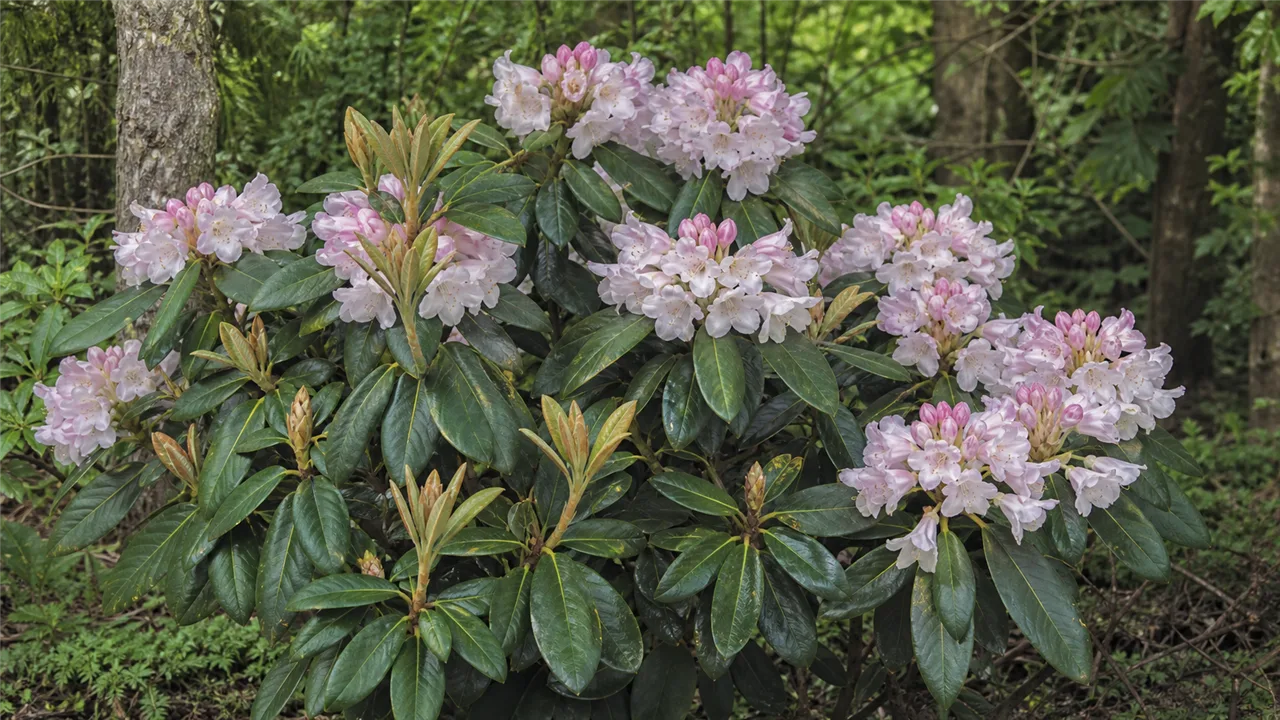
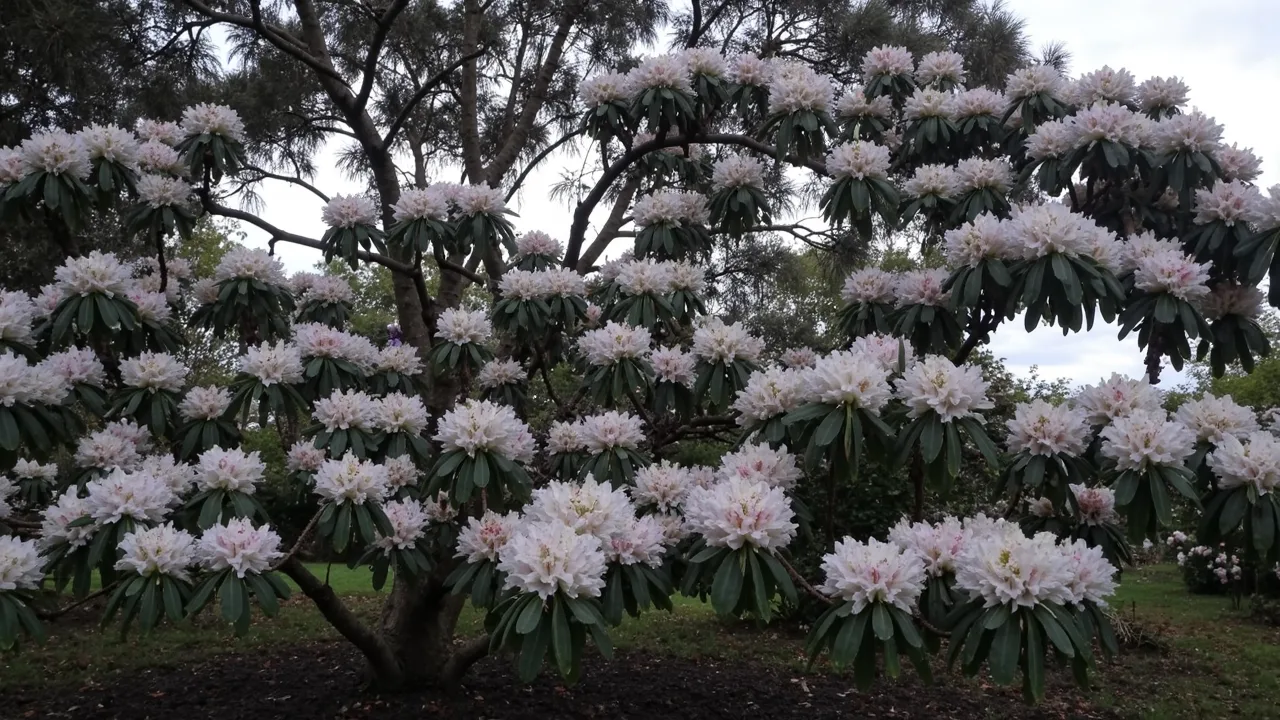
The Sichuan rhododendron, Rhododendron calophytum, is one of the most striking large-leaved rhododendrons in cultivation and one of only a handful to have earned the Royal Horticultural Society's Award of Garden Merit. Native to the cool, misty uplands of western China, it brings a distinctly architectural presence to UK gardens: bold, deeply textured foliage year-round and, in mid- to late spring, enormous trusses of white-to-blush-pink flowers marked with a vivid crimson throat. Given the right acid soil and a sheltered, lightly shaded position, it is a long-lived specimen that rewards patient gardeners with decades of reliable spring display.
Overview
Rhododendron calophytum belongs to the family Ericaceae and the large, mainly Asian genus Rhododendron. Introduced from Sichuan and Yunnan in the early twentieth century, it has become a mainstay of woodland and acid-border plantings in the mild, moist British Isles, and holds the RHS Award of Garden Merit.
In the garden it functions as a specimen shrub, a back-of-the-border anchor, or — in large acid-soil gardens — a structural component of a woodland mix alongside other ericaceous plants such as camellias, pieris, kalmias and other rhododendrons. Its eventual size means it needs space, but its slow-to-moderate growth rate keeps it manageable in the medium term, and it tolerates container cultivation for many years where garden soil is unsuitable.
Appearance
The plant develops a stiffly upright, eventually rounded habit, with strong main branches radiating from a single trunk or low fork. Over 10 to 20 years it can reach 4 to 8 metres in height and 3 to 5 metres in spread, depending on site and climate. In milder, wetter western gardens it tends to the larger end of this range; in colder, drier eastern districts it grows more slowly.
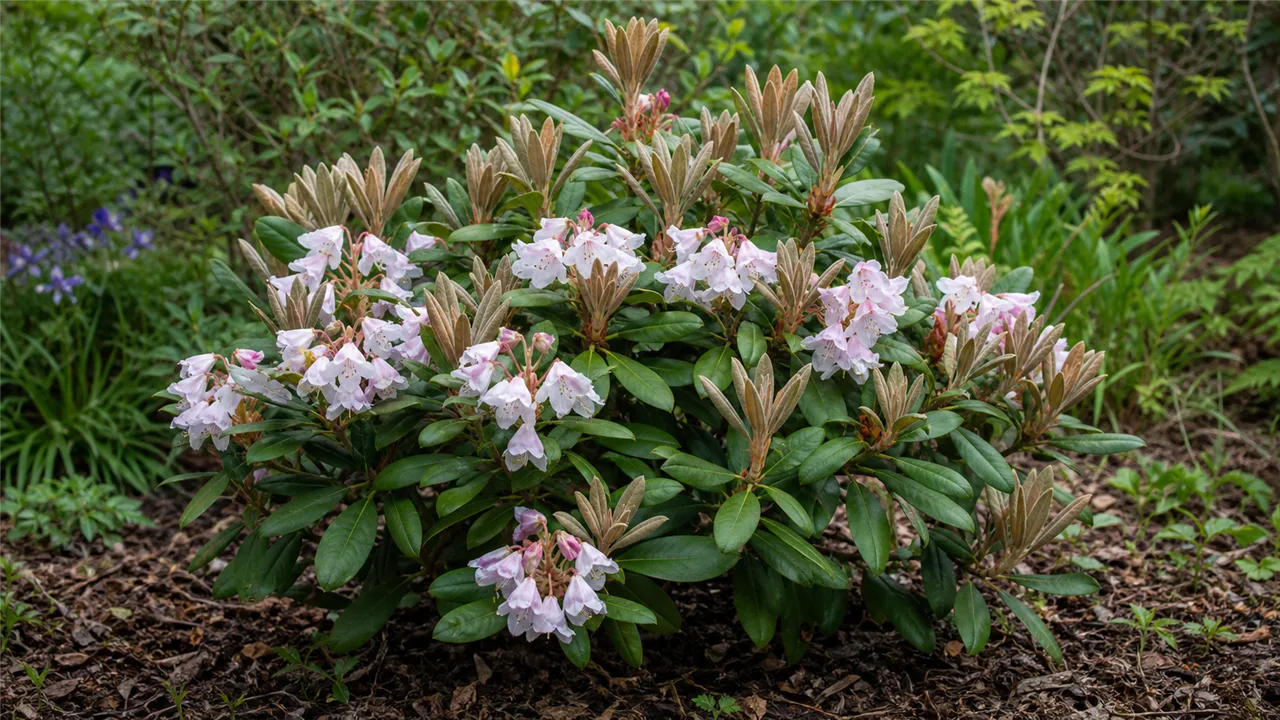
The leaves are the most immediately distinctive feature. They are oblong to lanceolate, leathery, and unusually large for a rhododendron — frequently 15 to 25 cm long and 4 to 7 cm wide. The upper surface is a deep, glossy dark green with a strongly impressed midrib; the underside is paler, often with a faint bluish or greyish bloom. New growth in late spring and early summer emerges as a fresh, lighter green, sometimes with a bronze or reddish tint, before maturing to the characteristic dark green of established foliage.
Flowers appear from mid- to late April and carry through May in most UK gardens. They are borne in rounded trusses of roughly 8 to 14 individual blooms at the shoot tips. Each flower is broadly funnel-shaped to bell-shaped, about 4 to 5 cm across, and ranges from white through pale blush pink, with a conspicuous deep crimson or maroon blotch on the upper lobe and a scattering of small purple or darker pink nectar guides within the throat. As the flowering fades, the developing seed capsules are themselves ornamental, persisting on the plant well into autumn as small, woody, rust-coloured structures.
Growing Conditions
Soil. As with all rhododendrons, R. calophytum demands acid soil. The target pH is roughly 4.5 to 6.0, ideally toward the lower end of that range. On neutral or alkaline ground the plant cannot take up iron and magnesium efficiently, and the leaves will progressively yellow between the veins (a condition known as chlorosis). Where the native soil is unsuitable, the practical options are container cultivation in ericaceous compost, raised beds built up with imported acidic topsoil, or — for very determined gardeners — excavation of the planting pit and replacement with an acidic planting medium. Avoid mushroom compost, lime, wood ash, or any alkaline amendment anywhere near the root zone.
Aspect and light. The natural habitat is montane woodland, and the plant performs best in dappled shade or at the filtered sunlight of an open woodland edge. Heavy midday sun on poor soil scorches the foliage and stresses the shallow root system, while deep shade reduces flowering. Shelter from cold east winds is important — these can scorch the large leaves and ruin flower buds.
Hardiness. The RHS has classified R. calophytum as H4, meaning it is hardy throughout most of the UK down to roughly –5 to –10 °C. Gardeners in colder inland or northern districts should still site it carefully, ideally against a west- or south-facing wall or among other shrubs that buffer wind and trap radiant warmth. Late spring frosts can damage open flowers; a position that allows cold air to drain away downhill reduces this risk.
UK climate match. Cool, moist conditions mirror its native habitat most closely. It performs particularly well in the south-west, Wales, western Scotland, parts of Northern Ireland, and other areas with reliable rainfall, high humidity, and mild winters. In drier regions it grows but needs more attentive watering and mulching.
Planting and Care
Planting. Plant in autumn or early spring, when the soil is moist and the plant is not under heat stress. Dig a hole no deeper than the root ball but two to three times as wide, and work generous quantities of ericaceous compost, well-rotted leafmould, or coarse bark into the backfill. Rhododendrons are surface-rooting, so planting too deep — burying the root collar — is one of the most common causes of failure. After planting, water thoroughly, firm the soil gently, and apply a 5 to 8 cm mulch of acidic organic matter such as pine bark, leafmould, or composted bracken.
Watering. For the first two to three years, water deeply during any dry spell, soaking the root zone rather than sprinkling the foliage. Once established, the plant is reasonably drought-tolerant in cool, shaded conditions but still benefits from irrigation in extended dry summers.
Feeding. Apply a proprietary rhododendron or azalea fertiliser in late winter or just as new growth begins in early spring. Slow-release formulations are particularly useful. Avoid high-nitrogen lawn feeds or general-purpose fertilisers containing lime.
Mulching. Top up the acidic mulch annually in spring. As well as suppressing weeds and conserving moisture, the mulch keeps the soil cool and gradually improves its organic content and acidity.
Pruning. R. calophytum rarely needs routine pruning. Remove dead, damaged, or crossing branches after flowering, and deadhead spent trusses by snapping them off carefully just above the new growth buds. The species resents hard pruning into old wood; if size reduction is essential, do it gradually over several years rather than in one severe cut.
Propagation. Propagation is by semi-ripe cuttings taken in mid- to late summer, or by layering low branches in autumn. Seed is possible but slow, and named cultivars will not come true.
Seasonal care. Mulch in spring, water in dry spells, deadhead after flowering, and inspect for pests from late spring through summer. In cold districts, fleece or hessian wrapping around the canopy can protect opening buds from late frost.
Common Problems
Chlorosis (iron deficiency). Yellowing leaves with darker green veins typically indicate soil that is too alkaline. Treat with sequestered iron applied to the soil and foliage, top up the acidic mulch, and avoid contact with lime or composts containing it.
Powdery mildew. A dull white fungal coating on the leaves in dry summers. Improve airflow around the plant, water at the base during droughts, and remove severely affected leaves. Fungicides are rarely necessary.
Azalea lily beetle (Lilioceris lilii). A bright red beetle whose grey, slug-like larvae can defoliate plants rapidly between late spring and summer. Hand-pick both adults and larvae; check the underside of leaves where the larvae shelter in a dark, wet frass coating.
Root rot (Phytophthora). Typically arises on poorly drained sites or where plants have been set too deep. Symptoms include wilting, pale foliage, and collapse. Prevention — free-draining acidic soil and correct planting depth — is far more effective than treatment.
Leaf-rolling aphid. Causes the terminal leaves to curl tightly in late spring and summer. Usually a cosmetic problem on a large established plant; if severe, treat with insecticidal soap or encourage natural predators.
Popular Varieties
The species itself is the most commonly grown form and is the form that has received the RHS Award of Garden Merit. A small number of selections and seed-raised variants exist within specialist rhododendron circles, but they are not widely encountered in general garden centres. Two of the more frequently referenced forms include:
- Rhododendron calophytum 'Sichuan Snow'. A white-flowered selection, sometimes seen in larger specialist collections, with the same bold foliage as the type but flowers of a clean, unmarked white rather than the typical blushed pink. Availability is limited.
- Seed-raised pink variants. Several named and unnamed clones with particularly deep pink flower buds opening to a richer pink truss are circulated among rhododendron enthusiasts under collector's numbers. They are typically sourced through specialist nurseries and the Rhododendron, Camellia and Magnolia Group, rather than mainstream garden centres.
For most UK gardeners, the Award of Garden Merit form of R. calophytum — sold simply as the species — remains the best and most reliable choice, combining proven garden performance with the strongest possible trade assurance.
---
Pests and Diseases
| Problem | Symptoms | Management |
|---|---|---|
| Vine weevil | Irregular notches on leaf margins and wilting or collapse of plants due to root feeding. | Apply nematodes in autumn or use biological controls like Steinernema carpocapsae. |
| Powdery mildew | White powdery fungal growth on leaves, buds, and shoots causing distortion. | Improve air circulation and apply a fungicide if infection is severe. |
| Bud blast | Flower buds turn brown, shrivel, and fail to open before flowering. | Remove and destroy infected buds promptly to reduce fungal spread. |
| Silver leaf fungus | Leaves develop a silvery sheen underneath and shoots may die back. | Prune out affected branches well below the infection and burn them. |
| Rhododendron leafhopper | Small bluish-green insects leap from foliage; nymphs are white on leaf undersides. | Monitor for damage to flower buds; control is rarely needed as feeding impact is low. |
| Pieris lacebug | Upper leaf surfaces show silvery or yellowish stippling with black tar-like spots underneath. | Encourage natural predators like ladybirds or use insecticidal soap for heavy infestations. |
For step-by-step help, read Treating Powdery Mildew. Or browse the full plant problem solver to diagnose an issue by symptom.
Recommended Products
GardenWizz earns a commission from qualifying purchases made through affiliate links on this page (including links within the article) — as an Amazon Associate, and from Thompson & Morgan via the Awin network. This does not affect the price you pay. See our disclaimer for details.