Folgner's Rowan
Sorbus folgneri
The Gardening Year
Best months in UK gardens · full planting calendar →
🖨 Printable care card (PDF)At a Glance
| Botanical name | Sorbus folgneri |
|---|---|
| Common name(s) | Folgner's rowan |
| Family | Rosaceae |
| Plant type | tree |
| Height × Spread | 12 m × — |
| Position | Full sun, Partial shade |
| Soil | Moderately fertile, humus-rich, moist but well-drained soil; suitable for chalk, clay, loam or sand |
| Flowering | May |
| Toxicity | — |
| Native range | central China |
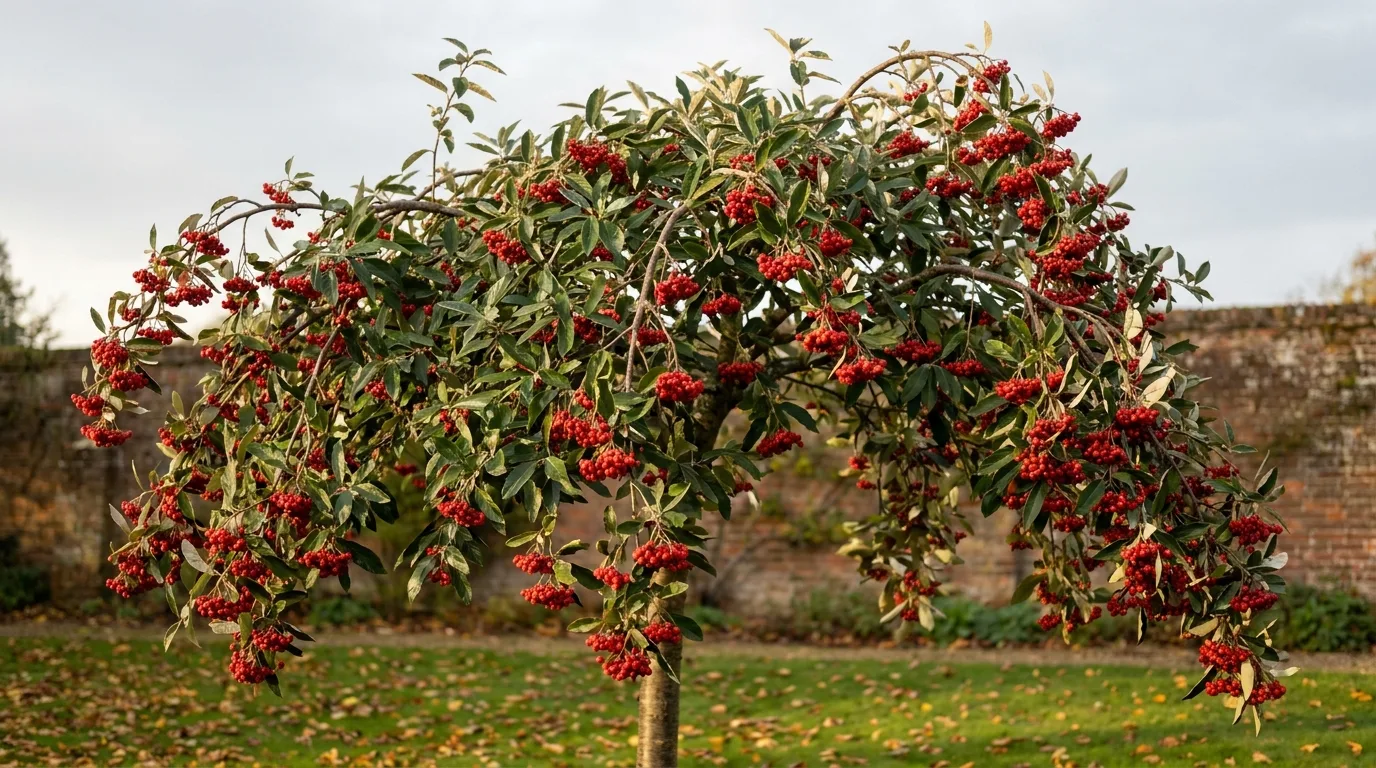
Quick answer: Sorbus folgneri (Folgner's whitebeam) is a graceful, oval-headed Chinese whitebeam introduced to British cultivation by Ernest H. Wilson, valued in UK gardens for its glossy dark-green foliage with silvery-white undersides, broad heads of creamy-white flowers in late spring, generous crops of small red berries in autumn, and a strong display of russet and orange autumn colour. It reaches roughly 8-10 m at maturity, is hardy across the UK, and the clonal selection 'Emiel' holds a current RHS Award of Garden Merit as the form most widely planted in British gardens.
Overview
Sorbus folgneri is one of the finest Asian whitebeams for British gardens, combining the graceful outline of a small orchard tree with the ornamental qualities of a flowering and berrying specimen tree. It was first collected for Western cultivation by the English plant-hunter Ernest Henry Wilson during his early-twentieth-century expeditions to central and western China for the Veitch nurseries, and it was described as a distinct species by Camillo Karl Schneider, with its present name fixed by the dendrologist Alfred Rehder in the 1920s. The species is one of a group of Asian whitebeams that some modern authorities now place in the segregate genus Alniaria; however, the name Sorbus folgneri remains the one used across the UK nursery trade and on the RHS Plant Finder, and that is the name retained throughout this article.
In UK conditions the tree grows reliably across most of the country, succeeds in gardens from Devon to the Scottish lowlands and Northern Ireland, and behaves as a fully hardy deciduous ornamental that earns its place through three sequential seasons: the clouds of late-spring bloom, the heavy clusters of late-summer and autumn berries, and the bronze-to-orange autumn colour of its simple (not compound) ash-like leaves. Its modest mature size of roughly 8-10 m makes it well suited to gardens of every scale, including small suburban plots where larger rowans would soon outgrow their station.
Appearance
The species develops a rounded to broadly oval crown, often as wide as it is tall at maturity, carried on a short, clean trunk of smooth grey-brown bark with prominent lenticels on younger twigs. The winter buds are conical, dark and slightly sticky, and they sit tightly against the shoot - useful identification marks when comparing dormant stock against other whitebeams and rowans.
The leaves are simple (not pinnate as on the more familiar Sorbus aucuparia), oval to narrowly ovate, typically 8-12 cm long with 7-11 pairs of shallow forward-pointing teeth. The upper surface is a lustrous dark green, while the underside is densely covered in a close, pale grey-white tomentum that gives the foliage its silver-backed look and flashes brightly in even a light breeze. New leaves emerge in April with a soft felty covering and quickly mature to the characteristic green-and-white combination.
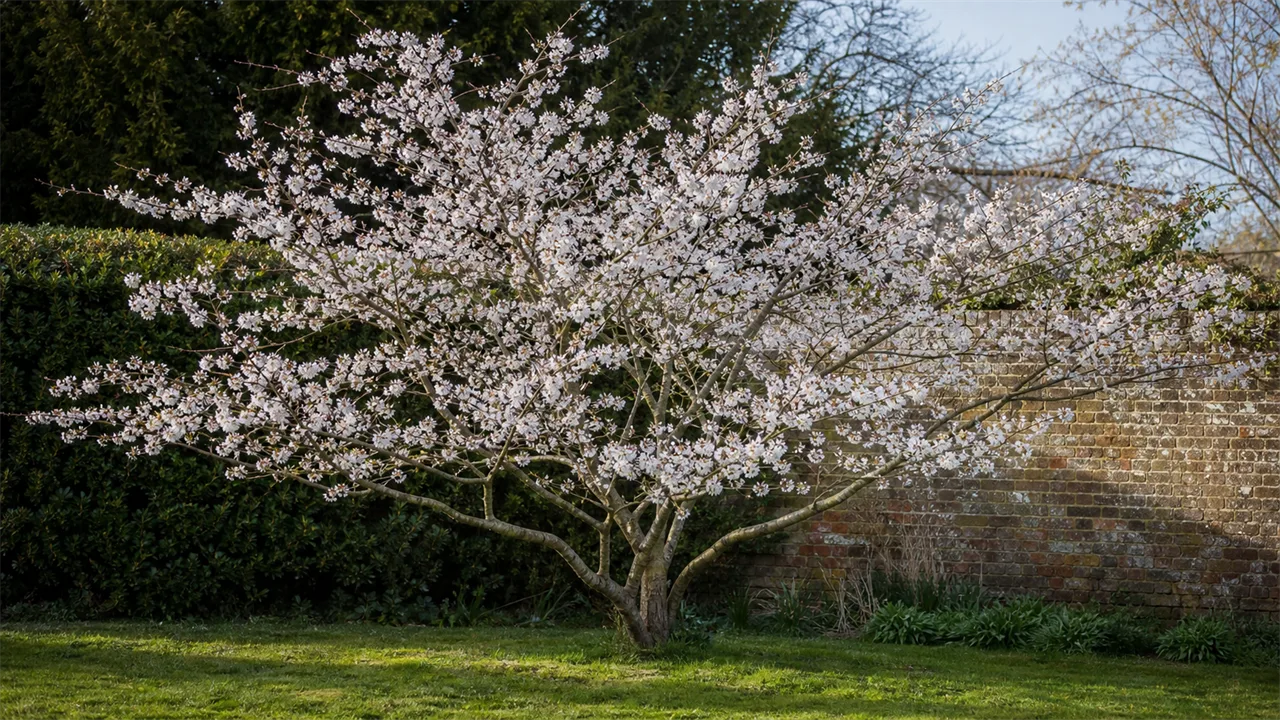
Flowers are carried in flattened corymbs 6-10 cm across, packed with small five-petalled creamy-white blooms that open in late May or early June. They are followed by rounded berries (technically pomes) about 8-10 mm across, which ripen from green through yellow to a deep brick-red by September. The berries are borne in heavy, slightly drooping clusters and persist on the tree well into November, often providing late-season bird interest after the leaves have dropped.
The autumn foliage starts as a bronzed green in early October, deepens through orange and russet over the following two or three weeks, and frequently finishes in a rich warm brown before leaf fall. The colour is reliable but rarely as flamboyant as that of Sorbus commixta or S. 'Joseph Rock', and it works best in gardens where it is planted against a dark evergreen background.
Growing Conditions
Sorbus folgneri grows well in any moderately fertile, humus-rich garden soil that remains moist through the growing season without waterlogging. It tolerates clay, loam and lighter sandy soils where drainage is reasonable, and it accepts the mildly acid-to-mildly-alkaline pH range (roughly 5.5-7.5) typical of most UK garden sites. Like all whitebeams it is shallow-rooted and benefits from a generous surface mulch of leaf mould or well-rotted garden compost for the first three to five summers after planting.
The tree performs best in a position in full sun. Its autumn colour is consistently warmer and more sustained in open ground, and the crown stays denser and more symmetrically oval than in heavier shade. Shelter from cold east winds reduces scorch of the young spring foliage in exposed sites, but the species is otherwise notably tolerant of exposed gardens, including coastal locations where salt-laden wind is a frequent constraint.
The species is hardy across the UK and reliable from the south coast gardens of Sussex and Cornwall to the cooler inland gardens of Yorkshire, Cumbria and central Scotland. It grows successfully in urban gardens where air quality is moderate to poor, and its tolerance of compacted soils makes it a useful choice for street-tree planting and parkland. Container cultivation is possible in a very large pot of loam-based compost (at least 60 cm across), but the tree will always do better in open ground and should be regarded as a permanent open-ground subject.
Planting and Care
Plant bare-root specimens between November and March while dormant, or container-grown stock at any time of year so long as the ground is workable and the young tree can be watered in thoroughly. Prepare a planting hole at least twice the width of the root ball and no deeper, loosen the base with a fork, and set the tree at the same depth it was growing in the nursery. Backfill with the excavated soil improved with a bucket of leaf mould or well-rotted garden compost, firm gently, water in thoroughly, and stake on the windward side with a low, short stake that supports the lower trunk without rigidly tying the upper crown.
Watering is most important in the first two growing seasons. Soak thoroughly once a week during dry spells rather than sprinkling lightly, and continue until the tree has put on at least 30 cm of new growth in a single season. Once established, S. folgneri is moderately drought-tolerant and rarely needs supplementary watering except on very free-draining soils after prolonged dry summer weather. A single heavy soak every ten days through August is far better than light daily sprinklings.
Feeding is generally unnecessary on reasonable garden soil. A single annual mulch of leaf mould or garden compost in March is usually sufficient, and high-nitrogen feeds should be avoided because they encourage soft late growth that is vulnerable to both fireblight and winter die-back. On thin sandy or gravelly soils a slow-release organic fertiliser in early spring can be applied for the first three years only.
Pruning is minimal. The tree forms a well-shaped crown naturally and needs only the removal of crossing, damaged or dead wood in late summer or early autumn. Cuts should be made cleanly and avoid heavy heading back in late winter or early spring when the wound tissue is most vulnerable to entry by fireblight bacteria. If a specimen outgrows its position, shorten selected laterals in late summer rather than topping the central leader.
Propagation is most reliably carried out from seed, which requires a period of cold stratification. Collect ripe berries in October, clean off the flesh by macerating in water and rinsing through a fine sieve, and sow outdoors in a seedbed where they will germinate the following spring after the winter chill. Named cultivars such as 'Emiel' and 'Lemon Drop' do not come true from seed and must be propagated by chip-budding or grafting onto Sorbus aucuparia rootstocks - work for a specialist nursery.
Seasonal care follows the rhythm of a hardy deciduous tree. In March and April, top-dress with compost and watch for aphid colonies as the leaves expand. In May and June, check the foliage for any irregular blackening or wilting after warm, humid spells. From July through September water young trees during drought and watch the berries colour. From October to February the tree is dormant and requires no intervention apart from the occasional check on stake ties.
Common Problems
Aphids, particularly the rosy apple aphid and related species, are the most frequent and predictable problem on Sorbus folgneri in the UK, building up on the soft young growth in May and June. Heavy infestations cause leaf curl, honeydew and sooty mould on the lower branches. Natural predators (ladybirds, hoverflies, lacewings and blue tits) usually gain control within two to three weeks; if the damage is unacceptable, a single application of soft soap or a winter wash of plant oil against the overwintering eggs is usually sufficient.
Fireblight (Erwinia amylovora) is the most serious disease of the genus as a whole and is recorded on S. folgneri in scientific literature, although it remains uncommon on this species in the UK. The bacterium causes young shoots to wilt, blacken and crook at the tip in a characteristic "shepherd's crook", often with a milky bacterial ooze in warm humid weather. The RHS advises prompt pruning back to at least 30 cm below visible symptoms in dry weather, sterilising secateurs between cuts, and removing badly affected specimens to prevent spread to neighbouring apples, pears, hawthorns and cotoneasters.
Scab (Venturia inaequalis-type fungi) can mark the leaves and disfigure the fruit in wet summers, particularly on specimens grown in damp, shaded corners. Affected foliage develops olive-green to black blotches and may drop early. Improving air circulation by thinning adjacent shrubs, clearing fallen leaves at the base in November, and choosing an open sunny site from the outset are the most effective long-term measures; fungicide treatment is rarely justified on a garden specimen.
Crown gall (Agrobacterium) and bacterial canker (Pseudomonas syringae) are occasionally reported on stressed specimens, particularly on poorly drained or compacted soils. Improving soil drainage, avoiding mechanical damage to the trunk, and selecting clean nursery stock from the start are the most effective long-term controls. There is no reliable chemical cure once a tree is systemically infected, and affected specimens should be removed and the ground rested before replanting.
Birds - particularly thrushes, blackbirds and fieldfares - take the berries heavily in late autumn and can strip a tree in a few days. This is rarely a problem for the tree itself, and the bird interest is one of the species' attractions in a wildlife garden. Squirrel damage to young bark can occur on isolated specimens in suburban areas and is best deterred with plastic tree guards for the first five years after planting.
Popular Varieties
Sorbus folgneri 'Emiel' is the cultivar most widely planted in the UK and is the form recognised by the RHS Plant Finder as holding a current Award of Garden Merit (confirmed 2012). It forms a compact, broadly oval tree to about 8-10 m tall with arching branches, slightly more vigorous in habit than the type, larger glossy dark-green leaves, and reliably heavy crops of brick-red berries. It is the default form offered by most UK specialist tree nurseries.
Sorbus folgneri 'Lemon Drop' is a yellow-fruited selection noted by Kew's Trees and Shrubs Online as a worthwhile cultivar where the red berries of the type are not desired. The fruit ripens to a soft lemon-yellow in late September and persists into November, and the autumn leaf colour is at least the equal of the species. It is available from a small number of specialist UK nurseries, including Frank P Matthews in Herefordshire, and is best ordered in advance because nursery production is limited.
Sorbus folgneri (the straight species, raised from seed) remains a perfectly good garden tree and is offered by several UK nurseries including Mallet Court in Hampshire and Burncoose in Cornwall. Seed-raised trees are more variable in habit than clonal cultivars, generally reaching 7-9 m at maturity with a slightly more open crown, and they are useful for gardeners restoring mixed plantings or hedgerow boundaries where uniformity is less important than genetic diversity.
The closely related Sorbus alnifolia (Korean whitebeam) is often confused with S. folgneri in trade and shares many of its garden qualities, including simple leaves with paler undersides and rich autumn colour. It is worth knowing that some material sold informally as "whitebeam species" in larger garden centres may be either species, and the only reliable distinction is the leaf shape: S. folgneri has narrowly ovate leaves with 7-11 pairs of teeth, while S. alnifolia has broader, more oval leaves with more teeth per side.
Sources & Further Reading
- Source: rhs.org.uk/plants/17557/sorbus-folgneri/details, accessed 2026-07-22
- Source: rhs.org.uk/plants/170493/sorbus-folgneri-emiel/details, accessed 2026-07-22
- Source: rhs.org.uk/plants/pdfs/agm-lists/agm-ornamentals.pdf (RHS AGM Ornamentals list, December 2024), accessed 2026-07-22
- Source: orangepippintrees.co.uk/trees/rowan/sorbus-folgneri-emiel, accessed 2026-07-22
- Source: burncoose.co.uk/site/plants.cfm?pl_id=5243 (Sorbus genus note), accessed 2026-07-22
- Source: treesandshrubsonline.org/articles/alniaria/alniaria-folgneri/ (Bean's Trees and Shrubs Hardy in the British Isles entry, modernised), accessed 2026-07-22
- Source: hortweek.com/trees-provide-best-eye-catching-foliage-garden/arboriculture/article/1836166 (2023 reclassification note for the Asian whitebeams), accessed 2026-07-22
Pests and Diseases
| Problem | Symptoms | Management |
|---|---|---|
| Powdery mildew | White, dusty fungal growth appears on leaves and shoots, potentially causing distortion. | Improve air circulation and apply a systemic fungicide if severe; resistant cultivars are preferred. |
| Aphids | Clusters of small soft-bodied insects on new growth, often accompanied by sticky honeydew. | Encourage natural predators like ladybirds or use a strong jet of water to dislodge them. |
| Slugs and snails | Irregular holes chewed in leaves and silvery slime trails visible on foliage. | Use physical barriers, copper tape, or iron phosphate-based pellets to control populations. |
| Vine weevil | — | Apply nematodes to the soil in autumn or use systemic insecticides for potted specimens. |
| Apple canker | Sunken, discoloured lesions on branches that may ooze sap and cause dieback. | Prune out infected wood well below the lesion and disinfect tools between cuts. |
For step-by-step help, read Controlling Aphids Naturally, Dealing with Slugs and Snails and Treating Powdery Mildew. Or browse the full plant problem solver to diagnose an issue by symptom.
Recommended Products
GardenWizz earns a commission from qualifying purchases made through affiliate links on this page (including links within the article) — as an Amazon Associate, and from Thompson & Morgan via the Awin network. This does not affect the price you pay. See our disclaimer for details.