Bay Tree
Laurus nobilis · bay laurel · sweet bay · true laurel
The Gardening Year
Best months in UK gardens · full planting calendar →
🖨 Printable care card (PDF)At a Glance
| Botanical name | Laurus nobilis |
|---|---|
| Common name(s) | bay tree, bay laurel, sweet bay, true laurel |
| Family | Lauraceae |
| Plant type | tree (evergreen) |
| Height × Spread | 1.5–4 m × 1–2.5 m |
| Position | Full sun, Partial shade |
| Soil | well-drained |
| Flowering | March–May |
| Toxicity | Fruit are ornamental - not to be eaten. Wear gloves and other protective equipment when handling Pets: Fruit are ornamental - not to be eaten - see the HTA guide to potentially harmful plants for further information and useful contact numbers |
| Native range | Mediterranean region |
The bay tree is an evergreen shrub or small tree native to the Mediterranean region and one of the longest-cultivated culinary plants in British gardens. Its aromatic, leathery leaves are the bay leaves of the kitchen, used fresh or dried in stocks, sauces, braises and stews. Outside the kitchen, bay is equally valued as a structural, topiary and container plant, holding its shape through pruning and tolerating the variable conditions of UK gardens better than most Mediterranean evergreens.
Overview
Laurus nobilis belongs to the family Lauraceae. It is the source of the true bay leaf used in European cookery and is not to be confused with several unrelated plants also called "bay" in common usage, including the cherry laurel (Prunus laurocerasus), the bay laurel of California (Umbellularia californica) and the West Indian bay leaf (Pimenta racemosa). Only Laurus nobilis is the culinary bay.
In the UK, bay is widely grown as a specimen shrub, as a clipped topiary (the familiar lollipop or "bay ball" standards sold in garden centres) and as a foliage plant in mixed borders. It is hardy across most of lowland Britain, evergreen, and tolerant of pollution, salt-laden winds and periods of drought once established. In colder inland areas and in northerly or exposed coastal sites it benefits from a sheltered position or winter protection, particularly when grown in a container.
Appearance
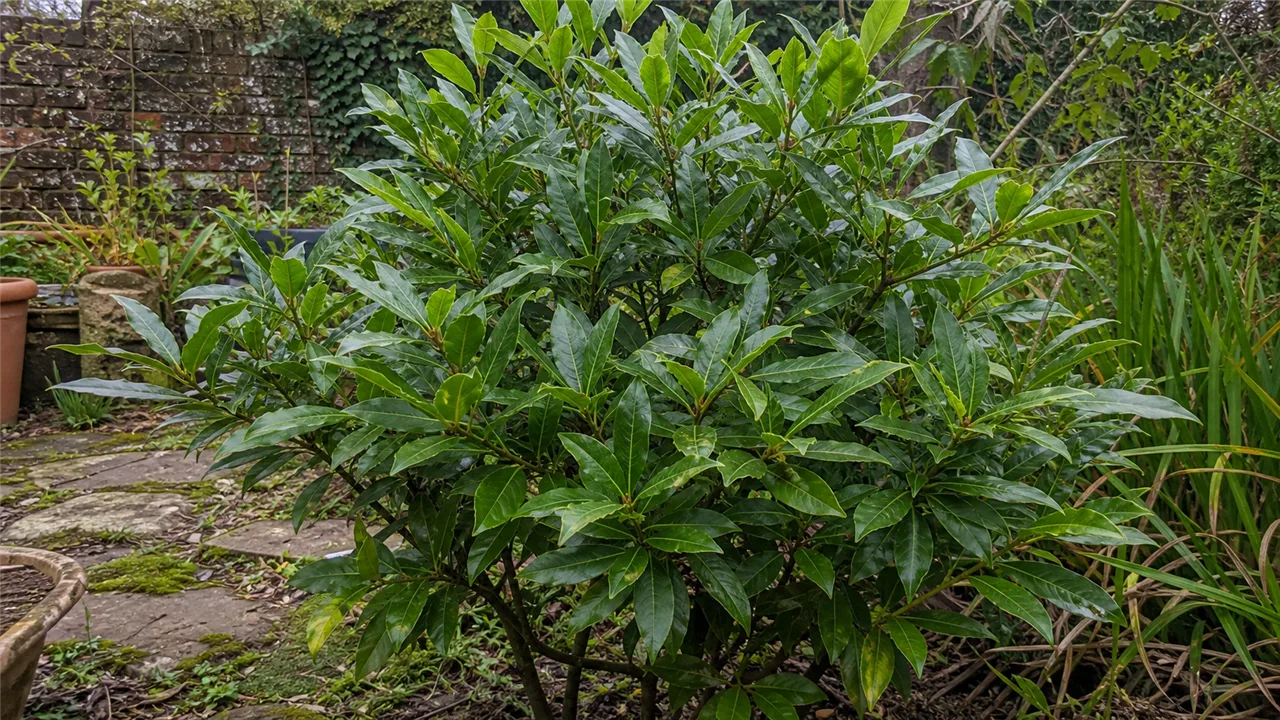
Bay is a bushy, evergreen shrub or small tree with a dense, upright habit. Left unpruned, mature plants reach around 7–12 m in height in their native range, though in British gardens they are commonly kept between 1.5 m and 4 m through regular pruning.
The leaves are the plant's most recognisable feature. They are alternate, lanceolate to narrowly oval, 6–12 cm long, with a smooth, slightly wavy margin. The upper surface is a dark, glossy green; the underside is paler and matt. Crushed or bruised leaves release a strong, aromatic, slightly resinous fragrance. Bay is dioecious: individual plants are either male or female, and small, pale yellow-green flowers appear in clusters at the leaf axils in spring (typically April to May in the UK). Female plants, if a male plant is nearby, produce small, oval, green berries that ripen to glossy black in autumn.
The bark is smooth and grey-green on young growth, becoming dull grey-brown and slightly fissured with age. Bay has a fibrous, shallow root system, which has implications for staking and for tolerance of root disturbance.
Growing Conditions
Bay thrives in a sheltered, sunny to lightly shaded position. In most of southern and central England it can be grown in the open ground with little fuss. In colder parts of the UK, in exposed gardens, or in frost pockets, a south- or west-facing wall provides useful protection and a longer growing season. Bay copes well with coastal exposure provided it is not planted in saturated soil, and tolerates urban pollution, which makes it a reliable choice for courtyards and city gardens.
The ideal soil is free-draining, moderately fertile and slightly acidic to neutral, although bay is tolerant of alkaline and chalky soils, which are common across much of southern England. Heavy clay that holds water in winter is the main risk: bay will decline in ground that is cold and wet for prolonged periods, and container culture is often the safer choice in such sites.
The RHS awards Laurus nobilis an H4 hardiness rating, indicating it is hardy across most of the UK in average to mild winters but may need winter protection in colder inland regions. The lower hardiness limit is generally given as around −5 to −10 °C once established, with container-grown plants and young specimens more vulnerable. In Scotland, northern England and exposed sites, fleece or horticultural fleece jackets are commonly used during hard frosts.
Planting and Care
Planting. The best time to plant bay in the ground in the UK is spring, from late March to May, so the root system has the full growing season to establish before its first winter. Container-grown plants can also be planted in early autumn in milder areas. Dig a hole roughly twice the width of the rootball and the same depth, tease out any circling roots, and set the plant so the top of the rootball sits level with the surrounding soil. Water in well and mulch with compost or bark, keeping the mulch clear of the stem.
Watering. Newly planted bay needs regular watering through its first growing season, typically once or twice a week in dry spells. Once established, in-ground plants are reasonably drought-tolerant and only need irrigation during prolonged dry periods. Container-grown bay is the opposite: it dries out fast, particularly in terracotta pots, and usually needs watering two to three times a week in summer, with daily watering in heatwaves. Pots must drain freely; bay will not tolerate waterlogged compost.
Feeding. Bay is not a hungry plant. A single application of a general-purpose slow-release fertiliser in spring, or a top-dressing of well-rotted garden compost, is sufficient for in-ground plants. Container-grown bay benefits from a monthly liquid feed (such as a seaweed or general-purpose feed) from late spring to late summer to replace nutrients leached by watering.
Pruning. Bay tolerates hard pruning and is commonly clipped into cones, balls, lollipop standards and pyramids. The main pruning window is mid- to late summer (July to early September), when growth has slowed and new cuts will heal before winter. Avoid heavy pruning in late autumn or winter, as cut stems are more vulnerable to cold damage. When shaping topiary, trim lightly several times during the growing season rather than cutting deeply in a single session. Always use sharp, clean secateurs; bay's leathery leaves bruise if crushed by blunt tools.
Propagation. Bay can be propagated by semi-ripe cuttings taken in late summer, by hardwood cuttings in autumn, or by layering of low branches. Semi-ripe cuttings, 10–15 cm long, taken with a heel and rooted in a 50:50 mix of peat-free compost and perlite under a propagator lid, usually root in 2–3 months. Seed is possible but slow and unpredictable, and named cultivars do not come true from seed.
Seasonal care. In the UK the gardening calendar runs roughly: plant in spring (March–May); prune mid- to late summer (July–September); feed container plants from May to August; check pot feet and shelter in October; and provide fleece protection in cold snaps from November to February. Bring container plants into a cold greenhouse, porch or against a sheltered wall for the worst of the winter, particularly in colder regions.
Common Problems
Frost and cold damage. The most common problem in the UK is leaf scorch and dieback after hard frost, particularly on container plants and exposed specimens, producing brown, papery patches in late winter or early spring. Plants usually recover if damage is limited to foliage; badly frosted stems can be cut back to live wood in late spring.
Waterlogging. Bay dislikes cold, saturated soil. Yellowing leaves and winter dieback are typical signs of waterlogging, especially in heavy clay. Improving drainage, raising the planting level, or moving plants into containers is the usual remedy.
Yellowing leaves and leaf drop. In containers, yellowing lower leaves most often indicate underwatering, overwatering, or nutrient deficiency. Check the compost moisture and feed during the growing season. Cold wind in winter can also scorch leaves on exposed specimens.
Scale insects and bay sucker. Bay is occasionally attacked by soft scale insects (a sticky, sooty mould may follow) and by the bay sucker (Lauritrioza alacris), a small psyllid that causes leaf margins to curl and thicken. Both can be managed by pruning out affected growth, encouraging natural predators, or, if severe, by an appropriate winter wash or horticultural oil applied in late winter. Chemical control options change; check the RHS advice for current recommendations.
Leaf spot. Fungal leaf spot can occur in damp, poorly ventilated conditions, producing dark spots and premature leaf drop. Improving air circulation and avoiding overhead watering reduces the problem; affected material should be removed and disposed of rather than composted.
Bay is generally regarded as non-toxic to humans in culinary quantities. As with all evergreen shrubs, leaves are not edible in large amounts and should be removed from food before serving.
Popular Varieties
Several named forms of Laurus nobilis are available in UK nurseries, although the range is more limited than for many other garden shrubs.
- Laurus nobilis (the species) — the standard culinary bay, sold as a shrub, a bush-on-a-stem, or as a topiary standard.
- Laurus nobilis 'Aurea' — the golden-leaved bay, with softer yellow-green new growth that matures to a paler green than the species. Slower-growing and often slightly less hardy; a sheltered position is advisable.
- Laurus nobilis 'Angustifolia' (also sold as 'Willow Leaf') — a narrow-leaved form with slender, lance-shaped leaves and a more open habit. Useful where a finer texture is wanted, though availability in the UK can be limited.
- Laurus nobilis 'Crispa' (sometimes listed as 'Crispata') — a form with distinctly wavy or crisped leaf margins, grown more as a curiosity than for culinary use.
- Laurus nobilis 'Little Ragu' (and similar dwarf selections) — compact, slower-growing forms marketed for smaller gardens and container use; supply and naming vary between UK growers.
Cultivar availability in the UK shifts with nursery stock, and a number of "lollipop" or "standard" bays sold in garden centres are simply the species trained rather than distinct cultivars. Where a named cultivar matters — for leaf colour, habit or hardiness — it is worth buying from a specialist nursery and checking the label carefully.
Cultivars and Varieties
| Cultivar | Height | Flower | Notes | AGM |
|---|---|---|---|---|
| 'Aurea' | — | — | RHS AGM (H4) | ✓ |
| 'L. nobilis 'Aurea'' | — | — | — | |
| 'L. nobilis f. angustifolia' | — | — | — |
Pests and Diseases
| Problem | Symptoms | Management |
|---|---|---|
| jumping plant louse Trioza alacris | curling and thickening of the edge of the leaves for the development of the insect's nymphs, eventually creating a necrosed gall | — |
| scale insect Coccus hesperidum | — | — |
Or browse the full plant problem solver to diagnose an issue by symptom.
Bay Tree in our guides
Recommended Products
GardenWizz earns a commission from qualifying purchases made through affiliate links on this page (including links within the article) — as an Amazon Associate, and from Thompson & Morgan via the Awin network. This does not affect the price you pay. See our disclaimer for details.