Holly
Ilex aquifolium · common holly · English holly · European holly
The Gardening Year
Best months in UK gardens · full planting calendar →
🖨 Printable care card (PDF)At a Glance
| Botanical name | Ilex aquifolium |
|---|---|
| Common name(s) | holly, common holly, English holly, European holly |
| Family | Aquifoliaceae |
| Plant type | shrub (Evergreen; dioecious (male and female flowers on separate plants); slow-growing; lifespan up to 300 years.) |
| Height × Spread | 2–4.5 m × 1–3 m |
| Position | Full sun, Partial shade |
| Soil | Moist but well-drained; acid, alkaline, or neutral pH; enriched with organic matter; avoid solid chalk. |
| Flowering | March–May |
| Toxicity | Fruit are ornamental - not to be eaten. Potentially harmful to pets. |
| Native range | western and southern Europe, northwest Africa, and southwest Asia |
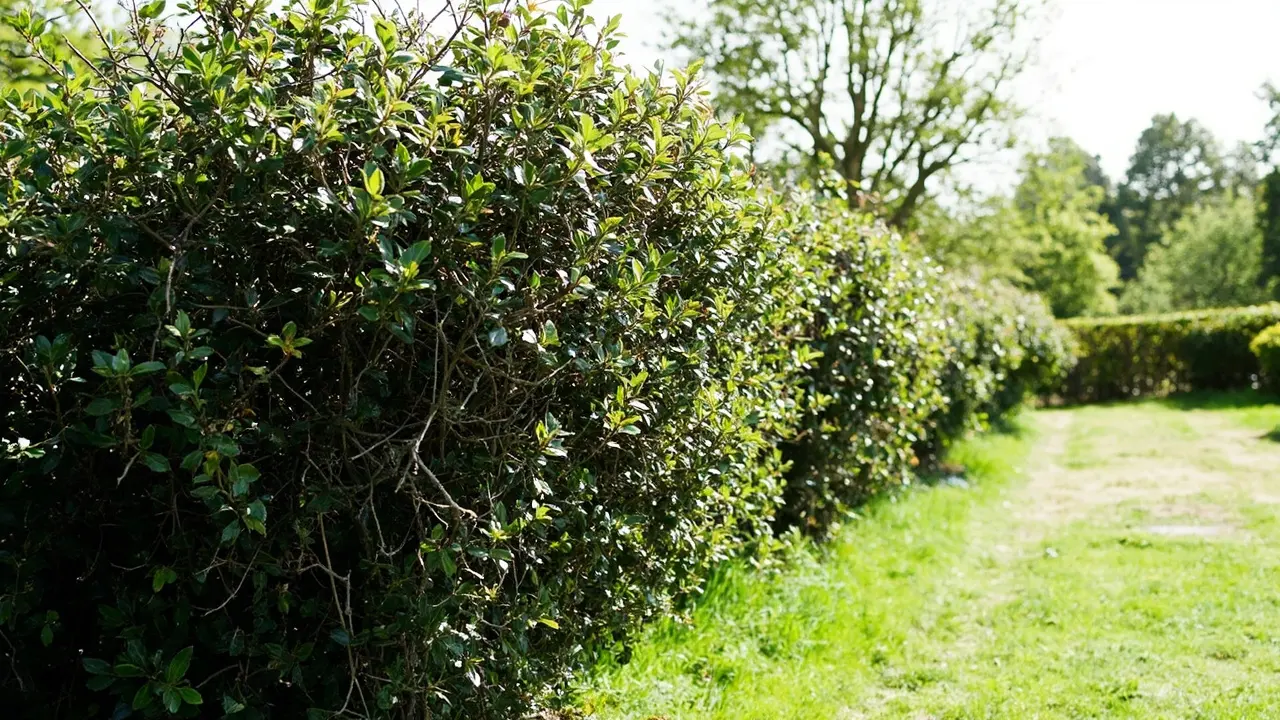
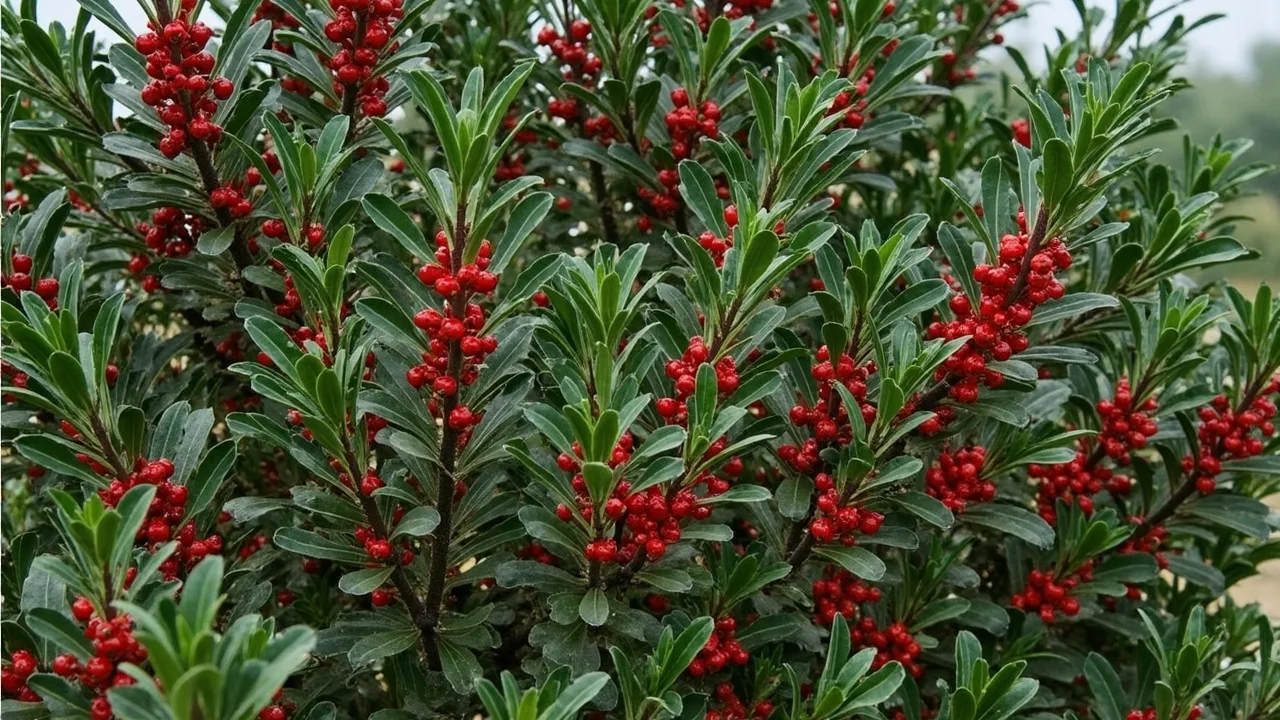
Holly is one of the most recognisable evergreen plants in the British landscape. A native species across much of the UK, it forms dense, glossy hedges and specimen shrubs that carry their spiny leaves through every season, with bright red — or, in some cultivars, yellow or orange — berries appearing in autumn and persisting well into winter. Its tolerance of shade, exposure and a wide range of soils has made it a backbone of British garden planting for centuries, both for ornament and for stock-proof hedging.
In the UK, holly is at its most visible from late autumn through to early spring, when the combination of evergreen foliage and coloured berries makes it a traditional feature of Christmas decoration as well as a valuable source of winter structure in the garden.
Overview
Ilex aquifolium is a slow-growing, long-lived evergreen tree or large shrub in the family Aquifoliaceae. In the wild it typically reaches 10–15 metres, forming a dense, pyramidal crown with a single trunk when grown as a tree, or a thick, suckering thicket where it has been allowed to grow unchecked. It is found throughout the British Isles in hedgerows, woodland edges and on rocky slopes, particularly on acidic soils.
Holly is dioecious: individual plants are either male or female. Only female plants produce berries, and they require a nearby male plant for pollination. The berries are mildly toxic to humans and to most domestic pets, although they are an important winter food source for birds such as thrushes, blackbirds and fieldfares. The leaves are also unpalatable to most grazing animals, which is one reason holly has survived in grazed landscapes.
Appearance
Holly leaves are the plant's defining feature. They are leathery, glossy dark green on the upper surface and paler beneath, typically 5–10 cm long, with a wavy, sharply spined margin on most forms. On older or higher growth the leaves often become smoother-edged, an adaptation that reduces water loss and deters browsing. The leaf surface is waxy and reflects winter light.
Flowers appear in May and June. They are small, four-petalled and white, sometimes tinged with pink, and carried in clusters along the previous year's growth. They are modest on their own but important for late-spring pollinators.
The fruits, which develop only on pollinated female plants, are spherical drupes 6–10 mm across, usually a bright sealing-wax red, ripening in October and November. Yellow-fruited and orange-fruited cultivars exist. The bark is smooth and grey when young, becoming finely fissured with age.
Mature size in cultivation depends heavily on training. As a free-standing specimen, 6–8 metres in height and 4–5 metres in spread is typical after several decades; clipped hedges are usually kept between 1 and 2.5 metres.
Growing Conditions
Holly is notably unfussy, provided a few basic conditions are met. It grows well in full sun or partial shade; in deep shade it becomes thin and produces fewer berries. It tolerates exposure, including coastal wind, and is one of the few evergreens that will withstand cold, exposed sites in northern and upland Britain.
Soil preference is for a moist but well-drained loam. It will grow in clay, provided the ground does not waterlog in winter, and in sandy soils if mulched. It is generally lime-tolerant, although on very shallow, chalky soils growth can be slow and leaves may yellow — adding organic matter at planting helps. Soil pH in the range of roughly 5.5 to 7.5 is acceptable.
RHS hardiness rating: H6, meaning hardy throughout the UK down to between –15 °C and –20 °C. In practice, holly is reliable in even the coldest mainland UK winters.
UK seasonal guidance: new foliage flushes in April and May, with the first flush of growth typically hardening off by midsummer. Flowering occurs in May and June, and the berries, once set, take roughly five months to ripen fully, reaching their brightest colour between late October and mid-November and persisting on the bush well into February or March of the following year. The heaviest leaf damage in cultivation usually follows hard frosts in late April, when tender new growth can be blackened; established plants recover quickly.
Planting and Care
Plant container-grown holly at any time between autumn and spring, when the soil is workable and not frozen. Bare-root plants are best lifted and planted in October or March. For a hedge, space plants 45–60 cm apart; for a single specimen, allow at least 3 metres from a wall or fence so the crown can develop naturally.
Watering: water thoroughly after planting and during the first two growing seasons whenever the soil dries out. Once established, holly is drought-tolerant and rarely needs supplementary watering except on very free-draining soils in prolonged dry spells.
Feeding: a single annual mulch of well-rotted garden compost or leaf mould in late winter is usually sufficient. On poor soils an application of a balanced general fertiliser in spring will support stronger growth.
Pruning: holly responds well to pruning and is traditionally clipped once a year. For hedges, trim in late summer (August) so that the new growth has time to harden before winter; this also avoids cutting off developing berries on female plants. For specimen shrubs, light shaping in mid- to late summer is enough. Old, neglected specimens can be hard pruned in spring and will regenerate from older wood, although regrowth is slow.
Propagation: from semi-ripe cuttings taken in late summer and rooted in a cold frame, or by layering low branches in autumn. Seed is slow and erratic, often taking two winters to germinate, so cuttings are the usual method for named cultivars.
Seasonal care: protect young plants from rabbits and deer, which browse the lower foliage in winter. In heavy snow, knock accumulated snow off branches to prevent splitting. Watch for waterlogging on heavy clay in winter — surface roots may rot if the ground stays saturated for long periods. Container-grown hollies under 60 cm in height are vulnerable to desiccation in exposed sites; wrapping the pot in hessian or moving it to a sheltered corner for the worst two or three winter months will reduce leaf scorch. A top-dress of fresh compost each March keeps pot-grown specimens in good condition for several years before they need potting on.
Common Problems
Holly is generally trouble-free, but a few issues are worth noting.
Holly leaf miner (Phytomyza ilicis): the most widespread holly pest in the UK. It causes pale, winding blotches in the leaves. The damage is largely cosmetic and does not weaken the plant. Pick off and destroy affected leaves if appearance matters.
Holly aphid and scale insects: these sap-sucking insects can cause sticky honeydew on the leaves and sooty mould beneath. They rarely require treatment; encourage natural predators such as blue tits, ladybirds and hoverflies.
Tar spot: black, tar-like spots on leaves, caused by fungi. Again, mostly cosmetic. Rake up and dispose of fallen leaves in autumn to reduce reinfection.
Phytophthora root rot: the only serious disease, occurring on waterlogged soils. Plants wilt despite moist soil, and the bark at the base may show dark staining. There is no cure; improve drainage or replace affected plants with a different species.
Toxicity note: holly berries contain saponins and are mildly toxic to humans, causing nausea and stomach upset if eaten in quantity. The spiny leaves can also cause mechanical irritation. Pets such as dogs and cats are similarly affected. Berries are, however, an important winter food for several native bird species.
Popular Varieties
Several reliable, widely-available cultivars are well suited to UK gardens. As holly is dioecious, it is worth noting which are male (pollinators only) and which are female (berry-bearing).
- 'J.C. van Tol' — a self-fertile female form with almost spineless, dark green leaves and heavy crops of bright red berries. Excellent as a specimen shrub, growing to around 4–6 metres.
- 'Argentea Marginata' — a female cultivar with leaves edged in cream-white, paired with red berries. Long-established and widely sold in the UK; grows to 6–8 metres if unpruned.
- 'Silver Queen' — despite the name, a male cultivar, grown for its striking silver-margined foliage. Useful as a pollinator for female silver-variegated hollies; produces no berries itself.
- 'Golden King' — a compact female form with broad, golden-edged leaves and red berries, reaching around 4–6 metres. Note that the name is historical and does not reflect the plant's sex.
- 'Handsworth New Silver' — a female cultivar with narrow, sharply spined leaves heavily edged in white, and red berries. Slower-growing and well suited to hedging or specimen use in smaller gardens.
- 'Pyramidalis' — a female, self-fertile form with a narrow, upright habit, useful where space is limited. Reliable berry production without needing a separate male.
Cultivars and Varieties
| Cultivar | Height | Flower | Notes | AGM |
|---|---|---|---|---|
| 'Amber' | — | — | RHS AGM (H6) | ✓ |
| 'Argentea Marginata' | — | — | RHS AGM (H6) | ✓ |
| 'Ferox Argentea' | — | — | RHS AGM (H6) | ✓ |
| 'Golden Queen' | — | — | RHS AGM (H6) | ✓ |
| 'Handsworth New Silver' | — | — | RHS AGM (H6) | ✓ |
| 'Ilex × altaclerensis' | — | — | hybrid between I. aquifolium and I. perado | ✓ |
| 'J.C. van Tol' | — | — | RHS AGM (H6) | ✓ |
| 'Madame Briot' | — | — | RHS AGM (H6) | ✓ |
| 'Pyramidalis' | — | — | RHS AGM (H6) | ✓ |
| 'Pyramidalis Fructu Luteo' | — | — | RHS AGM (H6) | ✓ |
| 'Silver Queen' | — | — | RHS AGM (H6) | ✓ |
Pests and Diseases
| Problem | Symptoms | Management |
|---|---|---|
| Holly leaf blight (Phytophthora ilicis) | Leaves turn brown and fall prematurely, often accompanied by twig dieback and arch-shaped patches of infection in hedges. | Improve drainage to avoid waterlogging, remove infected debris, and quarantine new plants for observation before planting. |
| Holly leaf miner | Distinctive brown or discoloured blotches appear on the leaves as larvae feed within the leaf tissue. | Generally harmless; prune out severely affected shoots if necessary, but usually no chemical control is needed. |
| Scale insects | Small, immobile, shield-like bumps appear on stems and leaves, often accompanied by sticky honeydew. | Scrape off small infestations manually or use horticultural oil sprays during the dormant season. |
| Aphids | Clusters of soft-bodied insects on young shoots causing curling leaves and sticky residue. | Encourage natural predators like ladybirds or treat with a targeted insecticidal soap if populations are high. |
| Winter desiccation | Leaves turn brown, crisp, or scorched due to moisture loss from cold winds and frozen soil. | Water well before ground freezes in autumn and mulch roots to retain moisture during dry winter spells. |
For step-by-step help, read Controlling Aphids Naturally. Or browse the full plant problem solver to diagnose an issue by symptom.
Holly in our guides
- Designing a Cottage Garden
- How to Attract Birds to Your Garden
- Box Blight: Protecting Box Hedging and Topiary
- Scale Insects: How to Spot and Control Them
Recommended Products
GardenWizz earns a commission from qualifying purchases made through affiliate links on this page (including links within the article) — as an Amazon Associate, and from Thompson & Morgan via the Awin network. This does not affect the price you pay. See our disclaimer for details.