Lupin
Lupinus · lupine · bluebonnet
The Gardening Year
Best months in UK gardens · full planting calendar →
🖨 Printable care card (PDF)At a Glance
| Botanical name | Lupinus |
|---|---|
| Common name(s) | lupin, lupine, bluebonnet |
| Family | Fabaceae |
| Plant type | perennial (Mostly herbaceous perennials, but some are annuals and a few are shrubs or trees.) |
| Height × Spread | 30–150 cm × — |
| Position | Full sun, Partial shade |
| Soil | Well-drained, sandy soil; neutral to slightly acid. Dislikes heavy, wet soil. |
| Flowering | April–August |
| Toxicity | Some lupins contain toxic alkaloids such as lupinine, anagyrine and sparteine. |
| Native range | North and South America |
Lupins are herbaceous perennials (and a few annuals) grown in British gardens principally for their tall, vertical spires of pea-like flowers in early summer. They belong to the legume family (Fabaceae) and the genus Lupinus, which contains several hundred species native to the Americas, the Mediterranean and North Africa. Garden lupins in the UK derive mainly from American species, crossed in the early twentieth century by George Russell to produce the tall, bicoloured border lupins widely grown today. They are valued for adding vertical structure to mixed herbaceous borders, for their nitrogen-fixing root nodules, and for attracting bumblebees.
Overview
Lupins are tap-rooted perennials that form a basal rosette of palmate leaves from which the flowering spikes emerge in late spring. They are hardy throughout most of the UK and are typically treated as short-lived border plants, lasting four to six years before flowering declines and the crown becomes woody. In addition to their ornamental value, lupins are useful in new gardens and on light, hungry soils because, like other legumes, they form symbiotic relationships with rhizobia bacteria and fix atmospheric nitrogen.
The most familiar garden plants are the Russell lupin hybrids, developed in the first half of the twentieth century from species such as Lupinus polyphyllus. Several other species, including the tree lupin (Lupinus arboreus) and a number of smaller perennials and annuals, are also grown in UK gardens. Cultivars carrying the Royal Horticultural Society's Award of Garden Merit (AGM) are widely available from British nurseries.
Appearance
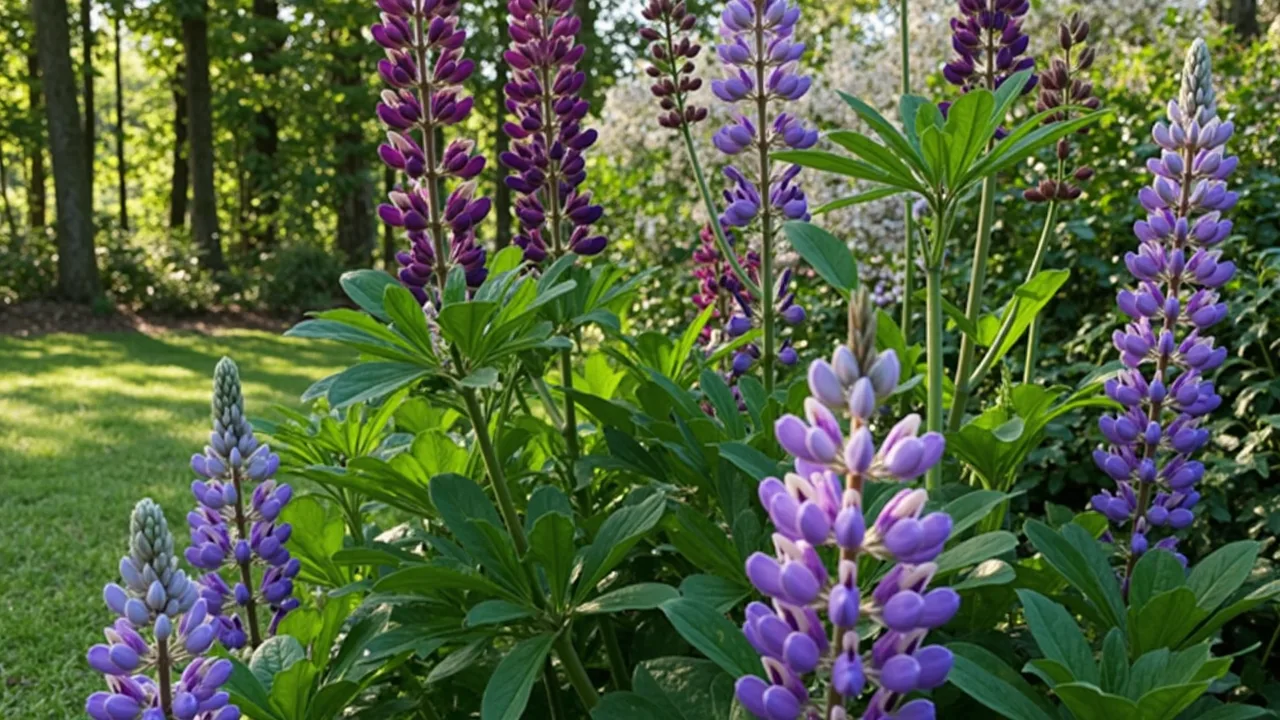
Lupin leaves are distinctive: palmately compound, with seven to eleven narrow, lance-shaped leaflets radiating from a central point, giving a parasol-like silhouette. The leaf surface is usually softly downy. Foliage colour is typically mid- to deep green, with some cultivars showing a slight bluish or grey-green cast.
Flowers are borne on tall, tapering racemes that arise from the leaf rosette in late spring. Each spike is densely packed with individual pea-type flowers, opening from the base upwards over a period of two to three weeks. Colours in Russell hybrids range across white, cream, yellow, pink, red, orange, purple, blue and bicolours. Bicolours, with a contrasting banner petal, are a Russell hallmark. The flowers are followed by hairy seed pods, which are best removed promptly in garden plants to encourage a secondary flush and to limit self-seeding where this is undesirable.
Mature clumps reach roughly 0.9–1.5 m in height when in flower, with the flowering spike held above the foliage. The basal rosette itself is typically 45–60 cm tall.
Growing Conditions
Lupins grow well throughout most of the UK, from southern England to northern Scotland, provided the site is not exposed and the soil is not strongly alkaline. The RHS hardiness rating for the genus is generally given as H6 (hardy across most of the UK, tolerating temperatures down to about −20 °C in a well-drained site), but exact ratings for individual named cultivars are not always published and may vary.
They prefer full sun, with at least six hours of direct light in midsummer to flower reliably. Light, dappled shade is tolerated at the cost of somewhat looser spikes and slightly later flowering. Soil should be moisture-retentive but free-draining; lupins have a deep tap root and resent waterlogging in winter, when crowns may rot. They are lime-tolerant to a degree but perform best in slightly acidic to neutral soil (pH roughly 5.5–7.0) and may show chlorosis on strongly chalky ground. In heavy clay, planting on a slight mound or incorporating well-rotted organic matter improves drainage.
A sheltered position is preferable: tall spikes can be flattened by strong winds, particularly in exposed northern and western gardens. Staking is rarely necessary in sheltered borders but is sensible in open sites.
Planting and Care
Watering. Newly planted lupins need regular watering during their first growing season to establish a deep tap root. Once established, they are reasonably drought-tolerant and rarely need supplemental irrigation except on very light, free-draining soils during prolonged dry spells. Overwatering, particularly in winter, is a more common cause of failure than drought.
Feeding. Lupins, as legumes, fix their own nitrogen and rarely need nitrogen fertiliser. In poor soils a light application of potash in early spring (such as a granular rose or tomato feed at half rate) can improve flowering. Mulching with well-rotted compost in spring helps conserve moisture and feeds the soil gradually.
Pruning. The single most useful intervention is deadheading: as the main spike fades, cut it back to a healthy pair of leaves or to a sideshoot. This often stimulates a smaller secondary flush in late summer and prevents the plant from exhausting itself setting seed. In autumn, once the foliage has blackened after the first frosts, cut the plant down to the basal rosette. The old stems and pods can be composted. Avoid cutting into the woody crown itself.
Propagation. Named cultivars do not come true from seed and should be propagated vegetatively. The standard method is basal cuttings taken in mid-spring from new shoots 7–10 cm tall, with a small heel of older tissue, inserted into a 50:50 mix of compost and grit and kept humid until rooted. Plants can also be carefully divided in early spring, although older woody crowns resent disturbance and are often better replaced. Species types, including the tree lupin, can be raised from seed sown in autumn or spring after chipping or soaking the hard seed coat.
Seasonal care. In March and April, watch for slug damage on emerging shoots, which is one of the most common causes of early failure. Apply cultural controls (nightly hand-picking, beer traps, iron-phosphate slug pellets) and check the crown in damp weather. In May and June, stake if the site is exposed and deadhead promptly. In July and August, water during drought and watch for aphids on the flower spikes. In October and November, cut down the spent foliage and apply a thin autumn mulch of compost around, but not over, the crown.
Common Problems
Aphids. The lupin aphid (Macrosiphum albifrons) is a particular nuisance, forming dense colonies on the flower spikes and distorting new growth. In small numbers it can be tolerated; heavier infestations are best controlled by spraying with a fatty-acid insecticidal soap or, on ornamental plants, by pinching out and binning affected tips.
Powdery mildew. A white fungal coating on the leaf surface appears from midsummer onwards, particularly in dry soil at the end of a hot spell. Improve watering, thin congested growth to increase airflow, and consider growing resistant cultivars where available.
Crown rot and root rot. In poorly drained soils, particularly over winter, the tap root and crown can rot, causing sudden collapse of the plant. There is no effective cure; lift and destroy affected plants, and avoid replanting lupins in the same spot for several years.
Slug and snail damage. Young shoots in spring are highly vulnerable. Cultural controls and, where necessary, iron-phosphate-based slug pellets are the usual response.
Virus diseases. Cucumber mosaic virus and bean yellow mosaic virus can affect lupins, causing mottling, distortion and reduced flowering. There is no cure; affected plants should be removed and destroyed, and aphid populations controlled to limit spread.
Toxicity. All parts of lupin plants, particularly the seeds, contain alkaloids and are toxic if eaten in quantity, and may also cause contact irritation in sensitive individuals. Gardeners should wash hands after handling and keep children and pets from ingesting seed pods or seeds. (The specific toxicity profile varies between species and cultivars and is not always documented for ornamental selections.)
Popular Varieties
The following cultivars are widely offered by UK nurseries, with the Russell hybrids dominant in the perennial border. AGM-holders (where listed) have been assessed by the Royal Horticultural Society and are considered reliable garden performers. Cultivar availability varies year to year, and named AGM ratings for some lupin cultivars are not currently published in the RHS database; this should be confirmed at the point of purchase.
- 'Russell Hybrids' (mixed) — the classic tall border lupins in a range of colours, generally reaching 1–1.2 m, derived from George Russell's early-twentieth-century breeding lines.
- 'The Governor' — AGM; deep navy-blue flowers with a white banner, a reliable and widely-grown Russell-type cultivar.
- 'My Castle' — AGM; brick-red to dusky-pink spikes on tall stems, one of the more strongly coloured Russell selections.
- 'Noble Maiden' — AGM; creamy-white flowers, useful in pastel and white border schemes.
- 'Gallery' series — compact plants typically 50–60 cm tall, bred for smaller gardens and container use, available in separate colours including yellow ('Gallery Yellow'), red ('Gallery Red') and blue ('Gallery Blue').
- Lupinus arboreus (tree lupin) — a short-lived shrubby species to about 1.5 m, usually in shades of yellow, useful for coastal and dry gardens; often grown as a single species rather than as named cultivars.
Pests and Diseases
| Problem | Symptoms | Management |
|---|---|---|
| Anthracnose | Stems and leaf stalks develop lesions with orange spores, causing twisting or corkscrewing of growth. | Remove affected plants immediately, avoid overhead watering, ensure good air circulation, and do not save seed from infected specimens. |
| Lupin aphid | Large greyish-white aphids form dense colonies on leaves and flower spikes, causing sticky honeydew and severe wilting. | Encourage natural predators like ladybirds; tolerate minor infestations on established plants but remove heavily affected growth if necessary. |
| Slugs and snails | Irregular holes chewed into new spring shoots and young leaves, often accompanied by slimy trails. | Use physical barriers such as copper tape or crushed eggshells around young plants, and hand-pick pests at night. |
| Powdery mildew | A white, dusty fungal growth appears on leaves and stems, particularly in dry but humid conditions. | Improve air circulation by spacing plants adequately and water at the base to keep foliage dry. |
| Root rot | Plants wilt and collapse despite moist soil, often with yellowing leaves and blackened, mushy roots. | Ensure planting in well-drained soil and avoid waterlogging, especially during winter months. |
For step-by-step help, read Controlling Aphids Naturally, Dealing with Slugs and Snails and Treating Powdery Mildew. Or browse the full plant problem solver to diagnose an issue by symptom.
Lupin in our guides
Recommended Products
GardenWizz earns a commission from qualifying purchases made through affiliate links on this page (including links within the article) — as an Amazon Associate, and from Thompson & Morgan via the Awin network. This does not affect the price you pay. See our disclaimer for details.