Daurian Rhododendron
Rhododendron dauricum
The Gardening Year
Best months in UK gardens · full planting calendar →
🖨 Printable care card (PDF)At a Glance
| Botanical name | Rhododendron dauricum |
|---|---|
| Common name(s) | daurian rhododendron |
| Family | Ericaceae |
| Plant type | shrub (deciduous to semi-evergreen shrub) |
| Height × Spread | 1.5–2 m × 1.5–2.5 m |
| Position | Full sun, Partial shade |
| Soil | moist but well-drained, leafy, humus-rich acid soil |
| Flowering | January–May |
| Toxicity | Harmful if eaten |
| Native range | Eastern Siberia, Mongolia, North China and Hokkaido, Japan |
Rhododendron dauricum is a compact, evergreen or semi-evergreen shrub belonging to the family Ericaceae. Native to a wide sweep of eastern Asia — including Siberia, Mongolia, northern China, Korea and Japan — it is among the earliest rhododendrons to flower in British gardens, often producing colour from late February into April. Its combination of tidy habit, hardiness and out-of-season bloom has long made it a useful plant for woodland plantings and acidic borders in the UK.
Overview
Rhododendron dauricum is a member of the large genus Rhododendron, which contains several hundred species of shrubs and small trees distributed across the temperate northern hemisphere and the mountains of Southeast Asia. Within that genus, R. dauricum sits in the subgenus Rhododendron, section Rhododendron, subsection Rhodorastra — a group of small-leaved, often early-flowering species prized for their tolerance of cold winters. The species name dauricum refers to Dauria, a historical region of eastern Siberia.
In UK cultivation, R. dauricum is valued chiefly for two traits: its willingness to flower in late winter, when little else is in bloom, and its compact, manageable size. It suits smaller gardens, woodland edges and shrub borders where taller, later-flowering rhododendrons might dominate. Like all rhododendrons, it is toxic if ingested and should be sited with that in mind around grazing pets or livestock.
Appearance
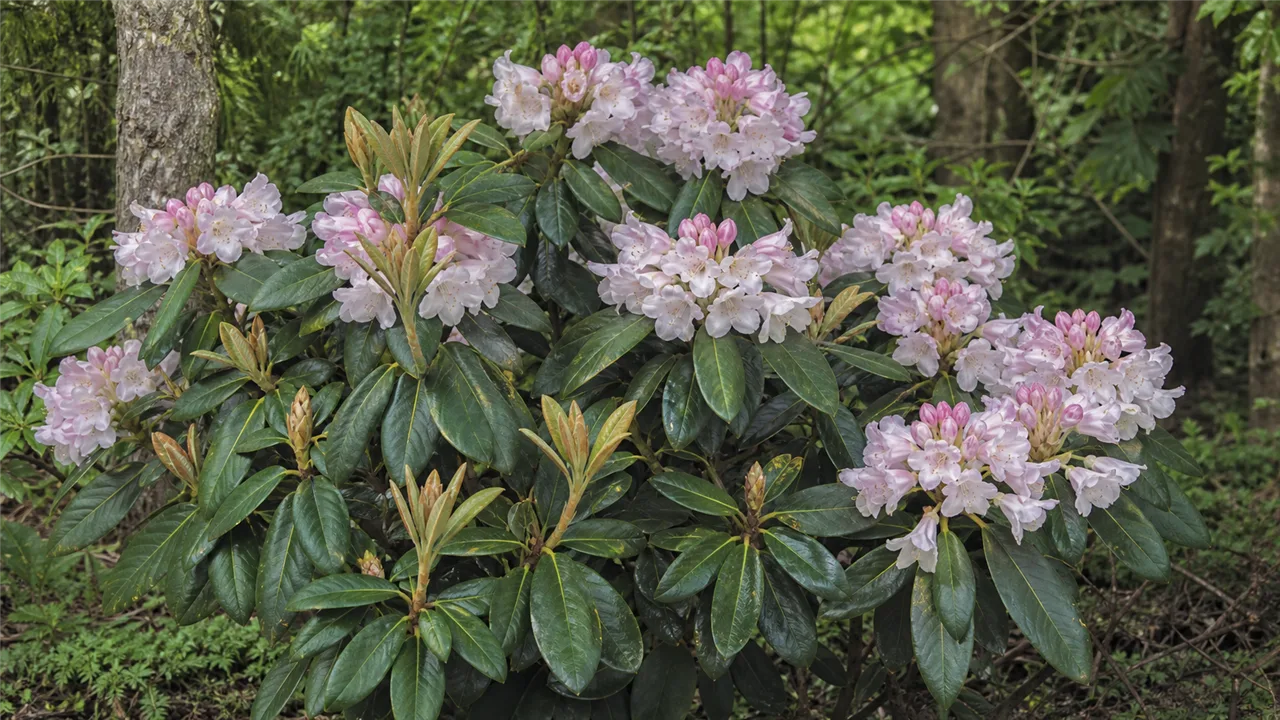
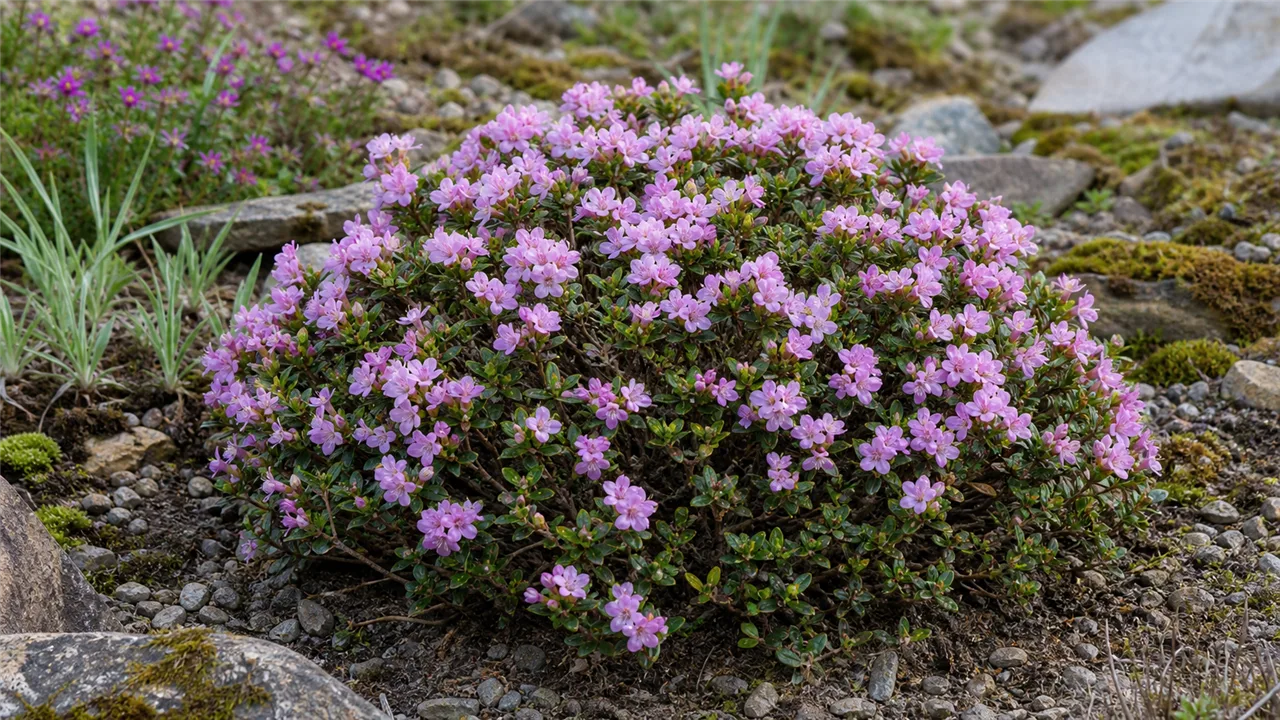
R. dauricum forms a compact, densely branched shrub typically reaching 1–2 m in height with a similar spread. The habit is rounded and tidy, with branches arising from near ground level to give a full, well-furnished silhouette. Established plants often look as broad as they are tall.
The leaves are small for a rhododendron, oblong to elliptical, leathery, and a glossy dark green on the upper surface. They are usually retained through winter in mild British sites, but in colder or more exposed positions the plant behaves semi-evergreen, shedding some or all foliage in late winter before the new leaves and flowers emerge. A faint resinous scent is sometimes noted on young foliage, particularly after cold weather.
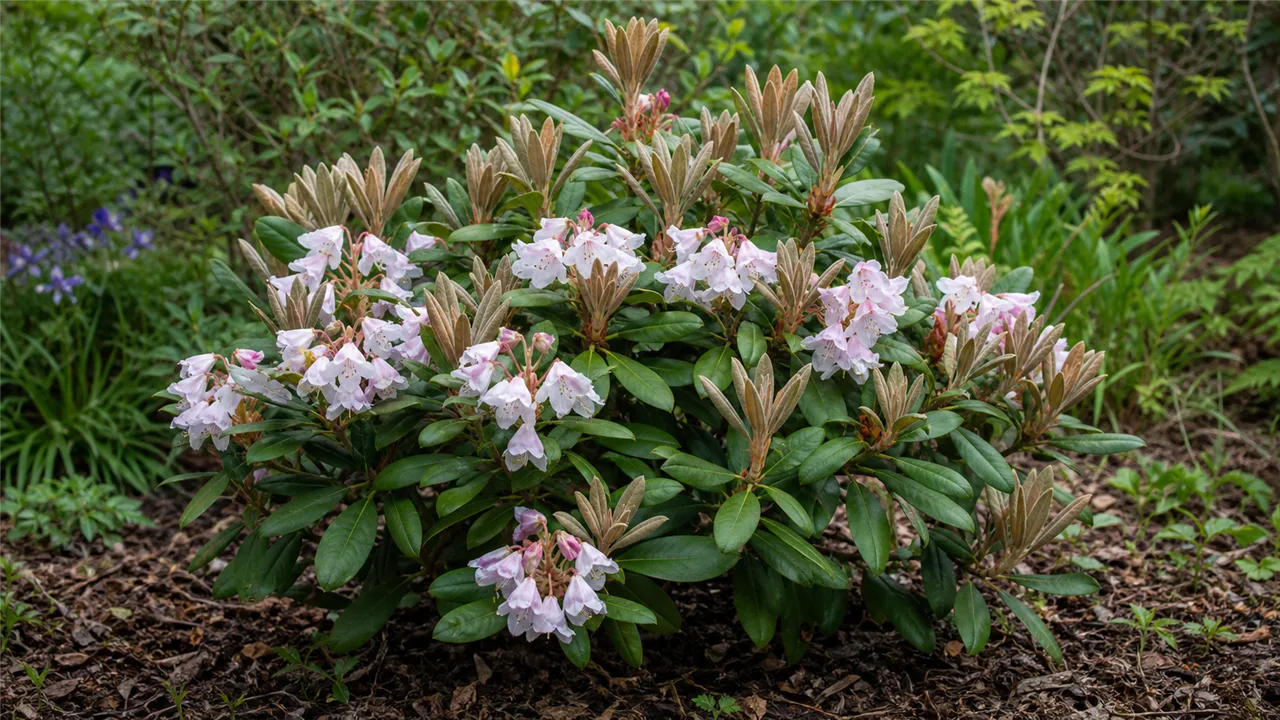
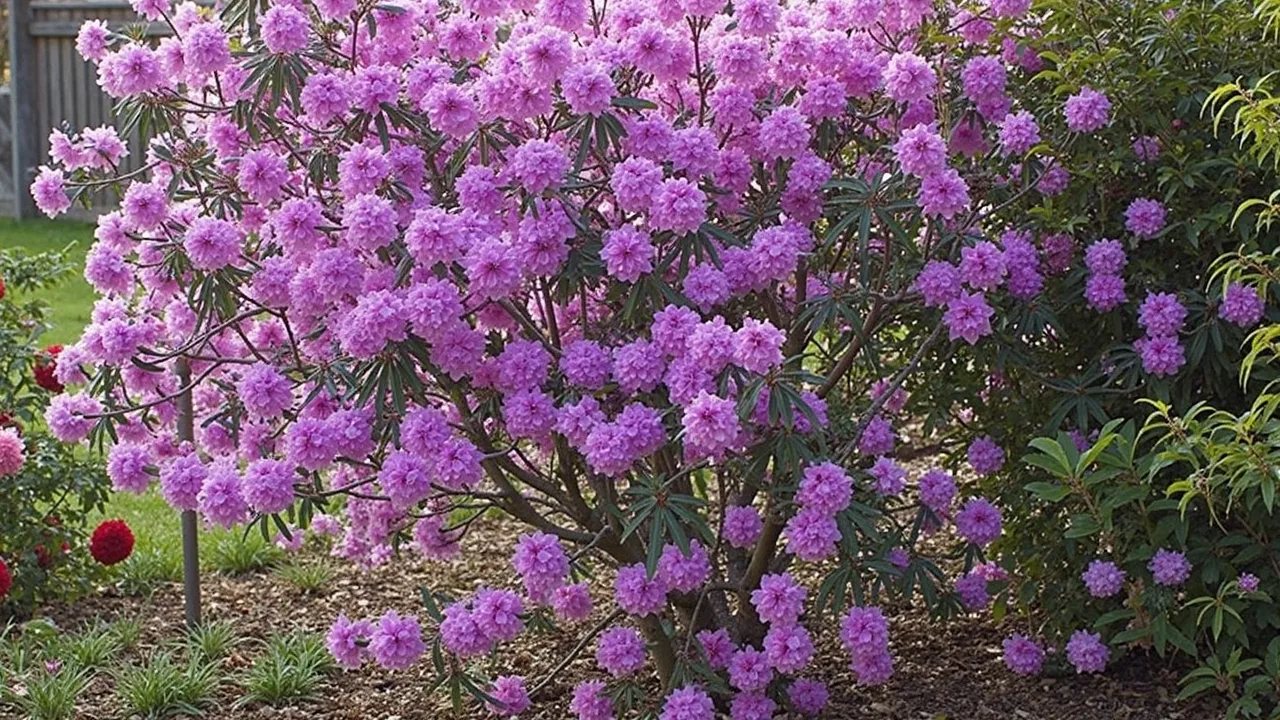
Flowers appear from late February through April, typically before or alongside the new leaves. Individual blooms are funnel-shaped, around 2–4 cm across, and carried in small terminal clusters of a few flowers each. Colour ranges from pale pink through rose-pink to a clear rose-purple, with the occasional white-flowered form appearing in wild populations. The flower's upper petal is lightly spotted, and the stamens are prominent.
Growing Conditions
R. dauricum requires acidic soil and will not thrive in chalky or alkaline ground. Aim for a pH between roughly 4.5 and 6.0; above this, leaves yellow (chlorosis) and growth suffers. The soil should be moist but free-draining — rhododendrons dislike sitting in waterlogged ground, where root-rotting Phytophthora fungi become a risk — yet they also dislike drying out. The ideal medium is humus-rich, with plenty of leaf mould, well-rotted pine bark or ericaceous compost worked into the planting area.
Light requirements are for partial shade. R. dauricum flowers most freely in dappled shade, such as the high shade cast by deciduous trees in spring, or on the shaded side of a building or wall. Deep shade reduces flowering; strong afternoon sun scorches foliage and bleaches flowers.
The Royal Horticultural Society lists R. dauricum as hardy to H5, meaning it tolerates low temperatures of roughly –15 to –20 °C and is suitable for gardens across most of the UK, including colder inland and northern sites. Cold, drying easterly winds can damage both foliage and opening buds, so a sheltered position is preferable. Good air movement, by contrast, helps reduce fungal problems.
Planting and Care
Plant in autumn or early spring, with spring planting the safer choice in cold or exposed regions so the root system establishes before the first winter. Dig a hole at least twice the width of the root ball and no deeper — rhododendrons are surface-rooters and should not be buried. Backfill with a 50:50 mix of the original soil and ericaceous compost, leaf mould or well-rotted pine bark. Water in thoroughly and apply a 5–8 cm mulch of acidic organic matter, keeping it clear of the stem.
Watering is most critical in the first two summers after planting and during dry spells thereafter, particularly from midsummer onwards when next year's flower buds are forming. Rainwater is preferable to hard tap water in alkaline regions, as tap water gradually raises soil pH.
Feeding is straightforward: apply a slow-release ericaceous fertiliser in spring, just as growth resumes, and water it in. Avoid general-purpose fertilisers, which often raise pH and scorch the fine roots. An annual mulch of pine bark or leaf mould in late autumn top-dresses the soil and helps maintain acidity.
Pruning should be light. R. dauricum does not regenerate from old wood, so hard cutting back into bare stems is usually unsuccessful. After flowering, remove spent trusses by snapping them off at the base, take out any dead, damaged or crossing shoots, and reduce wayward branches to a sideshoot if the plant outgrows its space.
Propagation is typically by semi-ripe cuttings taken in mid- to late summer, treated with a rooting hormone and rooted in a free-draining, acidic cutting compost under mist or in a closed propagator. Seed can be sown in autumn on the surface of a peaty compost, but named cultivars will not come true. Layering of low branches is the most reliable method for the gardener with patience: wound a low stem, peg it into the soil, and detach the rooted layer after one to two years.
Seasonal care is minimal. In late winter, watch for frost damage on opening buds in colder districts — frost-damaged buds turn brown and fail to open. In summer, water during dry spells and check container-grown plants daily, as pots dry out quickly. Container cultivation is possible using ericaceous compost, but pots must be large and watering consistent.
Common Problems
Chlorosis (yellowing leaves with green veins) is the most common issue and almost always indicates alkaline soil or a nutrient lock-out. Treat by mulching with acidic organic matter, applying chelated iron, and — in container-grown plants — replacing some of the compost.
Bud blast is a familiar rhododendron problem: flower buds turn brown, firm up and fail to open. It is caused by the fungus Pycnostysanus azaleae, which is spread by the rhododendron leafhopper. Control the leafhopper by spraying or encouraging natural predators, and remove and dispose of infected buds to reduce inoculum. Avoid planting in dry, stressed conditions, which predispose plants to attack.
Powdery mildew shows as a white, dusty coating on leaves in late summer, typically where airflow is poor or the plant is drought-stressed. Improve circulation, water consistently and remove affected leaves.
Root rot caused by Phytophthora species is the most damaging disease. It appears as wilting, pale foliage and dieback even in moist soil. There is no cure once a plant is badly affected; prevention relies on free-draining, acidic soil and avoiding planting too deeply.
Pests of note include vine weevil — particularly troublesome on container-grown plants, where the larvae chew roots — and rhododendron leafhopper, which is the vector of bud blast. Vine weevil can be controlled with biological nematodes applied in late summer.
Popular Varieties
Rhododendron dauricum 'Arctic Pearl' — a selection with white flowers opening from pink buds in late winter. Compact habit, suitable for smaller gardens and containers.
Rhododendron dauricum 'April Snow' — a white-flowered cultivar often confused with 'Arctic Pearl' in the trade; both are valued for illuminating shaded corners at the darkest point of the year. Plant buyers should confirm the specific clone from the supplier.
Rhododendron dauricum 'Midwinter' — a vigorous form with rose-pink to lilac flowers that can open as early as January in mild winters, particularly in the south and west of the UK.
Rhododendron dauricum 'P. J. Mezitt' — a widely grown pink-flowered cultivar often sold under the name "P. J. M." (a hybrid, but closely associated with R. dauricum in cultivation). Note: because this is widely treated as a hybrid rather than a pure cultivar of R. dauricum, growers seeking a pure species plant should confirm nomenclature with the supplier.
Rhododendron dauricum 'Nana' — a dwarf form reaching only about 60 cm at maturity, with smaller leaves and paler pink flowers. Useful for rock gardens or the front of an acidic border.
In addition to these cultivated forms, R. dauricum has been crossed with other rhododendrons to produce a number of hardy hybrids. The widely grown "P. J. M." group, Rhododendron ×pjm, derives in part from R. dauricum crossed with R. minus and is widely planted across the UK and northern Europe for its cold tolerance and early bloom. Where cultivar availability is limited in British nurseries, R. ×pjm hybrids (such as 'Olga Mezitt' and 'Elvira') make a reasonable substitute for similar garden effect.
Cultivars and Varieties
| Cultivar | Height | Flower | Notes | AGM |
|---|---|---|---|---|
| 'Mid-winter' | — | — | RHS AGM (H6) | ✓ |
Pests and Diseases
| Problem | Symptoms | Management |
|---|---|---|
| Bud blast | Flower buds turn brown and shrivel before opening, often following late spring frosts. | Site plants in sheltered locations away from cold drafts to protect developing buds. |
| Powdery mildew | White powdery fungal growth appears on leaves and stems, potentially causing distortion. | Improve air circulation around the plant and apply a suitable fungicide if severe. |
| Slugs and snails | Irregular holes chewed in young leaves and shoots, often accompanied by slime trails. | Use slug pellets, beer traps, or hand-pick pests at night to protect new growth. |
| Vine weevil | Notched edges on leaves above ground and root damage below, leading to wilting. | Apply systemic insecticide granules to the soil in autumn to control larvae. |
| Leaf spot | Small brown or black spots develop on leaves, sometimes surrounded by yellow halos. | Remove affected foliage and avoid wetting leaves when watering to reduce humidity. |
For step-by-step help, read Dealing with Slugs and Snails, Treating Powdery Mildew and Tackling Black Spot on Roses. Or browse the full plant problem solver to diagnose an issue by symptom.
Recommended Products
GardenWizz earns a commission from qualifying purchases made through affiliate links on this page (including links within the article) — as an Amazon Associate, and from Thompson & Morgan via the Awin network. This does not affect the price you pay. See our disclaimer for details.