Roseleaf Sage
Salvia involucrata
The Gardening Year
Best months in UK gardens · full planting calendar →
🖨 Printable care card (PDF)At a Glance
| Botanical name | Salvia involucrata |
|---|---|
| Common name(s) | roseleaf sage |
| Family | Lamiaceae |
| Plant type | perennial |
| Height × Spread | 120–180 cm × 90–120 cm |
| Position | Partial shade |
| Soil | humus enriched soil |
| Flowering | August–September |
| Toxicity | — |
| Native range | Mexican states of Puebla, Tamaulipas, and Veracruz |
Overview
Salvia involucrata, commonly known as Roseleaf sage, is a late-flowering tender perennial from the highlands of Mexico (Puebla, Oaxaca and Veracruz), first described by the Spanish botanist Antonio José Cavanilles in 1797. It belongs to the family Lamiaceae and sits within the New World "scarlet sage" clade of the genus Salvia — the same broad section as Salvia splendens, Salvia leucantha and Salvia coccinea. In British gardens it is prized above almost everything else for one reason: from late August into October, when most other border perennials have finished, it is still producing heavy heads of rosy-pink flowers on tall, leafy stems.
Its common name describes the leaves — they are broader, softer and more "rose-like" than those of typical Mediterranean salvias — while its species name refers to the showy involucre bracts that wrap each flower whorl and persist for weeks after the blooms themselves have dropped. These bracts give the plant several extra weeks of colour well into autumn, long after the last bumblebee has moved on.
For UK gardeners, Salvia involucrata sits firmly in the "microclimate margin": outstanding in coastal Cornwall, urban London, RHS Wisley in Surrey and the Isle of Wight, and perfectly viable in milder inland gardens in a sheltered border against a south- or west-facing wall. In colder regions — inland Scotland, the north of England, exposed Midlands plots — it is best treated as a pot-grown specimen or a borderline-hardy perennial given a deep autumn mulch and a forgiving attitude to losing top growth in a hard winter.
Appearance
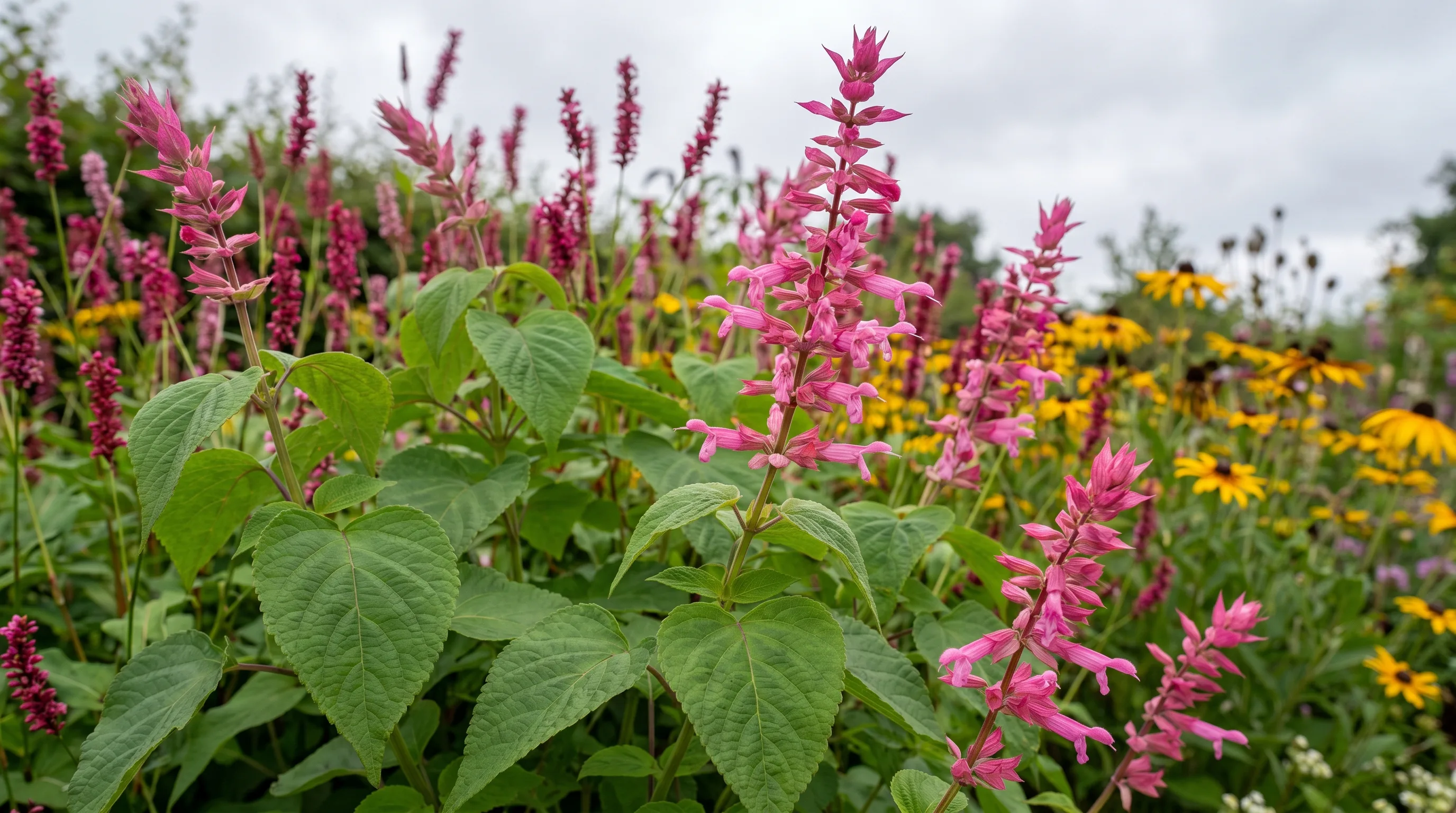
Roseleaf sage forms an upright, somewhat sparsely-branched clump that typically reaches 1.2 to 1.8 m tall and 0.9 to 1.2 m wide in a single UK growing season. In a long, warm summer it can push past 2 m. The stems are square (typical of the mint family), semi-woody at the base and frequently flushed purple. They become hollow and noticeably brittle as the season progresses, which has practical consequences for staking — see Planting and Care below.
The leaves are opposite, ovate to broadly lanceolate, 8 to 15 cm long, with a finely serrated margin and a slightly arrowhead-shaped base. The upper surface is mid-green; the underside is paler and softly hairy. Crushed leaves release a mild, vaguely sage-like aroma, though this plant is not a culinary sage and should not be treated as one.
The flowers are tubular and two-lipped in classic Salvia fashion, around 5 cm long, and a bright rosy-pink to magenta. They are borne in dense whorls at the upper nodes of the stems. The defining ornamental feature, however, is not the flowers themselves but the large, ovate, rose-pink bracts that subtend each whorl. These bracts begin green, flush pink as the flowers open, and persist on the stem for several weeks after the flowers have dropped, giving the plant a long "after-bloom" period of decorative colour. It is this involucre that the species name involucrata commemorates — Latin involucrum, a wrapper or covering.
Flowering in the UK runs from late August through October, sometimes into November in a sheltered spot. The plant is one of the latest salvias to bloom and one of the most valuable for late-season interest. Small nutlets may form in a long, hot summer, but viable seed is rarely set in UK conditions; established plants are propagated vegetatively.
Growing Conditions
Sun and aspect. Plant in full sun for the strongest flowering and the most compact habit. Light dappled shade for part of the day is tolerated but produces taller, lankier growth. A south- or west-facing aspect is ideal in the UK, and a sheltered position is essential — cold winter wind damages the top growth even where the roots survive. The base of a warm wall, the lee side of a hedge, or a courtyard garden all suit it well.
Soil. Moderately fertile, free-draining but moisture-retentive. Salvia involucrata tolerates a wide pH range (roughly 5.5 to 7.5) but it dislikes heavy, waterlogged winter ground — that is the single most common cause of plant loss in British gardens. If your soil is heavy clay, either improve drainage with generous amounts of grit and organic matter, plant on a low mound, or grow in a large container. Mulch deeply in autumn to insulate the crown.
Moisture. Even moisture through the growing season gives the best flowering display. Once established in a deeper soil, the plant tolerates short dry spells, but flowering is markedly better with consistent summer water during prolonged droughts.
Position in the garden. Middle to back of a mixed herbaceous border, the back of an exotic or "hot" border, or in a warm wall border. It combines particularly well with other late-season performers — Crocosmia, Rudbeckia, Helenium, Persicaria — and with ornamental grasses that take over as earlier perennials fade.
UK climate suitability. Excellent in coastal and urban microclimates of the south and west. Reliable in the south-east, the Midlands and East Anglia in a sheltered spot. Marginal in inland Scotland, the north of England and exposed sites, where pot culture or a conservatory overwinter is the safer option.
Planting and Care
When to plant. Plant out in late May or early June, once the risk of late frost has passed and the soil has begun to warm. Pot-grown plants from a garden centre can go in at any point in the growing season, but late spring planting gives the longest establishment period before the first winter.
How to plant. Dig a hole twice the width of the pot and to the same depth. Fork a generous spadeful of well-rotted garden compost or leaf mould into the base. Position the plant so the soil mark on the stem sits level with the surrounding ground, backfill, firm gently, and water in thoroughly. Keep watered through the first growing season, particularly in dry spells.
Mulching. Apply a thick organic mulch — 7 to 10 cm of leaf mould, garden compost or bark — in late autumn after the first frosts, once the top growth has begun to die back. This insulates the crown through winter. Pull the mulch back a little from the immediate crown in spring to prevent rot.
Spring care. New basal shoots appear late — often not until May — so do not assume the plant is dead if there is no growth in April. As the new shoots emerge, cut all old stems down to just above the new growth. In cold areas where the top growth has been killed back completely, cut to within 5 to 10 cm of ground level.
Staking. Stems are brittle and the plant is top-heavy when in full flower. Insert pea-sticks or grow-through supports in May or June, while the stems are still short enough to grow up through them. Trying to stake mature flowering stems once they have flopped almost always results in snapped stems.
Feeding. Apply a general-purpose granular fertiliser in spring as new growth begins, and switch to a high-potash liquid feed (the same type used for tomatoes) fortnightly from July through September to support the long flowering season.
Overwintering in cold areas. In colder UK regions, treat Salvia involucrata as a borderline-hardy or pot-grown specimen. Either lift and pot into a large container in autumn and overwinter in a frost-free greenhouse or conservatory, or take softwood cuttings in late summer as insurance against crown loss.
Propagation. Softwood cuttings taken in late spring to early summer root readily in two to three weeks in a propagator with bottom heat; semi-ripe cuttings in late summer are also reliable. Division of established clumps is possible but plants are slow to bulk up again afterwards, so cuttings remain the preferred method.
Common Problems
Winter wet and crown rot (caused by Botrytis and Phytophthora species) is the single biggest cause of plant loss in the UK. Prevent it by providing free-draining soil, applying a thick autumn mulch, and resisting the temptation to cut back old stems in autumn — the dead top growth provides valuable natural insulation through the worst of the winter.
Frost damage to top growth is normal in most UK winters. Plants reshoot from the base in late spring; do not write the plant off in April just because nothing is happening above ground.
Powdery mildew can appear in dry, hot spells at the end of summer on stressed plants. Improve airflow by giving the plant adequate space, water at the base rather than overhead, and avoid late-day watering onto the foliage.
Aphids (greenfly) colonise soft young shoots in late spring. They are usually controlled by natural predators within a few weeks; if numbers build up badly, a soap-based wash is sufficient.
Capsid bug can distort new growth on stressed plants but is generally a minor problem.
Slugs and snails damage emerging spring shoots. Standard UK controls — wool pellets, beer traps, night-time hand-picking — are effective.
Spittlebug (the frothy "cuckoo-spit" on stems in May and June) is purely cosmetic. Either tolerate it or wash it off with a jet of water.
Shoot brittleness is structural rather than a disease — see staking notes above. Site the plant somewhere sheltered and stake early.
Lack of flowers is almost always traceable to one of three causes: too little sun, over-rich soil producing leaf at the expense of bloom, or pruning carried out too late in the season. Address the underlying cause rather than reaching for more fertiliser.
Popular Varieties
The straight species Salvia involucrata is widely grown in the UK and is the form most often sold. Two cultivars are well documented and worth seeking out:
Salvia involucrata 'Bethellii'. The most widely planted cultivar in British gardens. It has deeper crimson-pink flowers than the species, a slightly more compact habit (around 1.2 m), and is generally considered marginally hardier. It is one of the forms most often recommended for first-time growers.
Salvia involucrata 'Hadspen'. A larger, deeper-coloured form raised at Hadspen Garden in Somerset. It produces particularly fine, richly coloured bracts and flowers and is worth searching out from specialist salvia nurseries.
A hybrid form sometimes labelled 'Boutin' has been used as a parent in several tender salvia crosses, but the resulting hybrids are sold under their own cultivar names and fall outside the scope of this entry.
Many excellent garden hybrids involve S. involucrata as a parent — crosses with Salvia microphylla, Salvia greggii and Salvia chamaedryoides have produced a wave of intermediate "involucrata-type" plants in shades from coral to deep wine. These are popular and widely available, but they should be sought and judged under their own hybrid names rather than treated as forms of the species itself.
Pests and Diseases
| Problem | Symptoms | Management |
|---|---|---|
| Root rot | Foliage turns yellow or brown and wilts despite adequate moisture, often accompanied by a general decline in vigour. | Ensure planting in well-drained soil and avoid overwatering to prevent waterlogging around the roots. |
| Powdery mildew | A white, dusty fungal growth appears on the leaves and stems, potentially causing distortion or yellowing. | Improve air circulation by spacing plants adequately and apply a suitable fungicide if infection becomes severe. |
| Slugs and snails | Irregular holes are chewed in young leaves and shoots, often accompanied by silky trails and slimy residue. | Use physical barriers like copper tape or organic pellets to protect tender new growth during damp weather. |
| Aphids | Clusters of small soft-bodied insects gather on new growth and undersides of leaves, causing curling and sticky honeydew. | Knock off infestations with a strong jet of water or treat with insecticidal soap for heavy attacks. |
| Winter damage | Foliage turns black, mushy, or desiccated after exposure to frost or wet cold conditions. | Provide winter protection such as mulch or cover for tender varieties in colder UK regions. |
For step-by-step help, read Controlling Aphids Naturally, Dealing with Slugs and Snails and Treating Powdery Mildew. Or browse the full plant problem solver to diagnose an issue by symptom.
Recommended Products
GardenWizz earns a commission from qualifying purchases made through affiliate links on this page (including links within the article) — as an Amazon Associate, and from Thompson & Morgan via the Awin network. This does not affect the price you pay. See our disclaimer for details.