Chinese Wisteria
Wisteria sinensis
The Gardening Year
Best months in UK gardens · full planting calendar →
🖨 Printable care card (PDF)At a Glance
| Botanical name | Wisteria sinensis |
|---|---|
| Common name(s) | Chinese wisteria |
| Family | Fabaceae |
| Plant type | climber (deciduous vine) |
| Height × Spread | 20–30 m × 8 m |
| Position | Full sun, Partial shade |
| Soil | moist but well-drained |
| Flowering | May–June |
| Toxicity | Wisterine |
| Native range | China (Guangxi, Guizhou, Hebei, Henan, Hubei, Shaanxi, Yunnan) |
Chinese wisteria (Wisteria sinensis) is a vigorous, woody, deciduous climbing plant native to China, widely cultivated in the United Kingdom for its dramatic cascades of fragrant, pea-like flowers in late spring and early summer. A long-lived specimen, it is capable of climbing 10 metres or more and covering substantial walls, pergolas, and outbuildings given the right support. It is one of the most recognisable flowering climbers in British gardens, though it demands firm management on account of its strength and its tendency to climb into roof spaces and gutters if neglected.
Overview
Wisteria sinensis belongs to the legume family (Fabaceae) and was introduced to European horticulture in 1816. It is a twining climber, climbing by stems that wrap clockwise around any available support, and is distinct from the closely related Wisteria floribunda (Japanese wisteria) by its shorter flower racemes, simultaneous opening of flowers along the raceme, and clockwise twining habit. Mature, well-tended plants can flower heavily for more than fifty years.
In the United Kingdom, Chinese wisteria is hardy throughout most of the country and is widely grown south of a line from roughly the Mersey to the Humber, though established plants survive further north given a sheltered position. It is regarded as an invasive risk in some warmer parts of the world but in the British climate its growth is constrained by cool summers and is generally well-behaved if pruned annually.
All parts of the plant, particularly the seeds and pods, are considered toxic if ingested. Gardeners should keep children and pets away from fallen seed pods and avoid using the cut material for animal bedding.
Appearance
Chinese wisteria is a large, twining, deciduous shrub. The leaves are pinnate, typically 25 to 35 centimetres long, divided into 7 to 13 oval leaflets with entire margins and a slightly downy underside. Young foliage emerges bronze-green in spring, darkening to a fresh mid-green through the summer before turning a clear, soft yellow in autumn.
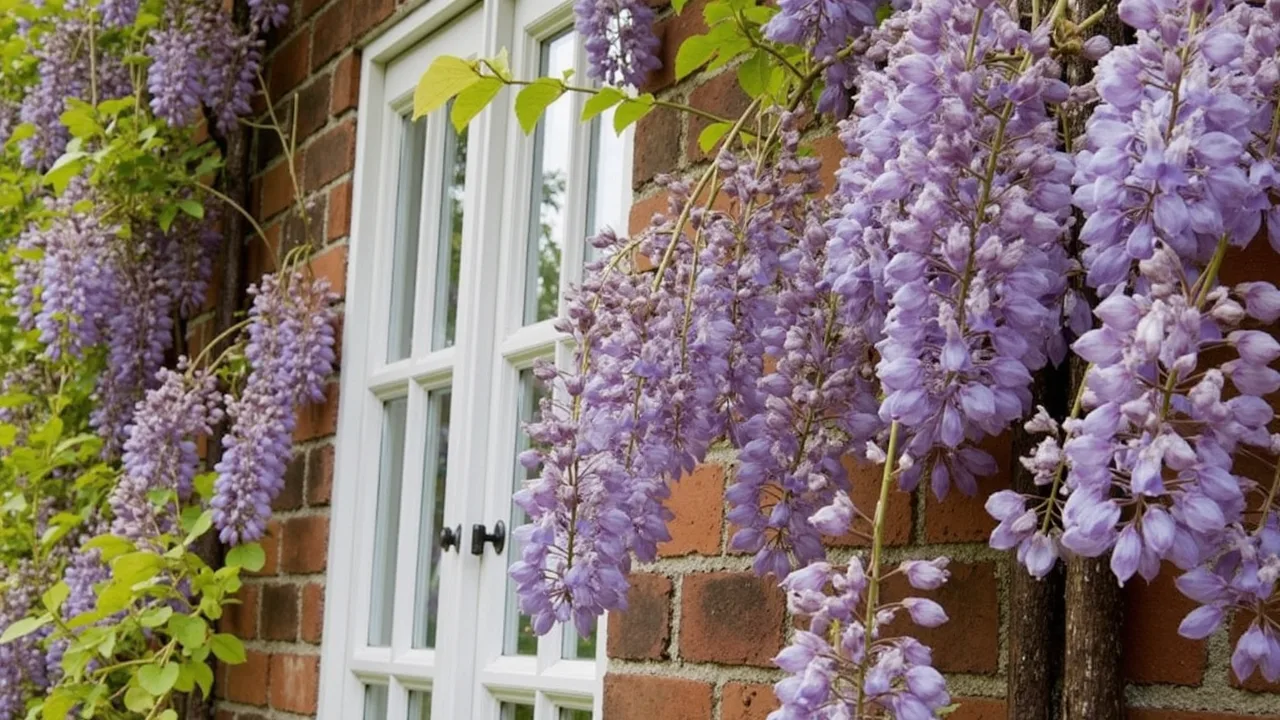
The flowers are the principal ornamental feature. They are borne in pendulous racemes 15 to 30 centimetres long, opening from the base of the raceme upwards over roughly two weeks in May and June. Individual flowers are pea-shaped, 2 to 2.5 centimetres across, in shades of lilac-blue to pale violet, with a yellow blotch at the base of the standard petal. They carry a strong, sweet, slightly musky fragrance that carries on still air.
Following successful pollination, plants produce velvety, pendant seed pods 10 to 15 centimetres long. These persist on the plant through winter and split open in spring to scatter the seeds, though seed-grown plants take many years to reach flowering size and are generally inferior to grafted or layered stock.
Growing Conditions
Chinese wisteria tolerates a wide range of soils provided they are free-draining, but it performs best in a deep, fertile loam that retains some moisture through the summer. It is unfussy about pH and grows well in mildly acidic through to chalky alkaline soils, making it suited to much of southern and central England.
A position in full sun is essential for reliable flowering. Plants grown in shade will produce vigorous foliage at the expense of blooms. A south- or west-facing wall is ideal, providing both the light and the radiant warmth that encourage flower-bud initiation. Although hardy, the flowers are vulnerable to damage by late spring frosts, so a site that is not exposed to a known frost pocket is preferable.
At maturity the plant is heavy and needs a permanent, robust support. Trellis fixed to masonry is acceptable for a small plant but a pergola, galvanised wire system, or a substantial wooden framework should be in place before planting. Support should never rely on the plant's grip alone, as a mature specimen can pull poorly fixed fittings from a wall.
The Royal Horticultural Society has not awarded Chinese wisteria a hardiness rating under the current H7 system in publicly accessible form, but the species is widely grown in gardens across the United Kingdom and is generally considered reliable in temperatures down to roughly -15 °C once established.
Planting and Care
Plant container-grown wisteria at any time between autumn and spring, avoiding frozen or waterlogged ground. Bare-root plants, occasionally offered by mail-order nurseries, should be planted from late autumn to early spring. The planting hole should be at least twice the diameter of the rootball, with the root collar at soil level. Improve heavy ground with well-rotted garden compost, though established plants tolerate ordinary garden soil.
Watering is most important in the first two growing seasons. Water deeply during dry spells to encourage roots to descend. Once established, Chinese wisteria is notably drought-tolerant and rarely needs supplementary watering in British summers.
Feeding should be restrained. Over-rich nitrogenous feeding promotes leaf at the expense of flower. A single annual application of a low-nitrogen, high-potash fertiliser such as a rose or tomato feed, applied in early spring, is generally sufficient. Mulching with garden compost in late winter helps conserve moisture and feeds the soil slowly.
Pruning is the single most important task in wisteria cultivation and is the difference between a leafy climber and a floriferous one. The method has two parts. In late summer, typically August, cut back the long, whippy current-season's growth to five or six leaves from the main framework. In midwinter, cut these shortened shoots back further to two or three buds. Flowers are borne on these shortened spurs. Neglected plants can be renovated over several years by removing dead or crossing wood and gradually reducing the framework to a manageable size.
Propagation is straightforward by layering in summer: peg a low, flexible shoot into a pot of compost sunk into the ground, sever it from the parent plant once rooted, usually after twelve months. Cultivar names do not come true from seed, so named forms must be propagated by vegetative means such as layering, basal cuttings, or grafting.
Seasonal care centres on the two pruning windows and a watchful eye for the wisteria scale insect during summer inspections. Container-grown plants need winter protection for the rootball and should be repotted every two to three years.
Common Problems
Failure to flower is the most frequent complaint and is usually attributable to one of three causes. Plants raised from seed may take fifteen years or more to bloom, so gardeners should always buy grafted or layered stock of a known-flowering form. Over-feeding with nitrogen, or pruning at the wrong time, also suppresses flowering. Wisteria pruned only in winter produces leaves but few flowers; both prunings are needed.
Wisteria scale (Eulecanium tegerrianum) is a sap-sucking insect that appears as small, brown, dome-shaped scales on the stems. Heavy infestations weaken the plant and produce sticky honeydew on which sooty mould grows. Light populations can be tolerated; severe cases respond to a winter wash of plant oil applied when the plant is fully dormant.
Honey fungus (Armillaria spp.) can attack wisteria, particularly on poorly drained sites, and is usually fatal. Plants showing mushroom clusters at the base, white mycelial fans beneath the bark, or sudden dieback should be removed and the ground rested before replanting.
Leaf spot, caused by various fungal pathogens, can mark foliage in damp summers but rarely warrants treatment. Maintaining airflow through the framework by sensible pruning reduces the risk.
Birds may nest in the dense cover; a brief check before the late-summer prune is courteous but not legally required for wisteria in England and Wales, where the relevant wildlife legislation protects active nests of all species.
Popular Varieties
The species itself is widely sold, but named cultivars are preferred for predictable flower colour, size, and habit. The following are real, established forms commonly offered by UK nurseries.
'Alba' bears pure white flowers in racemes of typical length and is the most widely grown white-flowered form of Wisteria sinensis. It is vigorous and suitable for large walls and pergolas.
'Prolific' is a Dutch selection, sometimes sold under the trade name 'Oosthoek's Variety', prized for its reliable, heavy flowering from a young age, often blooming within three to four years of planting. The flowers are a classic lilac-blue and the form is widely stocked by British nurseries.
Wisteria sinensis var. albiflora is the white-flowered botanical form from which the cultivar 'Alba' was selected. Plants raised from seed of var. albiflora vary in quality, and named stock is generally preferred, but the variety is offered by a small number of specialist woody-plant nurseries in the United Kingdom.
For smaller gardens or for training as a standard, Wisteria sinensis 'Prolific' is the most dependable choice, though grafted plants of the species on a single stem are also offered by some UK growers under the trade description "tree wisteria". Other cultivar names, including several double-flowered and variegated forms, appear in specialist lists but their UK availability varies year on year, and gardeners wishing to grow a particular named form should check current stock with their supplier.
Cultivars and Varieties
| Cultivar | Height | Flower | Notes | AGM |
|---|---|---|---|---|
| 'Alba' | — | white | — | |
| 'Amethyst' | — | reddish violet | extremely fragrant | ✓ |
| 'Prolific' | — | purple | more abundant with larger racemes, blooms at an earlier age than the traditional cultivar | ✓ |
Pests and Diseases
| Problem | Symptoms | Management |
|---|---|---|
| invasive species | — | — |
| cold sensitivity | serious dieback during cold snaps, sporadic blooming due to spring frosts | — |
Or browse the full plant problem solver to diagnose an issue by symptom.
Chinese Wisteria in our guides
- How to Grow Wisteria: Planting and Pruning
- Best Climbing Plants for UK Walls and Fences
- Small Garden Design Ideas
Recommended Products
GardenWizz earns a commission from qualifying purchases made through affiliate links on this page (including links within the article) — as an Amazon Associate, and from Thompson & Morgan via the Awin network. This does not affect the price you pay. See our disclaimer for details.