Great Basil
Ocimum basilicum
The Gardening Year
Best months in UK gardens · full planting calendar →
🖨 Printable care card (PDF)At a Glance
| Botanical name | Ocimum basilicum |
|---|---|
| Common name(s) | great basil |
| Family | Lamiaceae |
| Plant type | annual (can be grown as a short-lived perennial or biennial in warmer horticultural zones with tropical or Mediterranean climates) |
| Height × Spread | 30–150 cm × 10–50 cm |
| Position | Full sun |
| Soil | Moist but well drained soil; loam or sand; fertile; pH Acid, Alkaline, Neutral |
| Flowering | June–August |
| Toxicity | No specific toxicity is listed by the RHS. This is not a guarantee of safety — check with a vet or the ASPCA before pets or children eat any plant. |
| Native range | tropical regions from Central Africa to Southeast Asia |
Overview
Great basil (Ocimum basilicum) is a tender aromatic herb cultivated for its fragrant, glossy leaves, which are used widely in Mediterranean, Southeast Asian and Middle Eastern cookery. It is a member of the Lamiaceae (mint) family and behaves as a half-hardy annual throughout the United Kingdom, completing its life cycle in a single growing season. In the UK it is most commonly grown in containers, grow-bags and sheltered borders from late spring until the first frosts, and on warm sunny windowsills year-round. It is sensitive to cold and will not survive frost, so it is treated as a short-lived seasonal crop rather than a permanent garden plant.
Appearance
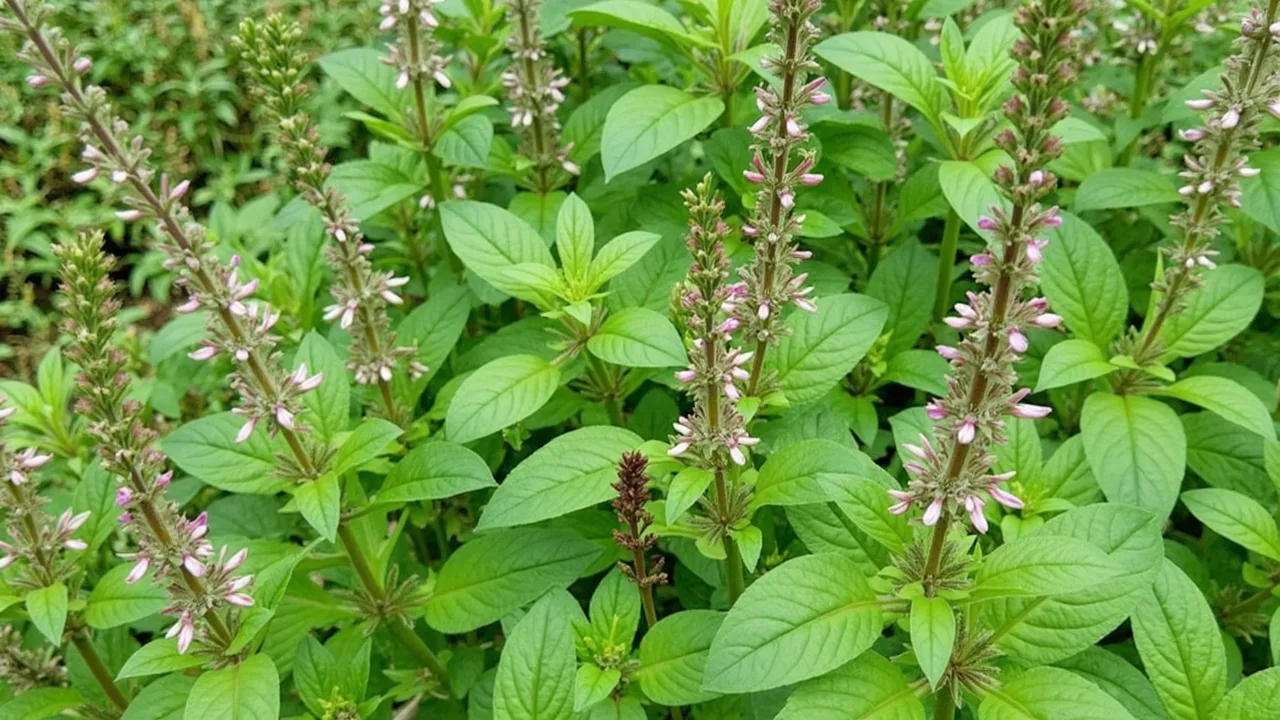
Great basil forms a bushy, well-branched plant with a single main stem that quickly produces opposite pairs of side shoots. The stems are square and slightly woody at the base on older specimens, green to faintly purple-tinged depending on cultivar. Leaves are arranged in opposite pairs, ovate to broadly lance-shaped, 3–11 cm long, with a smooth or gently toothed margin and a glossy upper surface. The leaf surface carries oil glands that release the characteristic anise-clove aroma when bruised.
Flowers appear in terminal whorls (verticillasters) arranged on spike-like racemes at the shoot tips from midsummer onwards. Individual flowers are small, two-lipped, and typically white, pale lilac or pinkish-white. If left unpinched, the plant diverts energy into flowering and the foliage becomes smaller, tougher and more pungent. In the UK, flowering is normally seen from July through to September, with viable seed forming in late summer on plants grown from a late spring sowing. The root system is fibrous and shallow, which makes the plant quick to establish but also quick to suffer in dry compost.
Growing Conditions
Great basil is a warmth- and light-demanding crop. It performs best in a sunny, sheltered position that receives at least six hours of direct sun per day. In most of the UK this means a south- or west-facing patio, a glasshouse bench, a cold frame, or a bright kitchen windowsill. The plant is not hardy: leaves blacken and die at temperatures below about 4 °C, and a frost will kill it outright. The cited RHS profile places it in H1C (heated glass, +5 °C minimum), so keep it indoors or under heated glass year-round and grow it outdoors only during the frost-free months.
Soil should be moisture-retentive but sharply drained. A peat-free multipurpose compost improved with a handful of horticultural grit works well in pots; in the ground, incorporate well-rotted garden compost into light or sandy soils, and lift heavier clay beds with grit to improve drainage. The optimum pH is approximately 6.0 to 7.5 — slightly acidic to neutral. Cold, wet compost is the most common cause of failure, particularly in early spring when plants are slow to grow.
Indoor plants appreciate steady warmth (15–24 °C) and good air circulation. Stagnant, humid air under a closed propagator lid encourages damping off and grey mould (Botrytis), so seedlings should be ventilated as soon as they germinate.
Planting and Care
Sowing. Sow indoors from late March to early May on a warm windowsill or in a heated propagator set to 18–21 °C. Surface-sow onto moist peat-free seed compost, press the seed in lightly and cover with a thin layer of vermiculite. Germination usually takes 7 to 14 days. Pot seedlings on once they have two true leaves, handling them by the leaf rather than the stem to avoid bruising.
Planting out. Wait until all risk of frost has passed — typically late May to early June across most of the UK, and a week or two later in northern or exposed sites — and harden plants off for 7 to 10 days beforehand. Space plants 20–30 cm apart in beds, or one plant per 15–20 cm pot. Water in well with a dilute seaweed feed.
Watering. Keep the compost consistently moist but never waterlogged. Water in the morning rather than the evening so that the foliage dries before night, which reduces the risk of fungal disease. Container-grown plants in summer may need daily watering during hot spells.
Feeding. Basil is a moderate to heavy feeder. Apply a half-strength balanced liquid fertiliser (such as a tomato feed) every 10 to 14 days once plants are established, switching to fortnightly when the foliage is being harvested heavily. Overfeeding with high-nitrogen fertiliser produces soft, leafy growth that is more prone to disease.
Pruning. Pinch out the growing tips once plants have four to six pairs of leaves to encourage bushy branching. Continue to pinch out flower spikes as they form, ideally back to a leaf joint, to keep the plant in active leaf production. A single plant can be kept productive for several months in this way.
Propagation. Easy from seed, as above. Stem cuttings of 8–10 cm root readily in a glass of water or in moist compost within 7 to 14 days; this is a useful way to overwinter a favourite cultivar on a windowsill.
Seasonal care. Plants in the ground should be lifted and brought indoors before the first autumn frosts, or alternatively allowed to flower late in the season to provide nectar for pollinators. On a kitchen windowsill, basil grows slowly through the winter under natural light and is best replaced each spring from a fresh sowing for the most vigorous cropping.
Common Problems
Frost and cold damage. Leaves blacken and collapse after a frost or a sudden cold snap. Move container plants indoors and cover outdoor plants with horticultural fleece if a late cold night is forecast.
Damping off. Seedlings collapse at the base, usually in cold, over-wet compost. Use fresh peat-free seed compost, water from below, and remove the propagator lid as soon as the seedlings emerge.
Fusarium wilt and Botrytis (grey mould). Stems brown at the soil line or grey fungal growth appears on damaged leaves in damp, stagnant air. Remove affected plants, improve ventilation, and avoid overhead watering.
Aphids and whitefly. Common on indoor plants and in glasshouses. A strong spray of water, biological controls (Encarsia formosa for whitefly) or insecticidal soap deal with most infestations. Basil is generally pest- and disease-free outdoors, where it is sometimes planted near tomatoes in the belief that the two make good companion plants; there is little evidence for any meaningful pest-deterrent effect, although the practice remains common in UK gardens.
Slow growth in cool summers. In poor UK summers plants may stay small and produce little usable leaf. Growing under a cloche or in an unheated glasshouse gives a more reliable harvest.
Popular Varieties
The following cultivars are widely available from UK seed suppliers, garden centres and online herb nurseries. Regional availability varies by season, and some are sold as young plug plants in spring rather than seed.
'Genovese' — the classic large-leaved Italian sweet basil, considered the standard for pesto. Tall, vigorous and strongly aromatic. Sold as seed by most UK suppliers and as potted herbs in many garden centres from late spring.
'Sweet Italian' — broadly similar to 'Genovese', with slightly broader, cupped leaves and a milder, sweeter flavour. A reliable, heavy-cropping garden variety.
'Thai' (often sold as Horapha or Thai sweet basil) — narrower, pointed leaves with a distinct anise-liquorice note and purple-tinged stems. Used in Thai, Vietnamese and Laotian cookery; widely available in the UK as seed.
'Napoletano' — a large, lettuce-leaved Italian type with crinkled foliage and a milder flavour, popular for wrapping and fresh use.
'Lemon' (sometimes sold as 'Sweet Lemon' or Ocimum × citriodorum cultivars) — a citrus-scented form useful with fish and in tea. Generally robust and easy to grow.
'Purple Ruffles' — an ornamental and culinary type with deep purple, frilled leaves. Less productive than green-leaved basils but useful for colour in salads and vinegars. Note: it is sometimes sold interchangeably with other purple-leaved basils, and the precise naming of purple cultivars in UK trade can vary between suppliers.
RHS hardiness ratings are not generally published for basil because it is treated as a half-hardy annual rather than a permanent planting. Gardeners who require an explicit rating should refer to the RHS hardiness scale and classify O. basilicum under H1c (heated glasshouse, 5–10 °C minimum) when overwintered, or as a tender annual outdoors.
Toxicity. O. basilicum is widely used as a culinary herb and is not listed as toxic to humans, dogs or cats by the ASPCA or RHS. As with many aromatic Lamiaceae, large quantities of the essential oil can be irritant, but the quantities used in normal cooking are harmless. There is no widely accepted evidence of toxicity to common UK garden animals; if a pet has consumed an unusual quantity of any garden plant, veterinary advice should be sought.
Cultivars and Varieties
| Cultivar | Height | Flower | Notes | AGM |
|---|---|---|---|---|
| 'Anise basil, Licorice basil, or Persian basil (O. basilicum ' | — | — | — | |
| 'Cinnamon basil (Ocimum basilicum 'Cinnamon')' | — | — | — | |
| 'Dark opal basil (Ocimum basilicum 'Dark Opal')' | — | — | — | |
| 'Genovese basil or Sweet Basil (Ocimum basilicum)' | — | — | — | |
| 'Globe basil, dwarf basil, French basil (Ocimum basilicum 'Mi' | — | — | — | |
| 'Greek basil (Ocimum basilicum var. minimum)' | — | — | — | |
| 'Lettuce leaf basil (Ocimum basilicum 'Crispum')' | — | — | — | |
| 'Purple Delight' | — | — | purple leaves |
Pests and Diseases
| Problem | Symptoms | Management |
|---|---|---|
| Fusarium wilt | soil-borne fungal disease that will quickly kill younger basil plants | — |
| Pythium damping off | seedlings may be killed by Pythium damping off | — |
| Gray mold (Botrytis cinerea) | common foliar disease of basil | — |
| Black spot (Colletotrichum genus) | seen on basil foliage | — |
| Downy mildew (Peronospora belbahrii) | significant disease | — |
For step-by-step help, read Treating Powdery Mildew and Tackling Black Spot on Roses. Or browse the full plant problem solver to diagnose an issue by symptom.
Companion planting
✔ Grows well with: tomato.
Full companion planting chart →
Great Basil in our guides
Recommended Products
GardenWizz earns a commission from qualifying purchases made through affiliate links on this page (including links within the article) — as an Amazon Associate, and from Thompson & Morgan via the Awin network. This does not affect the price you pay. See our disclaimer for details.