Pear
Pyrus communis
The Gardening Year
Best months in UK gardens · full planting calendar →
🖨 Printable care card (PDF)At a Glance
| Botanical name | Pyrus communis |
|---|---|
| Common name(s) | Pear |
| Family | Rosaceae |
| Plant type | tree (Deciduous) |
| Height × Spread | 4–8 m × 2.5–8 m |
| Position | Full sun |
| Soil | deep, fertile, moist but well-drained, fairly neutral soil; clay, loam, or sand; pH acid, alkaline, or neutral (will not thrive on very acid soils) |
| Flowering | March–May |
| Toxicity | No specific toxicity is listed by the RHS. This is not a guarantee of safety — check with a vet or the ASPCA before pets or children eat any plant. |
| Native range | central and eastern Europe, and western Asia |
Overview
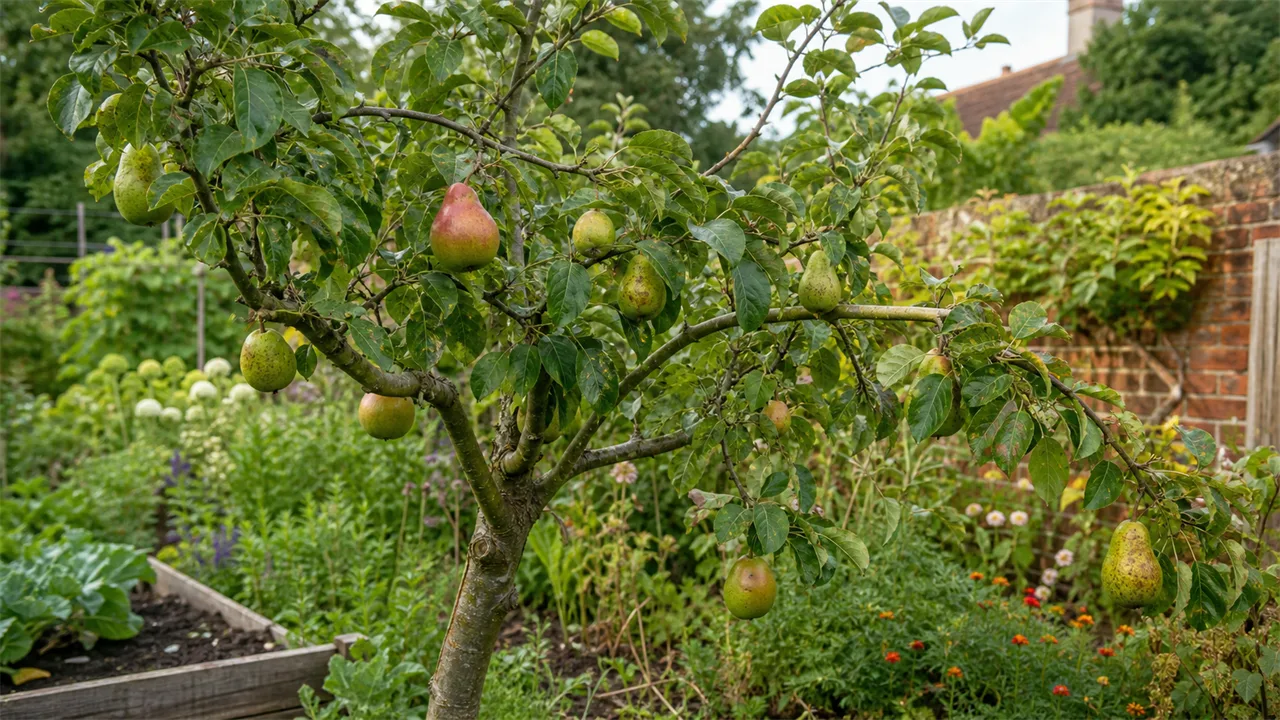
The European pear, Pyrus communis, is one of the oldest cultivated fruits in Britain and one of the most rewarding trees for the home grower. Established in English gardens by the Norman period and refined through a thousand years of grafting and selection, it produces fruit of extraordinary flavour when tree-ripened — nothing like the hard, grainy supermarket pears most UK shoppers know.
Pears crop reliably in years when apples fail, suffer fewer major pest and disease problems, and at peak ripeness are unmatched for flavour. The trade-off is that they demand more warmth and shelter than apples and must be picked firm to ripen indoors. Growers in the south, the Midlands and the warmer parts of Wales will find pears straightforward; growers in the north, in Scotland and at altitude need early-ripening cultivars and a sheltered, sunny aspect.
This guide covers the full UK growing cycle for dessert pears — choosing and siting a tree, planting, growing-season care, harvest and ripening — with regional timing for England, Wales, Scotland and Northern Ireland.
Sowing
Pear trees are not grown from seed for fruit production — seedling pears do not come true to type, and a pear grown from a pip will take 15–20 years to fruit, with poor-quality fruit. In commercial and amateur UK orchards, pears are propagated by grafting a scion (the cultivar wood) onto a rootstock, and trees are bought as one- or two-year-old maidens from a fruit nursery.
When to plant. Bare-root pear maidens are planted during the dormant season, from late October through to mid-March, provided the ground is not frozen or waterlogged. In mild southern England and the south-west, planting from late October to December gives the best root establishment before spring; in colder regions (the north, Scotland, exposed sites), leave planting until February or early March when the worst of the winter is past and the soil is starting to warm. Container-grown pears can be planted at any time of year, but spring and autumn are still preferable because watering through a hot summer is onerous.
Choosing a rootstock. UK pear rootstocks are limited compared with apples, but two main choices exist. Quince A is the standard semi-vigorous rootstock, producing a tree roughly 4–5 m tall at maturity — manageable for most gardens but needing space. Quince C is more dwarfing, giving a tree of about 2.5–3.5 m, suitable for smaller gardens and cordons; it needs permanent staking and richer soil. Pyro dwarf is a newer option giving a compact tree, useful for very small gardens or large containers (use a pot at least 60 cm deep). On cold, wet or shallow soils, Quince A is more tolerant than Quince C.
Pollination. Most European pears are partially self-fertile but crop far better with a pollination partner. Because UK pears flower earlier than apples — late March to mid-April in the south, often into May further north — they benefit from a sheltered site to protect blossom from frost and wind. Plant at least two compatible cultivars within 18 m, or grow near a neighbour's pear or a suitable ornamental pear (ornamental pears, including `Pyrus calleryana`, flower at the same time and can act as pollinators). Cultivars in the same or adjacent pollination groups will cross-pollinate; check the nursery's pollination table.
Sowing (planting) windows by UK region.
- South-west England, south coast, London, East Anglia: November to early March, with November–December ideal.
- Midlands, south Wales, central southern England: late November to late February.
- Northern England, north Wales, Yorkshire, Lancashire: December to late February, avoiding the coldest spells.
- Scotland (lowland and central belt): late January to mid-March.
- Scotland (upland, north-east, Caithness): wait until February to early March; site selection becomes critical.
- Northern Ireland: December to mid-March.
Planting method. Dig a hole wider than the root spread and the same depth as the tree stood in the nursery — the soil mark on the trunk should sit flush with the soil surface. Do not bury the graft union; it should remain at least 10 cm above the soil. Drive a sturdy stake in before planting (so roots aren't damaged) and tie the maiden with a tree tie, allowing a little movement. Backfill with the original soil, firm gently, water in well, and mulch with a 5 cm layer of well-rotted compost or manure over a 1 m radius, keeping it clear of the trunk.
Spacing. Quince A trees: 4–5 m apart in the open; 3.5 m in a fan against a wall. Quince C cordons: 60–90 cm apart on a support wire. Fan-trained pears against a south- or west-facing wall: 4–5 m of wall space per tree.
Growing
Formative pruning, years 1–4. A pear maiden should be headed at about 75 cm above the ground after planting, just above a sound bud, to encourage a balanced framework of three or four main branches. In subsequent winters, build up an open-centred or modified-leader shape, removing any crossing or inward-growing wood and shortening laterals by about a third. Pears fruit on two-year-old and older wood, plus on short spurs — be careful not to over-shorten. Summer pruning (late July to mid-August) of laterals to five or six leaves helps build fruiting spurs for the following year.
Watering and feeding. Young pears (first three years) need watering through dry spells in their first two summers to establish. Established trees in the open ground are largely drought-tolerant but benefit from a soak during extended dry periods in July and August, when fruit is sizing up. Feed in late winter with a balanced general fertiliser, then top-dress in spring with a mulch of well-rotted manure or compost — avoid high-nitrogen feeds, which promote soft growth susceptible to fireblight and pear rust.
Weeding and mulching. Keep a 1 m weed- and grass-free circle around young trees; grass competition is the single biggest cause of slow growth in newly planted fruit trees. Renew the mulch each spring, keeping it clear of the trunk to prevent collar rot.
Pests and diseases. The main UK issues are pear rust (orange spots on leaves, transferred to junipers — avoid planting near junus or remove infected ones nearby), pear scab (similar to apple scab, dark olive blotches on fruit and leaves — worse in wet summers), fireblight (bacterial, deadly — notify the plant health authorities if suspected; pruning out infected wood 60 cm below visible infection, sterilising tools between cuts), pear midge (tiny maggots in young fruitlets, causing them to drop blackened in early summer — pick up and destroy affected fruitlets), and codling moth (treat as for apples, late June–July). Birds, especially starlings and blackbirds, will peck ripening fruit; netting small trees or growing cordons under fruit cages is effective.
Thinning. Once a pear crop sets, thin in early to mid-July to one fruit per cluster and 10–15 cm between fruit on the branch. Thinning improves size, reduces branch breakage, and helps prevent biennial bearing. A heavy `Conference` crop may need further thinning in late July.
Conditions. Pears prefer a deep, free-draining, moisture-retentive loam, slightly acidic to neutral (pH 6.0–7.0), and a sheltered, sunny site. South-, south-west- or west-facing walls or fences are ideal for fan training and significantly extend the viable growing range into colder regions. Avoid frost pockets and exposed sites — pear blossom is more frost-tender than apple. Pears do not tolerate waterlogged ground; on heavy clay, plant on a shallow mound or in a raised bed, and use Quince A rather than Quince C.
Recommended cultivars for UK growers (planted inline, not as an ornamental table):
- `Conference` — the UK's most widely grown pear; self-fertile, heavy cropping, reliable in cooler summers, good flavour when properly ripened. The default choice for new growers.
- `Concorde` — a `Conference` × `Doyenné du Comice` cross, self-fertile, with `Comice`'s better flavour and `Conference`'s cropping reliability. Excellent garden choice.
- `Doyenné du Comice` — the connoisseur's pear, large melting fruit with rich flavour, but needs a warm site and a pollination partner; better in the south and south-west.
- `Williams' Bon Chrétien` (sold as `Bartlett` abroad) — the classic early-season pear; needs warmth, partially tip-bearing, best against a wall in cooler regions.
- `Beurré Hardy` — reliable mid-season, good flavour, partially self-fertile, decent cold tolerance.
- `Beth` — early-ripening dessert pear suited to cooler regions and shorter seasons; reliable in the north.
- `Onward` — later mid-season, heavy crops, good for cooler sites; needs a pollination partner.
Harvesting
When to pick. Pears do not ripen properly on the tree — the flesh becomes gritty and the core breaks down. Pick when the fruit is mature but still firm. Signs of readiness: the fruit separates easily from the spur when lifted and twisted gently (if you have to pull, leave it a few more days); the lenticels (skin pores) become more prominent and the skin lightens slightly; pips inside turn from white to brown at the wide end. Underpicked pears will shrivel in storage; overpicked ones will never ripen properly.
UK harvest windows by region and cultivar.
- Early cultivars (`Beth`, `Williams' Bon Chrétien`): mid-August to early September in the south; late August to mid-September in the Midlands; early to mid-September in the north; often too late to ripen properly in upland Scotland.
- Mid-season (`Conference`, `Concorde`, `Onward`, `Beurré Hardy`): late August to late September in the south; mid-September to early October in the Midlands and the north; late September to mid-October in lowland Scotland.
- Late cultivars (`Doyenné du Comice`, `Glou Morceau`, late-ripening `Conference` strains): mid-September to mid-October in the south; often only reliable against a south-facing wall elsewhere.
Pick on a dry day, handling the fruit gently to avoid bruising, and place (do not drop) into shallow trays.
Ripening indoors. Bring picked pears indoors and keep at 15–18 °C for a few days; they should yield gently to pressure at the stalk end when ripe. To speed ripening, place in a paper bag with a banana; the ethylene accelerates the process. Once ripe, eat within two or three days — ripe pears deteriorate quickly.
Eating
Pears are at their best eaten fresh, fully ripened, when the flesh is yielding and aromatic. Peeled or unpeeled, with a sharp cheese (Stilton, aged Cheddar, Wensleydale), they are a classic British combination; with cured ham or prosciutto they need no accompaniment.
In the kitchen, pears hold their shape better than apples in tarts, tatin and galettes, and are superb poached in red wine, spiced cider or a light syrup with cinnamon, star anise and a strip of lemon peel. They pair naturally with ginger, almond, chocolate, vanilla and black pepper. Classic British dishes include Tarte aux Poires, pear and ginger cake, pear chutney alongside cold meats and cheese, and pear crumble with a handful of crushed hazelnuts in the topping.
Storing
Late-season dessert pears keep for several weeks if picked slightly under-ripe, wrapped individually in newspaper and laid in single layers in shallow trays in a cool, dark, frost-free place — an unheated garage, shed or cellar at 4–7 °C is ideal. Check weekly and remove any showing rot; one bad pear taints the rest. `Conference` and `Concorde` keep longest, often to Christmas or beyond; `Williams'` keeps for only two or three weeks.
For longer storage, pears bottle well in light syrup, freeze as cooked purée for sauces and cakes, and make excellent pear chutney, spiced pear pickle and perry (the traditional fermented pear drink, made from perry pears rather than dessert cultivars). Sliced and dried in a dehydrator or very low oven, pears produce excellent leather and dried slices for winter compôtes.
Supporting
Pear trees, like apples, benefit from permanent staking for the first five years on exposed sites and for life on Quince C rootstock. Use a single 1.8 m treated stake driven 60 cm into the ground at planting, with a proper tree tie that allows some movement. Train the stake firmly to the trunk and check ties annually as the trunk thickens.
Fan-trained pears against a wall need a horizontal support wire system: fix galvanised wires at 30 cm vertical intervals, starting 30 cm above the ground, and tie in new summer growth in mid- to late July as it develops. Replace ties annually — old twine cuts into swelling shoots.
Cordons need a permanent post-and-wire framework, with the cordon tied to a cane attached to the wire. This is the most space-efficient way to grow several pear cultivars in a small garden.
Pests and Diseases
| Problem | Symptoms | Management |
|---|---|---|
| Pear rust | Bright orange spots appear on leaves and stems, often linked to nearby juniper hosts. | Remove infected junipers or prune out cankers; avoid fungicides to protect biodiversity. |
| Apple and pear scab | Olive-green to black velvety spots develop on leaves, shoots, and fruit skin. | Rake up fallen leaves in autumn and apply lime sulphur spray in winter. |
| Pear blister mite | New foliage shows raised pink or yellowish-green blisters that turn blackish-brown. | No control is necessary as damage is cosmetic and does not affect tree health. |
| Fireblight | Shoots wilt suddenly, turning brown and curling into a characteristic shepherd's crook shape. | Prune out infected branches well below the visible damage during dry weather. |
| Brown rot | Blossoms wilt and turn brown, while fruit develops soft, brown rot with fungal spores. | Remove all fallen and mummified fruit to reduce overwintering spore sources. |
| Aphids | Clusters of small green or black insects suck sap from new growth, causing leaf curling. | Encourage natural predators like ladybirds or use a strong jet of water to dislodge them. |
For step-by-step help, read Controlling Aphids Naturally. Or browse the full plant problem solver to diagnose an issue by symptom.
Pear in our guides
- How to Grow Turnips in the UK: A Complete Guide
- Gardening Jobs for November in the UK
- Codling Moth: How to Protect Apples and Pears
- Monty Don tells gardeners to complete important task on fruit trees
Recommended Products
GardenWizz earns a commission from qualifying purchases made through affiliate links on this page (including links within the article) — as an Amazon Associate, and from Thompson & Morgan via the Awin network. This does not affect the price you pay. See our disclaimer for details.