Japanese Primrose
Primula japonica
The Gardening Year
Best months in UK gardens · full planting calendar →
🖨 Printable care card (PDF)At a Glance
| Botanical name | Primula japonica |
|---|---|
| Common name(s) | Japanese Primrose |
| Family | Primulaceae |
| Plant type | perennial (Herbaceous perennial that dies back to below ground level each year in autumn, then fresh new growth appears again in spring.) |
| Height × Spread | 30–60 cm × 25–30 cm |
| Position | Full sun, Partial shade |
| Soil | deep moist or moist but well-drained neutral to acid, humus-rich soil |
| Flowering | May–June |
| Toxicity | — |
| Native range | Japan |
Overview
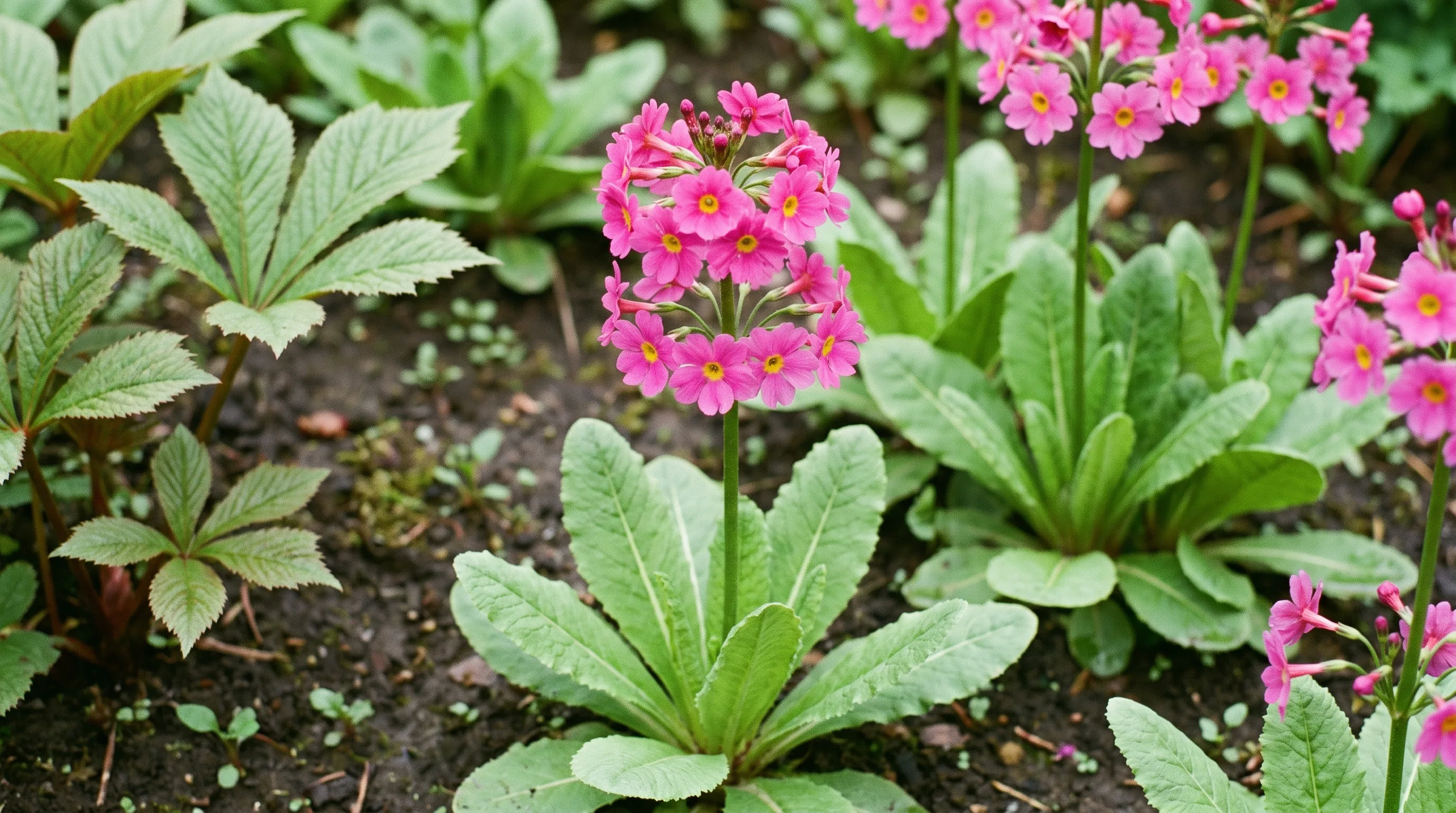
Primula japonica, the Japanese primrose or candelabra primrose, is a rosette-forming herbaceous perennial from the Primulaceae family, native to damp mountain streamsides across Honshu, Shikoku and Kyushu in Japan. It belongs to the Proliferae (candelabra) section of Primula, the group defined by tiered whorls of flowers opening successively up a single stem — a form that has made it, and its near relatives P. pulverulenta, P. beesiana and P. bulleyana, indispensable in the British bog garden since the late nineteenth century. In the UK it has naturalised in cool, damp districts of Scotland, Ireland, northern England and Wales, where self-sown drifts form in ditches, by streams and along the edges of old estate plantings.
Its place in the garden is sharply defined by one requirement: moisture. Given reliably damp, humus-rich ground and dappled light it is one of the easiest and most rewarding late-spring perennials; given dry shade or thin soil it sulks and disappears within a season. UK gardeners value it chiefly for the way its flowering scapes rise in late spring and early summer, holding tier after tier of bloom above basal rosettes of crinkled green leaves, and for the way it seeds itself about once established into colonies that increase year on year with almost no effort.
Appearance
The plant forms a single, leafy basal rosette, sometimes a small offset cluster, of obovate to oblong, soft and conspicuously wrinkled mid-green leaves up to about 20 cm long, with irregularly toothed margins. From the centre of this rosette rises an erect, sturdy flowering scape, typically 45–60 cm tall, occasionally taller in rich damp ground, carrying three to six distinct whorls of flowers spaced at intervals up the stem. Each whorl bears five to fifteen flowers, and the whorls open in sequence from the lowest upwards, so a single plant can be in flower for four to six weeks between late spring and midsummer — generally from about mid-May through to early July across most of the UK, with Scottish and northern gardens running a couple of weeks later.
Individual flowers are flat-faced and five-petalled, roughly 2–3 cm across, with a notched petal tip and a pale or yellow eye. In the wild type they are a deep magenta to red-purple, but in cultivation white, pale pink and crimson forms are common and seed-raised stocks will usually produce a colour mix unless isolated. The overall spread of a mature clump at flowering is about 30–45 cm. The plant dies back completely in late autumn and overwinters as a resting crown, sending up fresh foliage from late winter onward.
Growing Conditions
Japanese primrose thrives in dappled shade, ideally at the edge of woodland or on the north or east side of a building where light is filtered and the soil stays cool. It will tolerate full sun in the UK only where the ground beneath it remains damp through summer — pond margins, bog gardens, the lower end of a rain-fed border — and it resents the combination of direct midday sun and drying wind that scorches the soft leaves.
Soil should be humus-rich, moisture-retentive and slightly acidic to neutral; deep loam improved annually with leaf mould or well-rotted garden compost is ideal. Thin, sandy or free-draining soils, and dry chalk, are unsuitable without heavy modification and continuous irrigation. The plant tolerates mildly alkaline conditions provided the soil is deep, organic and never short of water, but the most reliable growth is on acid to neutral ground.
The defining cultural requirement is moisture at the root throughout the growing season. Established plants in genuinely damp ground need no watering; plants in ordinary borders need deep soaking in any dry spell from late spring through summer, because drought one year typically means failure to flower the next. A sheltered aspect, out of cold drying winds, matters more than absolute minimum temperature; the plant shrugs off British winters in boggy ground but suffers in cold dry sites.
Planting and Care
Plant container-grown stock in autumn or early spring, setting the crown at or just below the soil surface into ground that has been thoroughly prepared with garden compost or leaf mould to at least a spade's depth. Space clumps roughly 30–45 cm apart to allow each rosette room to expand, or closer if you want a quicker colony effect, since mature plants will jostle and self-seed regardless. In a bog garden set the crowns at the same level as the surrounding soil, not on ridges.
Watering is the single most important routine task: water copiously in any dry spell from late spring through summer, soaking the ground rather than sprinkling the foliage. Apply a slow-release general fertiliser, or a mulch of well-rotted garden compost, in spring as new growth emerges; avoid high-nitrogen feeds, which produce soft leafy growth at the expense of flower.
Propagation is overwhelmingly by division and by self-sown seedlings. Lift and divide clumps every two to three years in early autumn (September–October), immediately after flowering has finished, teasing the rosettes apart and replanting into freshly mulched, damp ground. This is essential rather than optional: candelabra primulas are naturally short-lived, and a clump that is not divided will often exhaust itself and vanish after three or four seasons. Saved seed germinates readily if sown fresh in autumn and overwintered outside; named cultivars will not come true from seed and must be propagated by division.
Cut back the spent flowering scapes once the topmost whorl has finished, typically in mid- to late summer, cutting to the base of the rosette. Tidy yellowing and dead basal leaves in late autumn (October–November) once the plant has fully died back, clearing debris from the crown to reduce overwintering botrytis. Mulch annually in spring with leaf mould or compost to conserve moisture and feed the soil.
In the UK the natural flowering season is roughly mid-May to early July in southern and central districts, running about two weeks later in the north and in Scotland.
Common Problems
Slugs and snails are the main nuisance, attacking emerging spring foliage in damp conditions and disfiguring leaves right through the growing season; in heavy infestations the plants can be defoliated almost overnight. Vine weevil adults notch the leaves in summer, and the larvae can damage roots at the base of clumps in autumn and in container-grown stock. Aphids colonise flowering scapes in late spring and can check growth if left unchecked. Red spider mite appears occasionally in hot dry summers, almost always on plants already under moisture stress.
Fungal problems include botrytis (grey mould) on overwintering rosettes in poorly ventilated, wet sites, and leaf spot fungi (Ramularia, Cercospora), which produce discoloured spots on foliage in prolonged wet weather. Crown rot and root rot, caused by Phytophthora and Pythium, are not problems in genuinely flowing bog conditions but appear in stagnant, waterlogged ground where drainage has failed, or in old containers with degraded compost. There is no cure for primula mosaic virus or cucumber mosaic virus, which cause mottling, distortion and stunting; affected plants should be lifted and destroyed to limit spread via sap and aphids.
A colony that dwindles and disappears after three or four years is not always diseased: candelabra primulas are constitutionally short-lived and will self-perish if not divided on the rotation described above.
Popular Varieties
The wild type of Primula japonica is a rich magenta to red-purple and is itself widely grown, but the most familiar garden forms are colour selections within the species, often sold as mixed seedling strains. The most reliably available are:
- P. japonica 'Miller's Crimson' — a deep, clear crimson selection, considered one of the best reds in the candelabra group; vigorous and reasonably true from division.
- P. japonica 'Postford White' — a clean white with a yellow eye; one of the standard whites for the bog garden and a reliable partner for crimson and magenta forms.
- P. japonica 'Apple Blossom' — pale pink with a deeper pink eye; softer in effect than the magenta or crimson forms and useful in pastel plantings.
- P. japonica 'Alba' — the straight white form, slightly variable in height but consistent in colour.
- Mixed candelabra seed strains — widely sold as Primula japonica hybrids or candelabra primula mixtures, drawing on P. japonica, P. pulverulenta, P. beesiana and P. bulleyana to give a colour run from cream and pale pink through to deep crimson and purple; excellent for naturalising in damp meadow or streamside plantings where a mixed drift is wanted rather than a single colour.
Within the candelabra group as a whole, Primula pulverulenta (mealy-stemmed candelabra, deep pink to wine red), Primula beesiana (rosy lilac, late flowering) and Primula bulleyana (orange, the earliest of the section to flower) are often grown alongside P. japonica and hybridise freely with it in mixed plantings, extending the candelabra season from late April into late July.
Pests and Diseases
| Problem | Symptoms | Management |
|---|---|---|
| Leaf spot (Ramularia, Pseudomonas) | Circular brown or black spots appear on leaves during wet weather, sometimes falling out to leave holes. | Remove and destroy infected foliage immediately and improve air circulation around the plant. |
| Primula rust (Puccinia primulae) | Clusters of tiny, cup-like orange or brown spore structures form on the undersides of leaves. | Prune out affected leaves as soon as symptoms are noticed to prevent spread. |
| Slugs and snails | Irregular holes chewed in leaves and flowers, often accompanied by silky trails and slime. | Use physical barriers like copper tape or apply iron phosphate-based pellets around the base. |
| Vine weevil | Notched edges on leaves above ground and root damage below, causing wilting in potted plants. | Apply systemic insecticides to soil or use biological controls like nematodes in early autumn. |
| Aphids | Clusters of small green or black insects on new growth and flower buds, causing distortion. | Squash by hand or blast off with a strong jet of water; encourage natural predators like ladybirds. |
For step-by-step help, read Controlling Aphids Naturally, Dealing with Slugs and Snails and Tackling Black Spot on Roses. Or browse the full plant problem solver to diagnose an issue by symptom.
Recommended Products
GardenWizz earns a commission from qualifying purchases made through affiliate links on this page (including links within the article) — as an Amazon Associate, and from Thompson & Morgan via the Awin network. This does not affect the price you pay. See our disclaimer for details.