Sweet Pea
Lathyrus odoratus
The Gardening Year
Best months in UK gardens · full planting calendar →
🖨 Printable care card (PDF)At a Glance
| Botanical name | Lathyrus odoratus |
|---|---|
| Common name(s) | sweet pea |
| Family | Fabaceae |
| Plant type | climber (Annual; dies after setting seed.) |
| Height × Spread | 1–2 m × 10–50 cm |
| Position | Full sun |
| Soil | fertile soil that drains easily |
| Flowering | June–August |
| Toxicity | The seeds and pods are toxic (can cause lathyrism) — do not eat; grown as an ornamental. (RHS: harmful if eaten.) |
| Native range | Sicily, southern Italy and the Aegean Islands |
Overview
Sweet pea (Lathyrus odoratus) is an annual climbing plant grown across the United Kingdom for its strongly scented, brightly coloured flowers. Native to the eastern Mediterranean — Sicily, Cyprus and the Aegean — it was introduced to British gardens in the late seventeenth century and has since become a staple of the cottage garden, the cut-flower border and the competitive show bench. Sweet peas are valued for their long flowering season, their suitability for training on obelisks, canes and trellis, and the quality of their perfume, which is most pronounced in older and heritage cultivars.
The plant is a member of the legume family (Fabaceae) and, like other legumes, forms a symbiotic relationship with nitrogen-fixing root-nodule bacteria. This allows it to thrive in reasonably poor soils without heavy feeding early in life. Although technically a perennial in mild climates, Lathyrus odoratus is cultivated almost exclusively as an annual in the UK, completing its life cycle in a single growing season.
Sweet peas are widely grown in gardens of all sizes and are equally suited to allotment rows, large containers and small courtyard patios. They are one of the standard plants offered by UK seed merchants each autumn and winter, with sowings typically made between October and April depending on the method used.
Appearance
Sweet pea is a climbing annual that uses slender, modified leaf-tip tendrils to clamber over supports. Stems are winged and can reach 1.8 to 2.4 metres in typical garden cultivars, though dwarf forms stay below 45 centimetres. The leaves are pinnate, composed of a pair of oval leaflets and a branched terminal tendril, light to mid-green in colour and slightly glaucous.
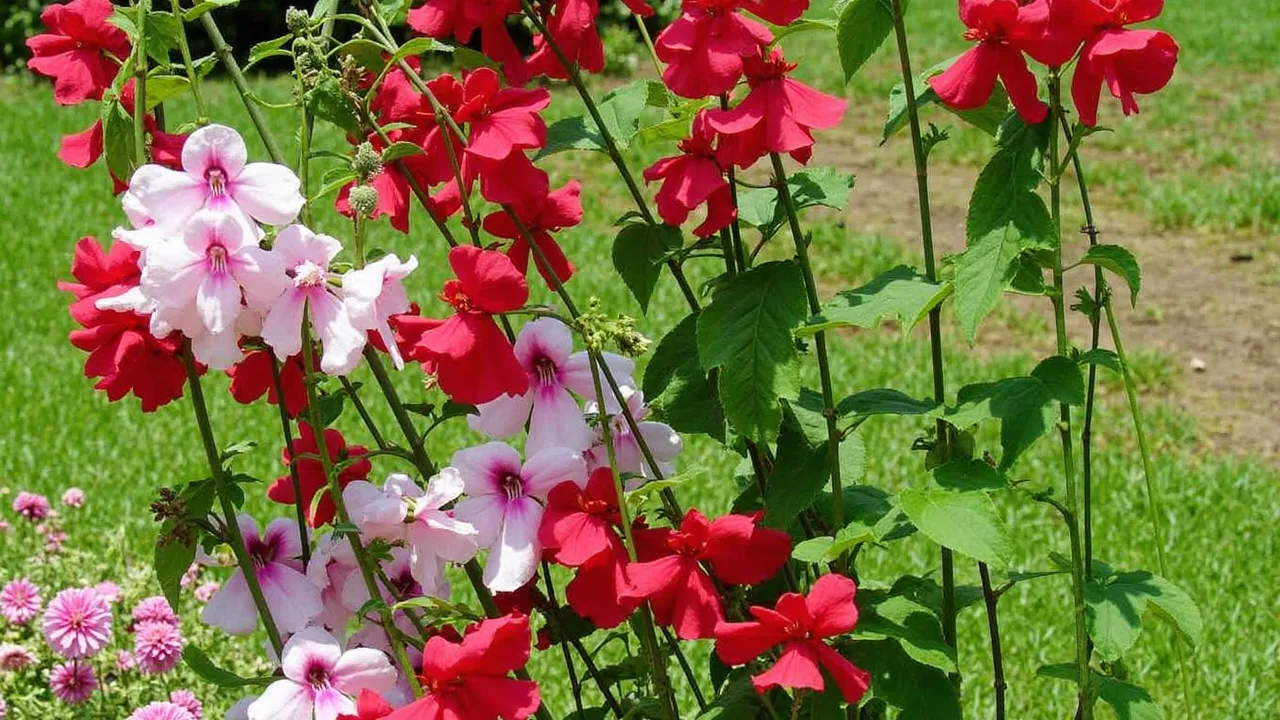
The flowers are borne in clusters of three to five on long, stiff stems (peduncles) held well clear of the foliage — a feature prized by exhibitors. Each flower has a large, often waved or ruffled standard petal at the top, two wing petals, and a lower keel. Colours range across white, cream, pink, carmine, lavender, blue, purple, maroon, bicolour and picotee patterns. Many modern cultivars have been bred for larger, more numerous florets per stem, while heritage types tend to have smaller but more strongly scented blooms.
The fruits are elongated seed pods, hairy when young, drying to a pale buff colour at maturity. Each pod typically contains six to ten round, hard-coated seeds, which are usually brown, grey or black depending on the cultivar. Sweet pea seeds resemble small dried peas.
It is important to distinguish the ornamental sweet pea (Lathyrus odoratus) from the unrelated everlasting pea (Lathyrus latifolius) and from edible garden peas (Pisum sativum). Only the latter is a food crop; the seeds and pods of L. odoratus are not eaten and are generally regarded as toxic if consumed in quantity.
Growing Conditions
Sweet peas perform best in an open, sunny position that receives at least six hours of direct light in midsummer. They tolerate very light shade, but flowering is reduced and stems become leggy in deeply shaded sites. A sheltered spot is helpful on exposed northern and western sites, where strong winds can snap the soft growth.
Soil should be free-draining yet moisture-retentive. Sweet peas dislike waterlogged ground, particularly in winter, where the roots are prone to rot. They are tolerant of a wide pH range, growing satisfactorily in soils from mildly acidic (around pH 6.0) to mildly alkaline (around pH 7.5), provided drainage is adequate. Soil that has been enriched for a previous crop is ideal; freshly manured or heavily nitrogen-fed ground tends to produce lush foliage at the expense of flowers.
RHS hardiness: sweet peas are grown as annuals and are not assigned a fixed RHS hardiness rating in the usual sense. They are killed by sharp frost and are treated as half-hardy.
In the UK, the active growing season runs from late February or March (for spring sowings) through to October. Flowering typically begins in late May or June for autumn-sown plants and continues until the first hard frost in autumn, often October or early November in southern England.
Planting and Care
Sowing. Sweet peas can be sown either in autumn (October to November) for sturdier plants and earlier flowers, or in spring (January to April). Autumn sowings are usually made in deep pots or root-trainers and overwintered in a cold frame or unheated greenhouse. Spring sowings can be made under cover or directly outdoors once the soil has warmed. Seeds have a hard coat; nicking the seed coat opposite the eye with a file or sharp knife (chipping) can speed germination, though it is not strictly necessary. Soaking seeds in tepid water for several hours before sowing is a common alternative.
Planting out. Harden off autumn-sown plants in early spring and plant out once the risk of hard frost has passed, typically from late March to mid-April in most of lowland Britain. Space plants 15 to 20 centimetres apart at the base of their support. Canes, hazel brush, obelisks, trellis panels and pea netting are all suitable; the taller the support, the taller the plants will grow.
Watering. Consistent moisture is important once plants are in active growth. Water deeply during dry spells, aiming to keep the soil evenly moist rather than saturated. Container-grown sweet peas dry out quickly and usually need watering once a day in warm weather, sometimes twice.
Feeding. Sweet peas benefit from a high-potash feed once flowering begins. A liquid tomato fertiliser applied every seven to ten days is a common choice. Avoid high-nitrogen fertilisers, which encourage leafy growth at the expense of blooms. Because sweet peas fix some of their own nitrogen, additional nitrogen feeding is rarely required.
Pruning and training. Tie in young stems to their support every week or so until the tendrils take hold. Pinch out the growing tip of each seedling once two or three pairs of leaves have formed to encourage bushy basal growth. For exhibition plants, laterals are restricted to a single stem by removing side shoots. Deadheading is essential: remove spent flowers at least twice a week to prevent seed-set, which would otherwise shorten the flowering season.
Propagation. Sweet peas are raised from seed each year and are not normally propagated by cuttings. Saved seed comes true to type for heirloom varieties but crosses readily between cultivars, so seed collected from modern F1 hybrids will not be uniform.
Seasonal care. Cut flowers for the house regularly — the more you cut, the more the plant produces. In late summer, mulch the base of the plants with garden compost to conserve moisture and keep roots cool. Once flowering finishes and the plants begin to die down in autumn, cut stems at ground level and add them to the compost heap, leaving the nitrogen-rich roots in the soil for the next crop.
Common Problems
Seedling failure. Seeds sometimes rot before germinating, particularly in cold, wet compost. Chipping the seed coat and using fresh, free-draining seed compost reduces this risk.
Aphids. Greenfly and blackfly commonly colonise young shoot tips. Heavy infestations distort growth and can transmit virus. Pinch out affected tips, spray with water to dislodge colonies, or use insecticidal soap where necessary.
Powdery mildew. A white, powdery fungal coating on leaves in late summer, encouraged by dry roots and humid air. Improve watering, mulch the base of plants, and remove affected foliage. Resistant cultivars are available.
Slugs and snails. Particularly damaging to young seedlings in spring. Standard controls (night picking, beer traps, ferric phosphate slug pellets, copper collars) all apply.
Bud drop. Flowers aborting before opening is usually a sign of water stress, sudden temperature change, or, occasionally, thrips damage. Steady watering and a thick mulch help.
Virus diseases. Sweet peas are affected by several viruses, including pea mosaic and cucumber mosaic virus, leading to mottled, distorted leaves and poor flowering. There is no cure; affected plants should be removed and destroyed. Aphid control helps limit spread.
Seed pods and self-seeding. Allowing seed pods to develop shortens flowering. Removing spent flowers is the main preventative measure. Self-sown seedlings are common in undisturbed beds and are usually welcome.
Toxicity. The seeds of Lathyrus odoratus contain lathyrogens and are regarded as toxic if eaten in quantity. They should not be confused with edible garden peas (Pisum sativum). Children and pets should be supervised around seed packets and stored seed.
Popular Varieties
The following are widely available in the UK through mainstream seed merchants such as RHS Plants, Suttons, Mr Fothergill's, Kings Seeds, Sarah Raven and the cottage-garden specialists at Owl's Acre Sweet Peas. The list mixes heritage and modern cultivars and is not exhaustive.
- 'Cupani' — a small-flowered, very strongly scented heritage variety dating from the 1690s, with purple-and-maroon bicolour flowers. Often cited as the original sweet pea in cultivation.
- 'Nimbus' — a modern Spencer-type cultivar with large, waved flowers in a smoky grey-lilac shade. A popular choice for cutting and for showing.
- 'Matucana' — another heritage bicolour (deep maroon standard, violet wings), valued for its strong, old-fashioned scent. Frequently recommended for cottage gardens.
- 'Royal Wedding' — a Spencer-type with pure white flowers on long stems, widely grown for wedding work and exhibition.
- 'Wiltshire Ripple' — a striped and flaked bicolour combining claret and white, popular on the show bench.
- 'Jet Set' — a dwarf, bushy cultivar reaching about 60 centimetres, suitable for containers and the front of borders where taller types are not practical.
Cultivars and Varieties
| Cultivar | Height | Flower | Notes | AGM |
|---|---|---|---|---|
| 'Alisa' | — | — | RHS AGM (H3) | ✓ |
| 'America' | — | — | RHS AGM (H3) | ✓ |
| 'Aphrodite' | — | — | RHS AGM (H3) | ✓ |
| 'Aurora Borealis' | — | — | RHS AGM (H3) | ✓ |
| 'Ballerina Blue' | — | — | RHS AGM (H3) | ✓ |
| 'Bobby' | — | — | RHS AGM (H3) | ✓ |
| 'Bounce Mid Blue' | — | — | RHS AGM (H3) | ✓ |
| 'Bounce Navy Blue' | — | — | RHS AGM (H3) | ✓ |
| 'Bramdean' | — | — | RHS AGM (H3) | ✓ |
| 'Bristol' | — | — | RHS AGM (H3) | ✓ |
| 'Bronze Prince' | — | — | introduced by Henry Eckford in 1882 | |
| 'Brook Hall' | — | — | RHS AGM (H3) | ✓ |
| 'Cathy' | — | — | RHS AGM (H3) | ✓ |
| 'Cedric Morris' | — | — | RHS AGM (H3) | ✓ |
| 'Charlie' | — | — | RHS AGM (H3) | ✓ |
| 'Chris Harrod' | — | — | RHS AGM (H3) | ✓ |
| 'Chrissie' | — | — | RHS AGM (H3) | ✓ |
| 'Crimson Cherub' | — | — | RHS AGM (H3) | ✓ |
| 'Dorothy Eckford' | — | — | named after a family member | |
| 'Duo Salmon' | — | — | RHS AGM (H3) | ✓ |
| 'Evening Glow' | — | — | RHS AGM (H3) | ✓ |
| 'Fire and Ice' | — | — | RHS AGM (H3) | ✓ |
| 'First Flame' | — | — | RHS AGM (H3) | ✓ |
| 'Gwendoline' | — | — | RHS AGM (H3) | ✓ |
| 'Hannah' | — | — | RHS AGM (H3) | ✓ |
| 'High Scent' | — | — | RHS AGM (H2) | ✓ |
| 'Jacqueline Heather' | — | — | RHS AGM (H3) | ✓ |
| 'Janet Scott' | — | — | RHS AGM (H3) | ✓ |
| 'Jilly' | — | — | RHS AGM (H3) | ✓ |
| 'John Gray' | — | — | RHS AGM (H3) | ✓ |
| 'Just Julia' | — | — | RHS AGM (H3) | ✓ |
| 'King Edward VII' | — | — | RHS AGM (H3) | ✓ |
| 'Lady Grisel Hamilton' | — | — | RHS AGM (H3) | ✓ |
| 'Lady T Cherub' | — | — | RHS AGM (H3) | ✓ |
| 'Lauren Landy' | — | — | RHS AGM (H3) | ✓ |
| 'Lavender Sprite' | — | — | RHS AGM (H3) | ✓ |
| 'Lipstick' | — | — | RHS AGM (H3) | ✓ |
| 'Madison' | — | — | RHS AGM (H3) | ✓ |
| 'Margaret Joyce' | — | — | RHS AGM (H3) | ✓ |
| 'Marseilles' | — | — | RHS AGM (H3) | ✓ |
| 'Martha Mary' | — | — | RHS AGM (H3) | ✓ |
| 'Mary Mac' | — | — | RHS AGM (H3) | ✓ |
| 'Miss Willmott' | — | — | RHS AGM (H3) | ✓ |
| 'Mrs Bernard Jones' | — | — | RHS AGM (H3) | ✓ |
| 'Mrs Collier' | — | — | RHS AGM (H3) | ✓ |
| 'Noel Sutton' | — | — | RHS AGM (H3) | ✓ |
| 'Northern Lights Cherub' | — | — | RHS AGM (H3) | ✓ |
| 'Oklahoma' | — | — | RHS AGM (H3) | ✓ |
| 'Pandemonium' | — | — | RHS AGM (H3) | ✓ |
| 'Patricia Anne' | — | — | RHS AGM (H3) | ✓ |
| 'Pink Cupid' | — | — | RHS AGM (H3) | ✓ |
| 'Pocahontas' | — | — | RHS AGM (H3) | ✓ |
| 'Prima Donna' | — | — | RHS AGM (H3) | ✓ |
| 'Queen Alexandra' | — | — | RHS AGM (H3) | ✓ |
| 'Sicilian Pink' | — | — | RHS AGM (H3) | ✓ |
| 'Solway Ballerina' | — | — | RHS AGM (H3) | ✓ |
| 'Solway Charm' | — | — | RHS AGM (H3) | ✓ |
| 'Solway Classic' | — | — | RHS AGM (H3) | ✓ |
| 'Solway Sapphire' | — | — | RHS AGM (H3) | ✓ |
| 'Solway Serenade' | — | — | RHS AGM (H3) | ✓ |
| 'Solway Snowflake' | — | — | RHS AGM (H3) | ✓ |
| 'Solway Splendour' | — | — | RHS AGM (H3) | ✓ |
| 'Somerset Lady' | — | — | RHS AGM (H3) | ✓ |
| 'Starlight' | — | — | RHS AGM (H3) | ✓ |
| 'Sunset' | — | — | RHS AGM (H3) | ✓ |
| 'Sweet Caroline' | — | — | RHS AGM (H3) | ✓ |
| 'Tahiti Sunrise' | — | — | RHS AGM (H3) | ✓ |
| 'Teresa Maureen' | — | — | RHS AGM (H3) | ✓ |
| 'Tranquillity' | — | — | RHS AGM (H3) | ✓ |
| 'Valentine' | — | — | RHS AGM (H3) | ✓ |
| 'Valerie Harrod' | — | — | RHS AGM (H3) | ✓ |
| 'Wedding Day' | — | — | RHS AGM (H3) | ✓ |
| 'White Supreme' | — | — | RHS AGM (H3) | ✓ |
| 'William Willson' | — | — | RHS AGM (H3) | ✓ |
| 'Wretham Pink' | — | — | RHS AGM (H3) | ✓ |
Pests and Diseases
| Problem | Symptoms | Management |
|---|---|---|
| aphids | suck the sap out of the plants, reducing growth | — |
| mosaic virus | yellowing of leaves, distortion of new shoots, and inhibited flowering | — |
| pollen beetle | eats the pollen and disfigures the flowers | — |
| caterpillars | — | — |
| thrips | — | — |
| slugs and snails | — | — |
| powdery mildew | white powdery coating that covers the leaves and slows down growth | — |
For step-by-step help, read Controlling Aphids Naturally, Dealing with Slugs and Snails and Treating Powdery Mildew. Or browse the full plant problem solver to diagnose an issue by symptom.
Sweet Pea in our guides
- Best Plants for Small Gardens and Tight Spaces
- How to Grow Runner Beans in the UK
- How to Grow Sweet Peas: Sowing to Cutting in the UK
- The Cut Flower Garden Revival
- Gardening Jobs for December in the UK
- Summer Garden Care
Recommended Products
GardenWizz earns a commission from qualifying purchases made through affiliate links on this page (including links within the article) — as an Amazon Associate, and from Thompson & Morgan via the Awin network. This does not affect the price you pay. See our disclaimer for details.