
Pea
Pisum sativum
The Gardening Year
Best months in UK gardens · full planting calendar →
🖨 Printable care card (PDF)At a Glance
| Botanical name | Pisum sativum |
|---|---|
| Common name(s) | Pea |
| Family | Fabaceae |
| Plant type | annual (one year) |
| Height × Spread | 40–120 cm × 50–100 cm |
| Position | Full sun |
| Soil | Moist but well–drained; fertile ground with garden compost, well-rotted manure or mushroom compost. pH Acid, Alkaline, Neutral. |
| Flowering | April–August |
| Toxicity | No specific toxicity is listed by the RHS. This is not a guarantee of safety — check with a vet or the ASPCA before pets or children eat any plant. |
| Native range | Mediterranean Basin and the Near East |
Overview
The garden pea (Pisum sativum) is one of the oldest cultivated vegetables in Britain and still one of the most rewarding for the home grower. A cool-season annual legume in the family Fabaceae, it is grown for its immature seeds — eaten fresh from the pod — and for its edible pods in the flat-podded "mangetout" and sugar-snap forms. The plant fixes its own nitrogen via root-nodule bacteria, which means it improves the soil it grows in, and it climbs by leaf tendrils, making it a natural choice for a vertical, space-efficient crop on a small UK plot.
It is worth growing at home rather than buying because peas lose their sweetness within hours of being picked — the sugars convert to starch almost immediately, which is why shop-bought peas taste dull compared with those shelled in the kitchen and boiled within the hour. A single 3 m row, succession-sown from spring to early summer, will give a household several kilograms of pods across a six- to eight-week harvest. Mangetout and sugar snaps extend the picking season further, and there are varieties bred specifically for autumn sowing that overwinter as small plants and crop before main-spring sowings have started.
Sowing
Peas are hardy enough to be among the first seeds into the ground each year. They germinate at soil temperatures as low as 4 °C and established plants tolerate several degrees of frost, so there is no need to wait for the last frost date — in fact, sowing too late into warm soil is a more common UK failure than sowing too early.
UK region-aware sowing windows:
- Mild south-west and south coast (Cornwall, Devon, Dorset, Hampshire, the Channel Islands): first outdoor sowing under cloches or fleece from mid-February; main outdoor sowings from early March to late May. Autumn sowings of hardy round-seeded varieties (e.g. 'Feltham First', 'Meteor') in late October to mid-November for an early-June crop the following year.
- South-east, central and eastern England, the Midlands: outdoor sowing from early March, finishing the main round by mid-June. Autumn sowings in late October to early November work in sheltered urban and southern gardens.
- Wales, the North of England, the Midlands uplands, Northern Ireland: outdoor sowing from mid-March to mid-May. Autumn sowings are a gamble above the Pennines; most northern gardeners rely on a very early spring sowing under cloches instead.
- Scotland, the far north, and exposed upland sites: reliable outdoor sowing from late March to mid-May. Use cloches or a cold frame to bring the earliest sowing forward by two to three weeks; in the Highlands, treat peas as a May–June sowing only.
How to sow:
- Direct sow into a prepared seedbed. Peas dislike freshly manured ground (lush foliage, poor pod set) — they prefer ground manured for the previous crop, with a light dressing of garden compost or well-rotted manure raked in a fortnight before sowing.
- Make a flat-bottomed drill 5 cm deep and 15 cm wide with a draw hoe. Space the seeds in two staggered rows along the drill, 5–7 cm apart, then backfill and firm gently. This double-row "broad drill" technique is traditional in UK kitchen gardens because it gives mutual support and uses space efficiently.
- For taller varieties, sow in a single row 5 cm deep, 5 cm apart, against the support structure described below.
- Pre-chitting seed on damp kitchen paper for 24 hours speeds germination in cold soil but is optional.
- Indoor sowings in deep modules or peat-free plug trays (toilet-roll tubes work well) at 10–15 °C from late January give a head start on early crops — transplant out at 8–10 cm tall, hardening off for a week first. Pea transplants do not like root disturbance, so module-grown plants must go out with the root ball intact.
Recommended cultivars for UK growers (inline, not an ornamental table):
- First early / round-seeded (hardy, for early and autumn sowings): 'Feltham First', 'Meteor', 'Early Onward'.
- Maincrop / wrinkle-seeded (sweeter, heavier crops): 'Onward' (the UK workhorse), 'Hurst Green Shaft' (a long-podded exhibition and kitchen-garden favourite), 'Alderman' (very tall, 1.8 m, needs tall supports).
- Mangetout: 'Oregon Sugar Pod' (the reliable UK mangetout), 'Snow Wind'.
- Sugar snap: 'Sugar Snap' (climbing), 'Delikata' (shorter, 60–75 cm).
- Petits pois: 'Waverex' (small, very sweet, heavy cropping).
Growing
Peas are largely trouble-free once they are up and running, but the first six weeks are where most UK crops are lost — to mice, pigeons, slugs, and cold wet soil.
Soil and bed preparation. Peas want a well-drained, moisture-retentive soil with a pH around 6.5–7.5. They dislike acidic ground; a light dressing of garden lime in autumn (if the rotation allows) helps. As legumes, they make their own nitrogen with the help of Rhizobium bacteria — but on a plot where peas have not been grown for several years, inoculating the seed with a pea-and-bean rhizobium product the first time you sow them noticeably improves early vigour.
Watering. Critical at flowering and pod-fill. In a dry UK May or June, give a deep soak every five to seven days rather than frequent light sprinklings — drought at flowering is the single biggest cause of poor pod set. Mulch between rows with 5 cm of garden compost or chopped straw once the plants are 15 cm tall to keep roots cool and moist.
Feeding. Peas need very little supplementary feeding — that is the point of growing them. On reasonable garden soil, no additional fertiliser is needed. On poor or sandy soil, a single light dressing of blood, fish and bone raked in before sowing is plenty. Excess nitrogen produces leafy plants with few pods.
Weeding and support. Keep the bed weed-free while the plants are small; once the canopy closes, the plants suppress most weeds themselves. Taller varieties need support from the day they are sown — not from the day they fall over. Pea sticks (twiggy hazel or birch prunings, 60–90 cm tall for short varieties, 1.5–1.8 m for tall ones) are the traditional answer; proprietary plastic or metal pea netting on canes works equally well. See Supporting below.
Pests and diseases.
- Mice take seed straight from the drill. Trap before sowing, or pre-sprout indoors and transplant; covering the row with fine mesh until germination helps.
- Pigeons strip emerging shoots and young plants in winter and early spring. Net to 2 cm mesh, particularly over autumn-sown crops.
- Pea and bean weevil notches the leaf edges in spring — mostly cosmetic on established plants, but devastating on tiny seedlings. Treat with a pyrethrin spray if damage is severe on autumn sowings.
- Powdery mildew appears in hot, dry midsummers as a white bloom on leaves. Choose resistant varieties (most modern maincrops carry mildew-resistance markers), water at the base rather than overhead, and don't let rows dry out at flowering.
- Pea moth larvae tunnel into pods in June–July. The standard UK control is to sow maincrops early enough to flower before mid-June or late enough to flower after mid-July, breaking the moth's flight period. Or grow mangetout and sugar snaps where the pest is less of an issue.
Supporting
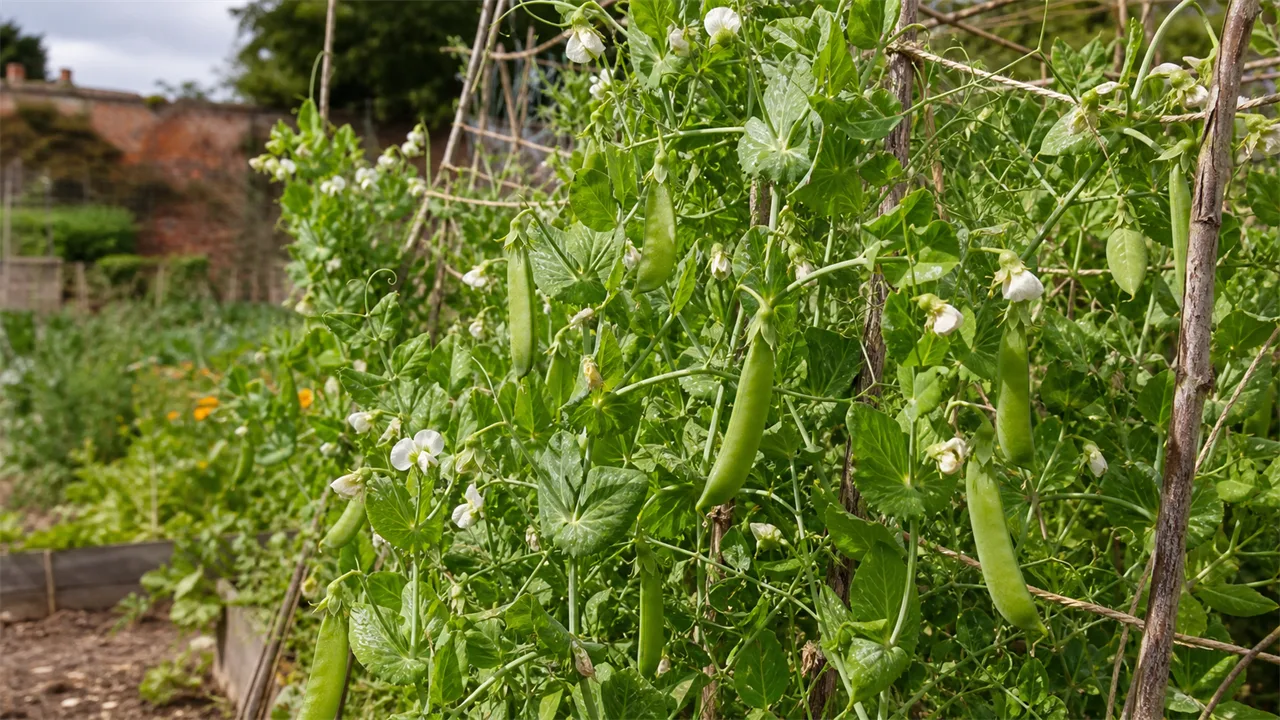
Tall and climbing peas must be supported from sowing — they climb by leaf tendrils, not by twining stems, so they need something fine enough for the tendrils to grip: pea sticks, twiggy prunings, plastic or jute netting stretched between canes, or a traditional row of hazel hurdles. Short varieties (60–75 cm) such as 'Tom Thumb', 'Half Pint', and 'Kelvedon Wonder' can be grown without support or with short brushy sticks pushed in along the row.
For tall varieties ('Alderman', 'Telephone', climbing sugar snaps) put the support in before sowing, so you don't drive canes through young roots later. A double row of canes 60 cm apart, with pea netting or hazel twiggy sticks woven horizontally between them, supports a 1.8 m row comfortably. Pinch out the growing tips of climbing varieties once they reach the top of the support — this diverts energy into the pods lower down and is also the moment to harvest the shoot-tips as a bonus pea-leaf crop for salads and stir-fries.
Harvesting
The UK pea harvest runs from late May (overwintered autumn sowings in the south) through to late September (latest maincrops and sugar snaps in cooler regions). Pick frequently — every two to three days — once the pods start to fill, because old pods left on the vine tell the plant its job is done and pod-set stops.
Signs of readiness:
- Garden peas: pods feel firm and rounded, with the peas inside visibly bulging but not distorting the pod. Open one and taste — the peas should be sweet and tender, not starchy. If they leave a dent when pressed with a thumbnail, they are past their best.
- Mangetout: pods are flat and the peas inside are just starting to swell. Snap them off while they are still bright green and crisp; oversized pods go stringy and tough.
- Sugar snaps: pods are fat and crunchy, with full-size peas inside. The whole pod is eaten; pick while they snap cleanly rather than bend.
How to harvest. Hold the vine with one hand and pinch the pod from the stem with the other — pulling the pod off strips the tendrils and damages the plant. Pick in the early morning while the pods are cool and turgid; that is when the sugars are at their highest.
Region-aware harvest timing summary:
- Mild south-west and south coast: outdoor harvest late May to late September, with overwintered crops starting the season; late summer sowings of sugar snaps under cover can extend into October.
- South-east, central England, Midlands: early June to mid-September.
- Wales, northern England, Northern Ireland: mid-June to early September.
- Scotland and the far north: late June to late August for outdoor crops; polytunnel sowings of sugar snaps and mangetout extend this to late September reliably.
A single row of a maincrop like 'Onward' will crop heavily for about three weeks; sow a second row three weeks after the first to keep the harvest coming through July and into August.
Eating
Freshly shelled garden peas — boiled for three minutes in lightly salted water with a sprig of mint — are one of the defining tastes of a British summer and need almost nothing else. The point of growing them at home is the speed from pod to pan: peas begin to sweeten on the plant and convert their sugars to starch the moment they are picked, so even a quick shelled-into-the-pan within an hour of picking will be sweeter than anything that has travelled.
Beyond the classic serving, home-grown peas lend themselves to:
- Pea and mint soup: sweat a chopped onion and a small potato in butter, add 500 g of freshly shelled peas and 750 ml of stock, simmer five minutes, blend, finish with crème fraîche and chopped mint. Freezes well.
- Pea risotto: stir shelled peas into a Parmesan risotto in the last three minutes of cooking — the residual heat sets the colour and keeps the sweetness.
- Mangetout and sugar snaps in stir-fries: these are the peas of choice for fast cooking. Sugar snaps need only 60–90 seconds in a hot wok with garlic and ginger; mangetout take about the same. Both keep their crunch and snap.
- Pea shoots: the top 10 cm of any climbing pea — pinching the plants out as they reach the top of the support — gives a salad and sandwich crop with a sweet, pea flavour. Restaurants pay good money for these; the home grower gets them free.
- Mushy peas: the British chip-shop staple is at its best made fresh. Simmer shelled peas with a little bicarbonate of soda and salt until very soft, mash with butter and black pepper — nothing like the processed bright-green version.
- Freezing: peas freeze exceptionally well. Blanch shelled peas in boiling water for 90 seconds, chill in iced water, drain, and pack in freezer bags. Mangetout and sugar snaps freeze less successfully; eat them fresh.
After harvest, cut the spent haulm at ground level but leave the roots in the soil — the nitrogen-fixing nodules release their stored nitrogen back into the bed as the roots break down, making the pea ground ideal for leafy brassicas, salads, or leeks in the following season.
Cultivars and Varieties
| Cultivar | Height | Flower | Notes | AGM |
|---|---|---|---|---|
| 'Alaska' | 150 cm | — | smooth seeded | |
| 'Early Perfection' | — | — | 65 days | |
| 'Kelvedon Wonder' | — | — | 65 days, 1997 RHS AGM winner | |
| 'Little Marvel' | — | — | 63 days, 1934 AAS winner | |
| 'Mr. Big' | — | — | 60 days, 2000 AAS winner | |
| 'Sabre' | — | — | 65 days, PMR | |
| 'Thomas Laxton (heirloom) / Laxton's Progress / Progress #9' | 100 cm | — | 60–65 days | |
| 'Tom Thumb / Half Pint' | 25 cm | — | heirloom, extra dwarf |
Pests and Diseases
| Problem | Symptoms | Management |
|---|---|---|
| Pea moth | — | — |
| Aphids | — | — |
| Pea and bean weevil | — | — |
| Pea thrips | — | — |
| Pigeons | — | — |
| Slugs and snails | — | — |
| Mice | May eat newly-sown seeds | — |
| Powdery mildews | — | — |
For step-by-step help, read Controlling Aphids Naturally, Dealing with Slugs and Snails and Treating Powdery Mildew. Or browse the full plant problem solver to diagnose an issue by symptom.
Companion planting
✔ Grows well with: carrot, Courgette, lettuce, potato, Pumpkin, Sunflower.
✘ Keep apart from: beet, bulb onion, Chives.
Full companion planting chart →
Pea in our guides
- Best Plants for Small Gardens and Tight Spaces
- Easy Houseplants That Are Hard to Kill
- How to Build and Plant Your First Raised Bed
- How to Build and Plant Your First Raised Bed
- How to Grow Carrots in the UK: A Complete Guide
- How to Grow Leeks: Sowing to Harvest
GardenWizz earns a commission from qualifying purchases made through affiliate links on this page (including links within the article) — as an Amazon Associate, and from Thompson & Morgan via the Awin network. This does not affect the price you pay. See our disclaimer for details.